Hard Rock · Heavy Metal
Five musicians from England turned sheer volume into an art form — and wrote the riff every guitarist learns first.
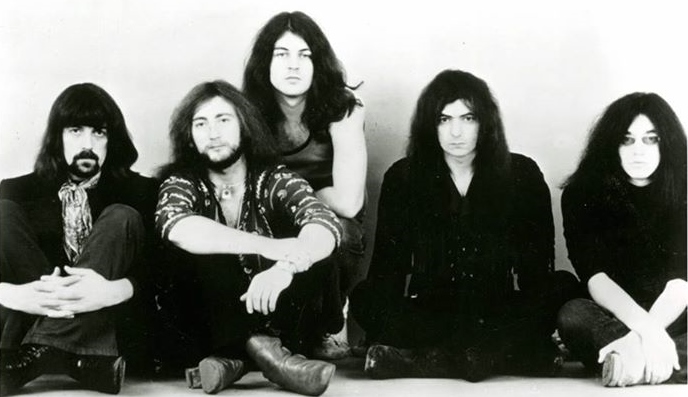
The biography
Deep Purple formed in Hertford, England, in 1968, when guitarist Ritchie Blackmore, organist Jon Lord and drummer Ian Paice joined forces with singer Rod Evans and bassist Nick Simper. The original lineup scored an American Top 5 hit with a cover of Joe South’s “Hush” in 1968, but the band’s true identity was still taking shape, caught between psychedelic pop and something far heavier.
That heavier identity arrived in the summer of 1969, when Evans and Simper were replaced by singer Ian Gillan and bassist Roger Glover. The new lineup — known to fans as Mark II — wasted no time. Lord, a classically trained keyboardist, had already signaled his ambitions with his Concerto for Group and Orchestra, performed with the Royal Philharmonic Orchestra at London’s Royal Albert Hall in September 1969. But In Rock, released in 1970, was the real detonation: a ferocious, high-volume statement featuring “Speed King” and the ten-minute epic “Child in Time,” on which Gillan’s wordless screams soar over Lord’s towering organ.
Fireball followed in 1971, and then came Machine Head (1972), the album that made Deep Purple immortal. Recorded in Montreux, Switzerland, with the Rolling Stones’ mobile recording studio after a fire gutted the casino where the band had planned to work — the incident immortalized in “Smoke on the Water” — Machine Head also featured “Highway Star” and “Space Truckin’.” It became one of the defining hard rock records of the 1970s. The double live album Made in Japan, recorded in 1972, captured the Mark II lineup at the peak of its powers.
By 1973, internal tensions had fractured the classic lineup. Gillan and Glover departed after Who Do We Think We Are, and the band rebuilt as Mark III with two new voices: the bluesy David Coverdale and the soulful bassist Glenn Hughes. Burn (1974) and Stormbringer (1974) leaned into funk and soul, proving Deep Purple could thrive beyond the Mark II formula.
When Blackmore left in 1975 to form Rainbow, American guitarist Tommy Bolin joined for Come Taste the Band (1975). The new lineup showed promise, but the band dissolved in 1976, exhausted by years of relentless touring and change.
The classic Mark II lineup reunited in 1984, releasing Perfect Strangers — whose brooding title track proved the old chemistry intact — followed by The House of Blue Light in 1987.
Alongside Led Zeppelin and Black Sabbath, Deep Purple invented hard rock and, by extension, heavy metal. The four-note “Smoke on the Water” riff remains the first thing millions of guitarists learn, and arguably the most famous riff in rock history. Jon Lord proved the organ could be a lead instrument in heavy music; Ian Paice set a new standard for power and precision in rock drumming; and the band’s long, improvisational concert epics helped define what a 1970s rock show could be. In 1972, their sheer onstage volume earned them recognition as the world’s loudest band — a title they carried with pride.

What to listen for
Listen for the dialogue between Blackmore’s guitar and Lord’s organ — in Deep Purple, the keyboard is not accompaniment but a second lead instrument, trading phrases, harmonizing riffs and dueling through solos. Notice how Paice’s drumming propels even the longest tracks without ever sounding mechanical, and how Gillan can move from intimate, bluesy phrasing to full-throated screams inside a single verse. On the Coverdale-Hughes records, hear a different band entirely: looser and funkier, with Hughes’ soaring soul vocals intertwining with Coverdale’s blues growl.