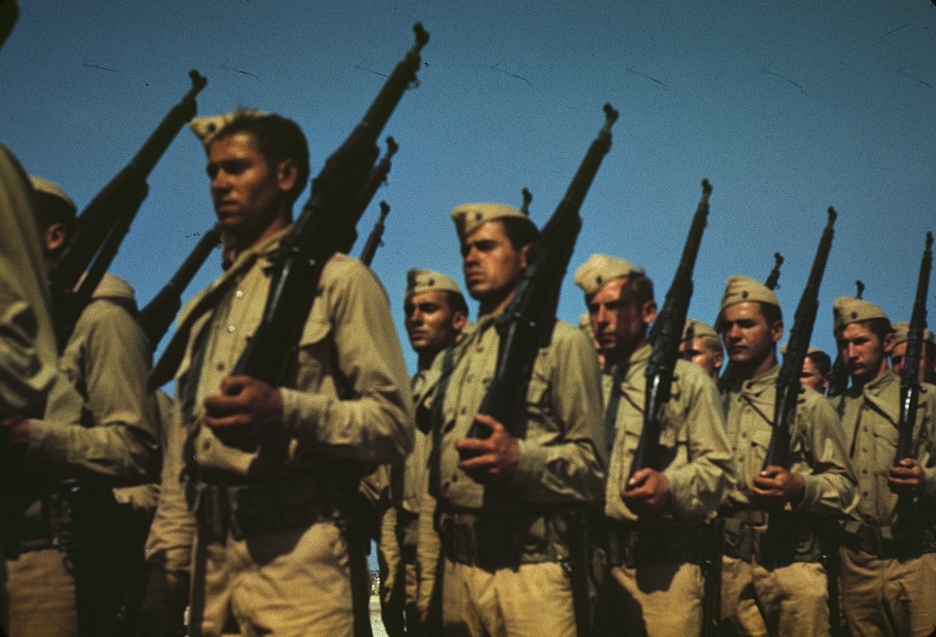
Illustrative image: Marines finishing training at Parris Island, S.C., public domain, via Wikimedia Commons (Library of Congress). This is a thematic military training image, not a photograph of the actor.
An old soldier in a new army
In Heartbreak Ridge, released in 1986, Clint Eastwood plays Gunnery Sergeant Tom Highway, a Marine who has fought in Korea and Vietnam and who now finds himself, in peacetime, assigned to train a platoon of young, undisciplined recruits. Highway is loud, profane, funny, and deeply old-fashioned, and the film knows that those qualities are both his strength and his problem. The young Marines do not want a legend; they want to get through their service without being shouted at. Highway does not want to be a museum piece; he wants to be useful. The comedy and the drama of the film come from that collision between a man who believes in the old ways and an institution that is trying, awkwardly, to become new.
Eastwood also directed Heartbreak Ridge, and that matters, because the film is as much about his own position in Hollywood as it is about the military. By 1986, Eastwood was in his mid-fifties, a star who had survived westerns, police films, comedies, and dramas, and who was now playing a man who is told, in various ways, that his time has passed. Highway’s response is not to retire quietly. It is to train harder, to fight harder, and to prove, on his own terms, that experience still counts. That is a very Eastwood theme: the older man who refuses to be written off, and who insists that discipline, loyalty, and humour are not outdated, even if the world around him has changed.
Training as comedy, combat as test
The first half of Heartbreak Ridge is largely a training comedy. Highway arrives at his new unit, inspects his recruits, and finds them soft, sarcastic, and badly led. He responds with insults, with impossible exercises, and with a kind of rough affection that the recruits do not recognise at first as affection. The film’s humour comes from the gap between Highway’s language — which is colourful, direct, and deliberately unpolished — and the recruits’ confusion. They think he is a caricature. He thinks they are a project. Slowly, through shared hardship, they begin to understand each other. Eastwood plays Highway with a twinkle that his western heroes rarely had. He is enjoying himself, and he lets the audience enjoy him, even when he is being outrageous.
That comedy, however, is preparation for something more serious. In the second half of the film, Highway’s platoon is sent to Grenada, in a fictionalised version of the 1983 American invasion, and the training is suddenly tested by real danger. The film does not pretend that combat is glorious. It shows confusion, fear, and the importance of the small, unglamorous skills Highway has been drilling: communication, cover, teamwork, and keeping your head when plans fall apart. The shift from comedy to combat is not seamless, and some critics at the time noted that the film’s politics were complicated, but as a character story it works. Highway’s old-fashioned methods, which looked like stubbornness in training, look like wisdom under fire, not because the film says so, but because his men survive by using them.
A romance with the past
Running alongside the military story is a quieter, more personal one. Highway is still in love with his ex-wife, Aggie, played by Marsha Mason, who runs a bar and who has learned, over years, how to live without him. Their scenes together are some of the best in the film, because they are not about grand romance. They are about two people who know each other too well to pretend, and who are trying to decide whether love, after a long separation, can be practical as well as passionate. Mason plays Aggie as intelligent, funny, and unwilling to be a prize for Highway to win. Eastwood, as director and actor, gives her room to be an equal, not a reward. Their conversations are full of old jokes, old hurts, and a tentative hope that is more moving than any battle scene.
That romance connects Heartbreak Ridge to Eastwood’s broader interest in men who have to earn their way back. Highway is not a young hero proving himself for the first time. He is an older man trying to repair relationships — with his wife, with his men, and with an army that is not sure what to do with him. The film suggests that repair is possible, but only if Highway is willing to listen as well as to shout. In training, he learns to listen to his recruits. With Aggie, he learns to listen to a woman who has her own life. That listening, more than any act of bravery, is what makes Highway a complete character rather than a slogan.
The Marine Corps on screen
Heartbreak Ridge was made with the cooperation of the United States Marine Corps, and it shows in the film’s attention to detail: uniforms, drills, language, and the rhythms of military life. That cooperation also raised questions, at the time and since, about how the film portrays the military and the Grenada operation. It is worth watching the film with that context in mind. It is not a documentary, and its version of Grenada is simplified and heroic in ways that real history was not. What it does capture, more accurately, is the feeling of being a career soldier in peacetime: the boredom, the bureaucracy, the pride, and the fear of becoming irrelevant. Highway’s platoon, with its mix of backgrounds and attitudes, feels like a real unit in a way that many war films do not, because the film spends time on their jokes, their arguments, and their small loyalties before it sends them into combat.
Eastwood’s direction here is efficient and unshowy, as it usually is. He does not linger on spectacle for its own sake. He focuses on faces, on dialogue, and on the moment when a joke stops being funny because someone might actually get hurt. That restraint serves the film well, especially in its final act, where the action is tense but never cartoonish. Highway does not become a superhero. He becomes a sergeant who does his job, protects his men, and comes home with a clearer sense of what his job was for.
Why Tom Highway endures
Tom Highway endures as a signature Eastwood role because he is funny, flawed, and unmistakably Eastwoodian, while also being different from the western and police heroes who made Eastwood famous. He talks more, he jokes more, and he cares more openly about other people. He is also, crucially, an older hero. In a film industry that often discards older stars, Eastwood made a film about an older man who is still essential, and he played that man without embarrassment about his age. Highway’s wrinkles, his gravel voice, and his impatience are not hidden; they are the point. Experience, the film argues, is not a consolation prize. It is a skill, and it can save lives.
Watch Heartbreak Ridge for its humour first, and then for its heart. Notice how Eastwood balances the comedy of training with the seriousness of combat, and how he lets Marsha Mason’s Aggie challenge Highway in ways his recruits cannot. Notice, too, how the film’s final scenes do not simply celebrate victory. They celebrate return: to a unit, to a marriage, to a life that is not perfect but is, finally, shared. That is a fitting signature for Eastwood in the 1980s. He was no longer just the man with no name. He was a director and a star who could make a film about growing older, staying useful, and learning, late in life, how to listen. Tom Highway, shouting on a parade ground and quietly trying to win back his wife, is that lesson in uniform.