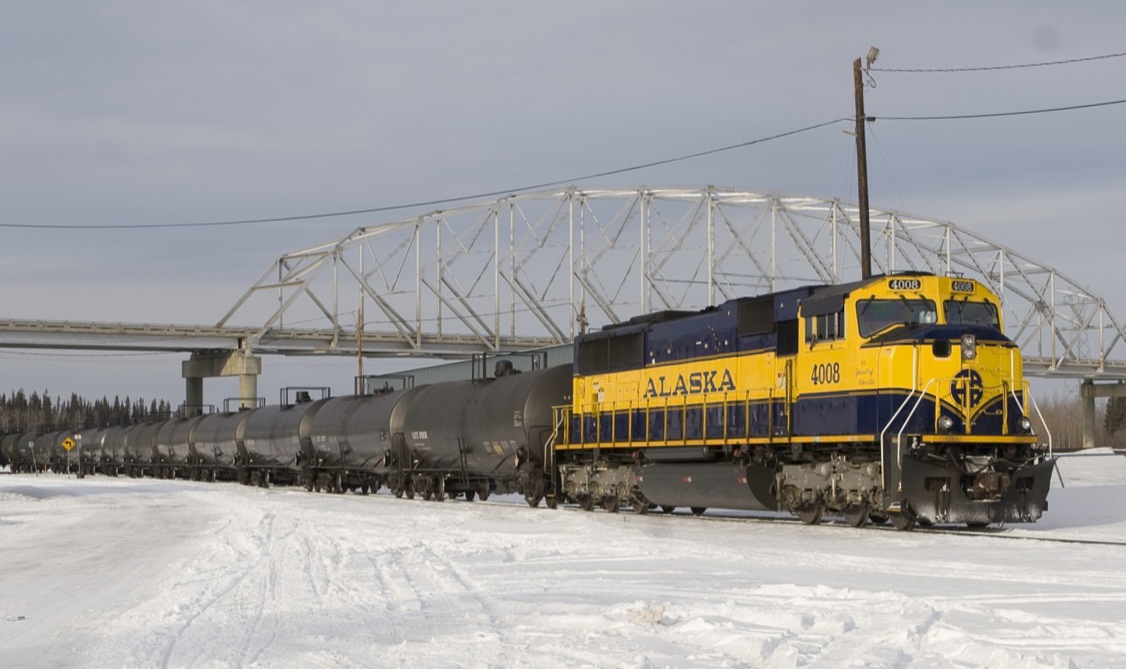
Photo: Carl Chapman, Wikimedia Commons, CC BY-SA 2.0 – Alaska Railroad train in snow, Nenana, Alaska.
A train with no driver, a man with no brakes
In Runaway Train, released in 1985 and directed by Andrei Konchalovsky, Jon Voight plays Oscar Manny Manheim, a hardened convict who escapes from a brutal Alaskan prison with a younger inmate, Buck, played by Eric Roberts, and boards a freight train that soon loses its crew and hurtles driverless through snow and ice. The premise is pure action cinema, but the film, based on a story by Akira Kurosawa, is also a philosophical drama about freedom, fate, and the human will. Voight’s Manny is the film’s soul: a man who has spent his life refusing to be caged, and who now finds himself trapped on a machine that cannot be stopped.
From his first scenes in prison, Manny is a force of nature. He is scarred, wary, and utterly determined. The prison warden, played by John P. Ryan, wants to break him, and Manny refuses to be broken, even when that refusal costs him solitary confinement and physical punishment. Voight plays Manny with a coiled, animal intensity. He moves slowly, speaks sparingly, and watches everything. When he escapes, it is not a triumph. It is simply the next thing a man like Manny does. He does not know how to stay still.
Manny, Buck, and Sara
On the train, Manny is joined by Buck, a younger, more impulsive convict who idolizes him and fears him in equal measure, and by Sara, a railroad worker played by Rebecca De Mornay, who becomes trapped on the train with them. The three characters form an unlikely, tense family. Manny protects Buck, bullies him, and teaches him, often in the same breath. He is suspicious of Sara at first, then grudgingly respects her competence. Voight plays these relationships with a complexity that lifts the film above genre. Manny is not a mentor in the warm sense. He is a man who has learned to survive by being harder than everyone else, and who discovers, on the train, that hardness alone will not save anyone.
The train itself is a character. Konchalovsky films it in long, freezing takes, with snow, steam, and steel filling the frame. The cold is palpable, and Voight’s physical performance, shivering, climbing between cars, fighting the wind, makes the audience feel it. He does not play Manny as superhuman. He plays him as a man whose body is failing him, whose hands are cut, whose breath is short, and who keeps moving anyway. That stubbornness, more than any stunt, is what makes the film thrilling.
Freedom, fate, and the final ride
Runaway Train is, at its core, a film about a man who would rather die free than live caged. As the train accelerates toward a seemingly inevitable crash, Manny faces a choice: try to save himself and the others by stopping the train, or ride it to its end on his own terms. The film’s ending, in which Manny climbs onto the roof of the locomotive and raises his arms to the sky as the train plunges forward, has become iconic. It is not a victory. It is a declaration. Voight plays the moment without a smile or a speech. He simply stands, battered and free, and lets the image speak.
That ending has been read in many ways: as a metaphor for the human spirit, as a critique of institutions, as a portrait of a man who cannot live within limits. Voight’s performance supports all of those readings because he never explains Manny. He embodies him. The character’s past, his crimes, and his reasons for escaping are sketched rather than detailed, and Voight fills those gaps with presence. He makes Manny feel like a man with a long, hard history, even when the film does not tell us all of it.
A performance of pure will
Voight received an Academy Award nomination for Best Actor for Runaway Train, and it was richly deserved. The role required him to be both terrifying and sympathetic, often simultaneously. He is a convicted murderer, and the film does not hide that fact. Yet audiences root for Manny, not because they approve of his crimes but because they recognize his refusal to surrender. Voight’s Manny is not a nice man, but he is an honest one, in the sense that he does not lie to himself about who he is or what he wants.
Konchalovsky’s direction, with its philosophical voiceover and operatic score, could have overwhelmed a lesser performance. Voight holds the center. His Manny is quiet where the film is loud, still where the train is fast, and human where the story risks becoming abstract. That balance is the achievement. He gives a mythic story a human face.
Why Manny endures
Manny endures as a signature Jon Voight role because it is his most elemental performance. Joe Buck was naive, Ed Gentry was haunted, Luke Martin was angry, and Billy Flynn was loving. Manny is will itself, a man reduced to a single, unstoppable desire to be free. Voight plays that desire without irony or apology, and the result is one of the great action performances of the 1980s, a performance that proves action cinema can also be serious art.
Watch Runaway Train for Voight’s stillness. Notice how little he moves in prison, how much he moves on the train, and how, in the final moments, he stops moving altogether and simply stands. That arc, from caged animal to free man, is the performance, and it is why Manny remains unforgettable.
It is a rare action film that trusts its audience to sit with that question rather than supplying an easy answer, and Voight’s performance is the reason that trust feels earned.