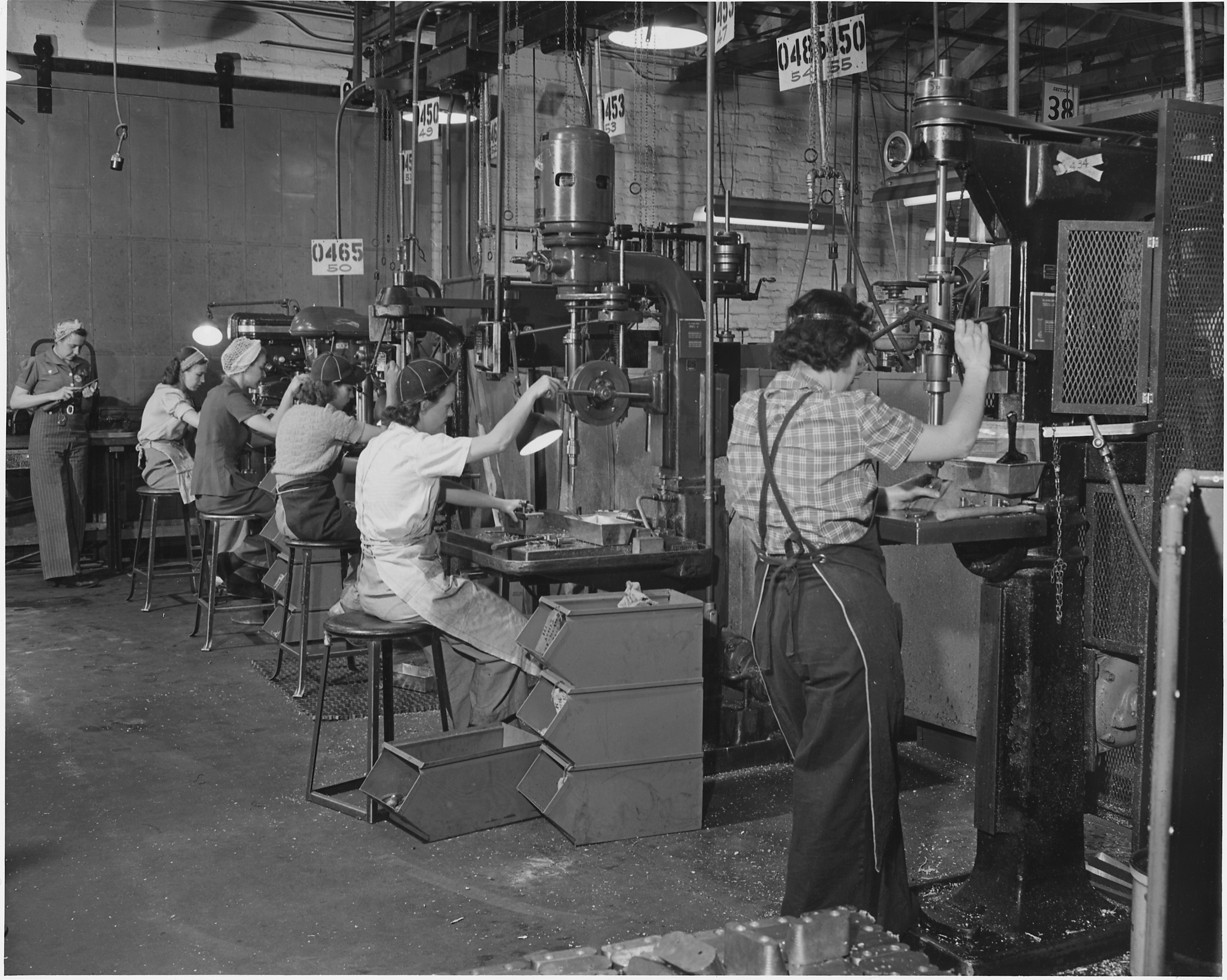
Swing-shift factory photo, Wikimedia Commons, public domain.
Swing Shift occupies a unique place in Goldie Hawn’s filmography. It is a wartime drama about women who went to work in American factories during the Second World War, a love story, a friendship story, and, famously, a troubled production. Yet beneath its complicated history lies a performance of real warmth and sincerity. As Kay Walsh, a housewife who discovers independence, friendship, and desire while her husband is away at war, Hawn connects her own star persona to a larger, often overlooked chapter of American history: the story of Rosie the Riveter and the women who kept the country running.
The film opens on the eve of American involvement in the war. Kay Walsh, played by Hawn, is happily married to Jack Walsh, played by Ed Harris, a man who enlists in the Navy shortly after the attack on Pearl Harbor. Left alone in California, Kay does what millions of American women did in the early 1940s: she goes to work. She takes a job in an aircraft factory, learning to rivet, to work the swing shift, and to live a life that does not revolve entirely around her husband. There she befriends Hazel Zanussi, played by Christine Lahti, a nightclub singer and fellow factory worker who becomes her closest confidante. She also meets Lucky Lockhart, played by Kurt Russell, a trumpet player and factory foreman who is exempt from military service and who pursues Kay with charm and persistence. When Jack returns, Kay must choose between the life she had and the woman she has become.
Hawn’s Kay is, at first, very much the Goldie Hawn heroine audiences knew: cheerful, slightly scatterbrained, eager to please. As the film progresses, however, Kay changes. Work gives her confidence. Friendship with Hazel gives her a new kind of honesty. The factory, with its noise, its camaraderie, and its dangers, teaches her that she is capable of far more than being a wife waiting at home. Hawn plays that transformation with subtlety. She does not suddenly become a different person. She becomes more herself, more grounded, more willing to speak her mind. Her scenes with Lahti are the film’s strongest, full of laughter, gossip, and mutual support, capturing a female friendship that feels authentic rather than scripted.
Director Jonathan Demme, who had made his name with Melvin and Howard and would later win an Academy Award for The Silence of the Lambs, brought a humanist, observational style to Swing Shift. His original vision emphasised the friendship between Kay and Hazel and the ensemble of women workers. The released film, after extensive reshooting and re-editing in which Hawn, whose production company was involved, played a major role, shifted the emphasis toward the romance between Kay and Lucky. Demme later described the experience as the worst of his career, and the existence of his longer, more ensemble-focused cut, circulated among enthusiasts, has fuelled decades of debate. What remains on screen, however, still contains much of Demme’s warmth: his affection for ordinary people, his eye for workplace detail, and his belief that history is lived in kitchens and factories as much as in battlefields.
The real-life story behind the film adds another layer. Hawn and Russell fell in love during the production of Swing Shift, beginning a partnership that has lasted more than forty years. Their on-screen chemistry as Kay and Lucky is therefore both a performance and a glimpse of something real. Russell, as Lucky, is charming without being predatory, a man who genuinely admires Kay’s spirit. Harris, as Jack, is not a villain but a decent man returning to a wife who has changed, and who must reckon with that change. The film’s final scenes, in which Kay must decide what kind of marriage she wants, are more complicated than a simple choice between two men. They are about whether a woman who has found independence can, or should, return to the role she left behind.
Swing Shift was not a commercial success, and its troubled production has often overshadowed its achievements. Yet it deserves attention for what it attempted: to tell the story of women’s wartime work with humour, romance, and respect. Hawn, as both star and producer, was central to that attempt. She understood that Kay Walsh’s story was not just a love triangle. It was the story of a generation of women who discovered, through work, that they were stronger than society had told them they were, and who were then expected, when the war ended, to quietly give that strength back. Kay’s dilemma is their dilemma, and Hawn plays it with empathy.
For Past Tunes readers, Swing Shift is a fascinating, flawed, and ultimately moving film. It shows Goldie Hawn taking on history, taking on production responsibility, and taking a risk. Not every risk succeeds completely, but Kay Walsh remains a memorable creation: a woman who learns to rivet metal, to make friends, to fall in love, and to choose her own future, all while the world around her is at war.
The history behind Swing Shift makes it especially valuable for Past Tunes readers interested in women’s stories. During the Second World War, more than six million American women entered the workforce, many in factories, and their labour was essential to victory. When the war ended, many were expected to return home without complaint, and their contributions were quickly forgotten in popular culture. Swing Shift, for all its production troubles, tries to restore those women to the centre of the story. Kay Walsh is fictional, but her experience echoes real lives: learning a trade, earning a wage, forming friendships outside marriage, and then facing a difficult return to domestic life. Hawn, whose own mother ran a dance school and whose career depended on women’s changing opportunities, understood that history personally. Her performance honours it not with speeches but with everyday detail: the pride of a job well done, the laughter of a factory floor, the ache of a choice between love and independence. That everyday truth survives every edit, and it is why the film still matters.