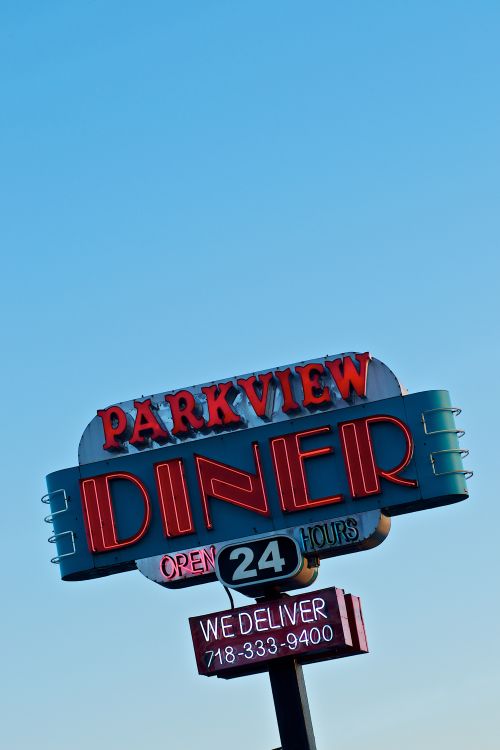
Photo by Dave Garcia on Pexels. Source: https://www.pexels.com/photo/vintage-parkview-diner-sign-against-blue-sky-36057344/
Alice Doesn’t Live Here Anymore begins with a joke and ends with a choice, and Ellen Burstyn makes both feel earned. Martin Scorsese’s film, written by Robert Getchell, tells the story of Alice Hyatt, a housewife in Socorro, New Mexico, whose husband dies suddenly in a road accident. Left with her eleven-year-old son, Tommy, and very little money, Alice decides to return to Monterey, California, where she once dreamed of becoming a singer, and to support herself by singing along the way. Burstyn won the Academy Award for Best Actress for the role, and it is easy to see why: she plays Alice as a woman who is funny, flawed, frightened and determined, often in the same scene. The film’s opening is deliberately stylised, a homage to The Wizard of Oz in which a young Alice sings in a field and dreams of a different life. When the story jumps forward, that dream has curdled into domestic routine. Burstyn shows us a woman who has not given up, exactly, but who has learned to settle. She argues with Tommy, she copes with a dull job, she tries to keep her spirits up. When her husband dies, her grief is real, but it is mixed with something else — a sudden, guilty sense of possibility. Burstyn never simplifies that mixture. She lets Alice mourn and, almost in the same breath, begin to plan. That honesty is the film’s great strength. On the Road, Starting Again. Much of the film is a road movie, as Alice and Tommy travel through Arizona, working in diners and motels, meeting kind strangers and dangerous ones. Burstyn is wonderful in these passages because she refuses to make Alice either a saint or a fool. She takes a waitressing job in Phoenix and hates it; she quarrels with Tommy in a motel room and then apologises; she falls for a charming but violent man, Ben, played by Harvey Keitel, and then finds the courage to leave him. Each episode tests Alice’s judgment, and Burstyn shows her learning, slowly and painfully, to trust herself again. Her singing scenes are especially revealing: Alice is not a great singer, and Burstyn does not pretend otherwise. She sings with enthusiasm and a touch of self-consciousness, as if she knows the dream is fragile but is determined to try it anyway. Her relationship with Tommy, played by Alfred Lutter, is the emotional anchor of the film. Their arguments feel like real family arguments — repetitive, unfair, funny and loving all at once. Burstyn never plays down to the child actor; she treats Tommy as a person with his own opinions, which is why their reconciliation scenes are so touching. When Alice finally settles in Tucson and meets David, played by Kris Kristofferson, a rancher who offers her a different kind of partnership, Burstyn plays her hesitation beautifully. She wants love, but she does not want to lose the independence she has fought for. The film’s famous final scene, in which Alice and David argue in a diner and then decide, tentatively, to try again, works because Burstyn has made us believe that Alice will not settle for less than respect. Scorsese, better known for violent urban dramas, directs the film with surprising tenderness. He gives Burstyn long takes and room to breathe, and she rewards him with a performance that feels improvised even when it is carefully shaped. The camera often stays close to her face, catching the small shifts between hope and doubt. Her Alice is not a symbol of women’s liberation, though the film was embraced by feminist audiences; she is a particular woman, with a particular history, trying to make a decent life for herself and her son. That particularity is why the film still resonates. An Oscar-Winning Portrait of Independence. Alice Doesn’t Live Here Anymore arrived at a moment when American cinema was beginning to take women’s stories seriously, and Burstyn’s Oscar win helped to confirm that change. She had been nominated twice before, for The Last Picture Show and The Exorcist, and this time the Academy recognised a performance that was less showy than either of those, but in some ways more difficult. There is no possession, no small-town scandal, only a woman trying to earn a living, raise a child, and hold on to a dream. Making that story compelling requires an actress of Burstyn’s warmth and intelligence, and she delivers it without ever asking for pity. For modern viewers, Alice Hyatt remains a refreshingly unsentimental heroine. She makes mistakes, she loses her temper, she chooses badly and then chooses better. Burstyn’s performance reminds us that independence is not a single decision, but a daily practice — finding work, setting boundaries, apologising to a child, and daring to sing again after years of silence. That is why the film’s title, taken from a sign on a door, feels so poignant: Alice has moved on, and Burstyn makes us glad that she did, even as we understand what she left behind. The film’s influence can still be felt in later stories about single mothers on the road, from independent dramas to mainstream comedies, but few have matched Burstyn’s balance of humour and seriousness. She never lets Alice become a lesson, and she never lets the audience feel superior to her. When Alice takes a bad job, or trusts the wrong man, or snaps at Tommy, Burstyn plays the moment as a human error, not a moral failure, and that generosity invites viewers to recognise their own mistakes in hers. It is that quality — compassion without condescension — that makes Alice Hyatt feel less like a character from 1974 and more like a neighbour, a friend, or a younger version of ourselves.