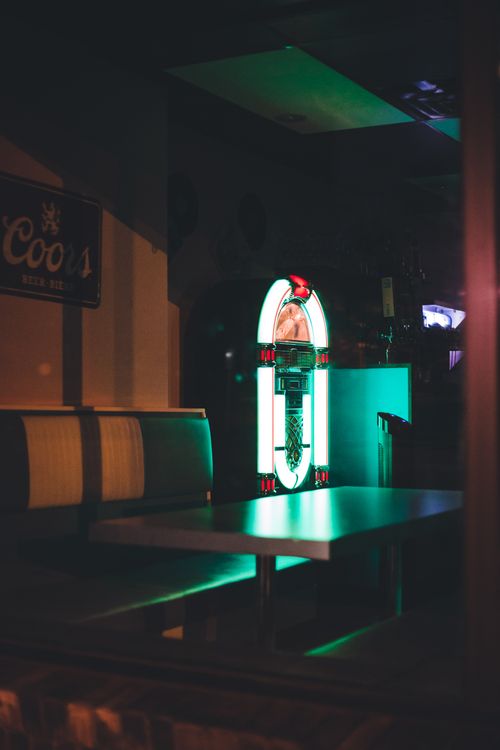
It begins with a sound that is barely music at all: a single guitar, ringing out alone, as if from behind a wall. Then the band crashes in behind it, and a voice tells a story every rock fan knows by heart, even if they have never lived it. A kid stands outside a sold-out arena, too broke or too late to get a ticket, and listens to the concert leaking through the doors. He hears one guitar, and in that moment his whole life changes. When Foreigner released “Juke Box Hero” in 1981, it was not their biggest hit, and it was not their smoothest. But it became something rarer: the song that turned the audience into the hero. It is a rock-and-roll fairy tale based on a true story, and it is still, more than forty years later, the moment in a Foreigner concert when the whole arena sings about itself.
To understand why the song mattered, you have to understand where Foreigner stood in 1981. They were not newcomers, and they were not a cult act. They were one of the biggest arena-rock bands in America, and they were at a crossroads. The band had been formed in New York City in 1976 by English guitarist Mick Jones, who had already made a name for himself as a session player, alongside fellow Brit Ian McDonald, formerly of King Crimson, and American singer Lou Gramm, with drummer Dennis Elliott, keyboardist Al Greenwood and bassist Ed Gagliardi. Their first three albums had made them stars: “Feels Like the First Time,” “Cold as Ice,” “Hot Blooded,” “Double Vision” — a run of hits built on Gramm’s powerhouse voice and Jones’s guitar hooks, polished into radio-ready rock. But by 1980 the band was fracturing. McDonald and Greenwood left, and the remaining four — Jones, Gramm, Elliott and bassist Rick Wills — faced the question every successful band eventually faces: whether to repeat the formula or to sharpen it. Their answer was 4, an album recorded with producer Robert John “Mutt” Lange, the man behind AC/DC’s Back in Black, who would go on to produce Def Leppard’s greatest records. Lange stripped the band down to its essentials and pushed them harder. The result was their biggest album, and “Juke Box Hero” was its beating, swaggering heart.
The song’s story begins, fittingly, outside a concert. Jones has told it many times, and the details have stayed remarkably consistent. Foreigner were playing an arena — Jones has said he thinks it was in Cincinnati — and they had gone in for a sound check in pouring rain. A bunch of fans were waiting at the door when the band went in. When the band came back for the show, hours later, all that was left was one lonely fan, a young guy waiting out there in the rain, soaked to the skin. Jones, struck by the kid’s dedication — he had waited something like five hours — decided to take him in and give him a glimpse of what happens backstage at a show. The kid, Jones recalled, was mesmerized by everything: the lights, the gear, the sheer scale of it. And Jones found himself imagining what was going through the boy’s mind, seeing rock stardom for the first time from the inside. That image stuck with him. He had also been toying with a title, “Juke Box Hero,” which he thought was almost a satire on what the band did and how it was perceived from the audience’s side. The rain-soaked kid gave the title a story.
There is a second strand to the story, and it belongs to Gramm. Years later, on July 19, 2016, Gramm told the Brother Wease radio show in Rochester, New York, that the song was about him: about waiting outside the Rochester War Memorial as a young fan to see Jimi Hendrix, only to find the show sold out. He stood outside, locked out of the concert he most wanted to see, and the experience stayed with him. Both stories are probably true in the way that matters most for a song. Jones saw the fan from the stage door; Gramm had been the fan at the stage door. Between them, they had both sides of the story: the kid looking in, and the star looking back at the kid. That double perspective is what makes “Juke Box Hero” more than a simple wish-fulfilment fantasy. It understands both ends of the dream.
The song itself was built the way its story was built: from two separate pieces fitted together. Jones had developed the “Juke Box Hero” portion, and Gramm had a separate idea he had called “Take One Guitar.” Producer Lange helped merge the two into a single song, and the seam never shows. The finished record opens with that lone guitar figure — the “one guitar” the kid hears from outside — and then builds, verse by verse, into a full-band roar. The lyric follows the kid’s whole arc in a few economical scenes. He cannot get a ticket, so he stands outside and listens. He hears that one guitar and has an epiphany. He buys a guitar, learns to play it, and realizes that with the guitar he has a chance at stardom. Then comes the harder part, the part most rock fantasies skip: the struggle to stay on top of the charts once he gets there, the grind of being a juke box hero rather than just dreaming of being one. And then, in the song’s closing twist, the circle closes: the new star encounters another fan outside the stage door at one of his own concerts, a kid who reminds him of himself and how it all began. It is a song about fame that remembers where fame comes from.
The recording captures that arc in sound. The band on 4 was a leaner machine than the six-piece of the early years: Gramm on lead vocals, Jones on lead and rhythm guitars, Wills on bass, Elliott on drums, with Thomas Dolby on main synthesizers, Larry Fast on sequential synthesizer, Ian Lloyd and Lange himself on backing vocals. Lange’s production gave the track its punch: a snarling rocker, as Billboard called it on release, featuring tough guitar breaks and hot vocals. Gramm’s vocal is the engine of the record. He sings the kid’s story with the conviction of a man who had lived the first half of it, and the chorus — the chant of “juke box hero” — lands like a crowd already singing along. The song does not sound like a band showing off. It sounds like a band telling a story they believe, and the belief is contagious.
The single’s chart story was solid rather than spectacular, and that is part of why the song’s later life is so interesting. “Juke Box Hero” first entered the Billboard Hot Mainstream Rock Tracks chart in July 1981, before the album was even out, and eventually reached number 3 on that chart — a sign of how immediately rock radio embraced it. Released as the album’s third single — in Britain on October 2, 1981, and in America on January 27, 1982, with “I’m Gonna Win” on the B-side — it went on to number 26 on the Billboard Hot 100. It reached number 39 in Canada, number 24 in Germany, number 7 in South Africa, and number 48 in Britain. Those were respectable numbers, but they did not make it Foreigner’s biggest hit; that honour belonged to the ballads, “Waiting for a Girl Like You” and, later, “I Want to Know What Love Is.” “Juke Box Hero” was something else: a rock-radio staple, a concert anthem, a song whose real chart was the set list, where it has never left.
That afterlife has been longer and stranger than the chart run suggested. The song became a fixture of classic rock radio, the track DJs reach for when a room needs to remember why guitars matter. Ultimate Classic Rock critic Matt Wardlaw ranked it as Foreigner’s all-time greatest song, writing that for anyone who has ever been on the wrong side of a sold-out concert, it touches a chord. Billboard’s Gary Graff rated it the band’s fifth greatest song. Jones himself has rated it one of his 11 favourite Foreigner songs, and Gramm has called it his favourite Foreigner song of all. The physical 45 sold fewer than 500,000 copies, but the song has since been certified platinum by the Recording Industry Association of America for over a million digital downloads — a second life in the streaming era that the 1982 chart never predicted. A live version recorded at a 2005 Las Vegas concert, folding in portions of Led Zeppelin’s “Whole Lotta Love,” appeared on the band’s Extended Versions album, and another live version featured on 2014’s Best of Foreigner 4 & More.
The song’s most unexpected afterlife came on stage, in a different kind of theatre altogether. In February 2019, Jukebox Hero, a coming-of-age jukebox musical built around Foreigner’s songs, premiered at the Ed Mirvish Theatre in Toronto, Ontario, with a book by Dick Clement and Ian LaFrenais and an all-Canadian cast led by Nova Scotian actor and singer Geordie Brown. The musical took the song’s story — a kid dreaming his way from outside the arena to the stage — and made it literal, the plot of a whole show. It was a fitting tribute, because “Juke Box Hero” had always been a small musical in itself: a three-act story with a hero, a dream, and a twist ending. The stage version simply gave the kid a name and a hometown.
And then there was the search for the kid himself. In 2019, ahead of the musical’s premiere, Foreigner announced a search for the original juke box hero — the die-hard fan from that rainy Cincinnati night — offering him the backstage, VIP experience one more time. The search was sparked, fittingly, by a fan’s memory: a Canadian radio DJ reminiscing about the song’s anniversary had wondered aloud who the kid had been. Whether the original fan was ever definitively found is, in a way, beside the point. The search itself proved the song’s premise. Forty years on, the kid in the rain was still out there somewhere, and the band still wanted to bring him inside. The dream the song describes had not dated, because the experience it describes — standing outside something you love, wanting in — never dates.
There is a final pleasure in the story, and it belongs to the two men who wrote it. Jones, the English guitarist who had crossed an ocean to build a band in New York, and Gramm, the Rochester kid who had once stood outside a sold-out Hendrix show, wrote a song that holds both of their stories at once. One of them had been the star who noticed the fan; the other had been the fan who became the star. Together they made a record that refuses to choose between those two positions. The kid in “Juke Box Hero” is not a passive dreamer. He hears one guitar, and he acts: he buys a guitar, he learns it, he fights to stay on top, and then he recognizes himself in the next kid outside the door. That is the song’s real wisdom, and it is why it still works in arenas where everyone in the crowd is, for three minutes, both the fan and the hero. The dream is not just getting inside. It is remembering, once you are inside, to leave the door open behind you.
Watch the video below and listen for the moment the lone guitar gives way to the full band. It is the sound of a kid outside an arena, hearing his future through a wall, and deciding to go and meet it.