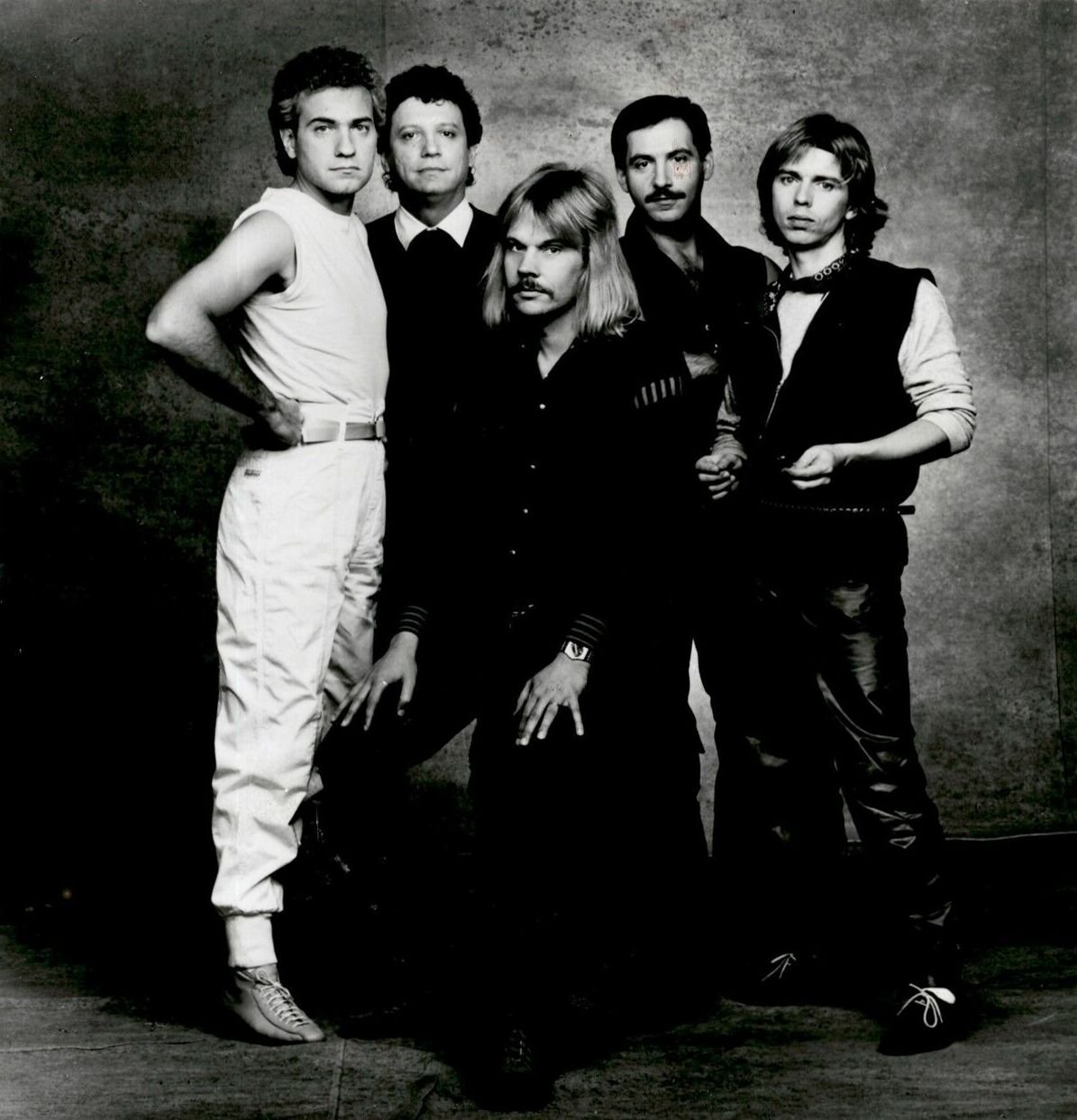

It begins with a piano, alone in the dark, playing a melody so wistful it sounds like a memory — and then, without warning, the whole band crashes in. Guitars snarl, drums thunder from speaker to speaker, keyboards hammer and glissando, and Dennis DeYoung’s voice lifts into a declaration that is half celebration and half challenge: tonight, we are rocking the paradise. When Styx opened their tenth album, Paradise Theatre, with “A.D. 1928” and “Rockin’ the Paradise” in January 1981, they were not just starting a record. They were raising a curtain. Behind it stood a grand old movie palace, a band at the very top of its commercial powers, and a question that would haunt the whole album: what happens to a country when its grandest rooms fall into ruin — and can a rock band, for three and a half minutes, bring one of them back to life? The story of “Rockin’ the Paradise” is the story of a song that did two jobs at once: it opened the biggest album Styx ever made, and it turned a Chicago theatre into a metaphor for America itself.
To understand why the record mattered, you have to understand where Styx stood in 1981. They were not newcomers, and they were not a cult act. They were one of the biggest American rock bands in the world, and they were coming off a run most bands would envy. Formed in Chicago in the early 1970s around keyboardist and singer Dennis DeYoung, guitarist and singer James “J.Y.” Young, bassist Chuck Panozzo, drummer John Panozzo and, from 1975, guitarist and singer Tommy Shaw, Styx had built a career on a combination nobody else quite managed: progressive-rock ambition and pop hooks, theatrical presentation and hard-rock muscle. By the end of the 1970s they had sold millions of records with albums like The Grand Illusion (1977) and Pieces of Eight (1978), and hits like “Come Sail Away,” “Renegade” and “Babe.” But success had a cost. The band’s two songwriting camps — DeYoung’s theatrical pop on one side, Shaw and Young’s harder rock on the other — pulled in different directions, and the pressure to keep producing hits was immense. Paradise Theatre, their tenth studio album, would be their answer to that pressure: a concept album, a commercial blockbuster, and, as it turned out, the last time the classic line-up would stand together at the summit.
The concept came, as so many great album ideas do, from a picture. DeYoung was walking through an art gallery in Chicago when he saw a Robert Addison serigraph of the Paradise Theatre, a beautiful, opulent, cavernous movie palace on the city’s west side. The real Paradise Theatre had opened in 1928, in the last glory days of the silent era, and it had been hailed as one of the most beautiful movie theatres in the world. But it was built before talking pictures, and when sound arrived in the 1930s, the theatre’s acoustics turned out to be terrible — audiences, quite simply, could not hear the films. People drifted away to newer theatres built for sound, the palace fell into disrepair, and it was eventually demolished. DeYoung saw in that story something larger than one building. Here was a grand American room, built for beauty, undone by a change in technology it could not adapt to, left to rot while the world moved on. It was, he felt, a perfect metaphor for America itself at the turn of the 1980s: a country coming out of the disillusionment of the late 1970s, its golden age apparently behind it, wondering whether its best days were over or whether something could still be saved.
“Rockin’ the Paradise” was the sound of that question being answered with a shout. The song was a genuine three-way collaboration, which was rare enough in a band whose writers usually worked separately: James Young wrote the riff, Tommy Shaw came up with the verse, and Dennis DeYoung wrote the lyrics — and, as Young later recalled, once those pieces came together, “there it was.” Young has said he knows exactly which building he was in, in the south suburbs of Chicago, where the band were rehearsing, when he wrote that riff, and that he still drives past it sometimes. The track was recorded in 1980 at Pumpkin Studios in Oak Lawn, Illinois, with the band’s longtime engineer Gary Loizzo at the helm, and it shows the classic Styx line-up at its most unified: DeYoung on keyboards and lead vocal, Shaw and Young on guitars and backing vocals, Chuck Panozzo on bass, and John Panozzo on drums. It is credited to DeYoung, Young and Shaw, runs three minutes and thirty-five seconds, and it is, as one critic later put it, a total team effort of wonderfully stripped-down hard rock.
What the track actually sounds like is worth describing carefully, because it is a masterclass in how a band can be both theatrical and tough at the same time. It does not start with the band at all. It starts with “A.D. 1928,” a short, piano-based prelude by DeYoung, set to the same melody as “The Best of Times,” the album’s lead single — a wistful overture, like the house lights dimming and a single spotlight finding the piano. Then, with no pause, “Rockin’ the Paradise” explodes out of it: Young’s riff, Shaw’s verse, DeYoung’s lead vocal full of simple bravado and the occasional growl, piano glissandos and hammered keys, guitars with slickness to spare, and John Panozzo’s drums flashing from one channel to the other. It is a sprightly, digestible rock rush, as one later review called it, but it is not empty. The arrangement keeps adding sparks — a guitar fill here, a keyboard flourish there — without ever losing the forward drive. The effect is exactly what an album opener should be: it tells you, in under four minutes, that you are in a theatre, that the show is about to start, and that this band intends to fill every seat in the house.
The lyric is where the song’s second job begins, and it is more serious than the party atmosphere suggests. On the surface, “Rockin’ the Paradise” is a celebration — a call to get together, to make noise, to enjoy the room while it is still standing. But DeYoung’s words carry a message he took seriously. Writing about the song at the time, the Bismarck Tribune’s Patrick Miller described its message as a call for Americans to get back to the honest hard work that made the country great, and DeYoung expanded on the idea himself: what was needed, he said, in order to turn things around in America, was common decency between human beings, and people feeling useful. One of the biggest crimes in the United States, he argued, was people not feeling useful — people needed to feel like a useful part of society, because they are, and they needed to believe in themselves, that they are important. Other critics were less kind: Newsday’s Wayne Robins felt that some of the lyrics were worthy of a politician’s adventures in locution, quoting lines about sticking together and “futurizing” attitudes and challenging the schemers who cheat all the rules. Both reactions are fair. The lyric is earnest to the point of awkwardness, and it is also, unmistakably, sincere. Styx were not being ironic about the paradise. They meant it.
The album around the song did what the song promised. Paradise Theatre was released on January 16, 1981, by A&M Records, and it became Styx’s most commercially successful album: it topped the Billboard 200 for three weeks in April and May 1981, it was the band’s only American number one album, and it went on to sell more than three million copies in the United States alone, making it their fourth consecutive triple-platinum album. It was also a singles machine. “The Best of Times,” written by DeYoung, went to number 3 on the Billboard Hot 100; “Too Much Time on My Hands,” written by Shaw, went to number 9 and became Shaw’s only top 10 hit as a member of the band; “Nothing Ever Goes as Planned” reached number 54. And “Rockin’ the Paradise” itself, released as the album’s fourth single in November 1981, backed with “Snowblind,” became a rock-radio hit in its own right, reaching number 8 on Billboard’s Mainstream Rock chart. Its chart story should be told honestly: unlike its three predecessors, it did not cross over to the Billboard Hot 100. On rock radio, though — the chart that measured the audience the song was actually made for — it was a top 10 record, and it has stayed in that world ever since.
The song’s life beyond the charts began almost immediately, and in two places at once: on stage, and on television. On the ambitious year-long world tour that followed the album — one of the top-grossing tours of 1981, with Broadway and movie-infused staging, a dramatic opening featuring a theatre sweep and DeYoung alone beside a player piano, and a show that ended with traditional movie credits — “Rockin’ the Paradise” was the opening number, just as “A.D. 1928” and “Rockin’ the Paradise” opened the album. It would remain a set opener for decades, through the band’s later line-ups and through the 1996 Return to Paradise reunion tour, when the classic band returned to the stage together. And on August 1, 1981, the day MTV debuted on American cable systems, the video for “Rockin’ the Paradise” became the tenth video ever shown on the channel — a small piece of music-television history that says a lot about where the song sat in 1981: not quite a pop hit, but absolutely part of the new visual age of rock, a theatrical band with a theatrical song, made for a medium that had just been invented.
The song’s afterlife has been longer, and stranger, than a number 8 rock-chart peak would suggest. In the band’s later years, “Rockin’ the Paradise” became a showcase for Lawrence Gowan, the keyboardist and singer who joined Styx in 1999: a top-hatted, ringmaster-style performance, played from top to bottom on piano with a showman’s swagger, that Gowan himself has described as an over-the-top moment in which he realised he could really rev up the character. Gowan has said the lyric struck him immediately as a dissertation — uplifting, positive, very much in the spirit of the early-1970s Elton John records he loved — and his version has kept the song at the front of the band’s live show into the 2020s. The song even lent its name to the band’s own event: “Rockin’ in Paradise,” the multi-day Styx beach weekend at Miramar Beach, Florida, first held in the mid-2020s and returning in 2027, takes its title directly from the 1981 track. A song about a theatre became, forty years later, the name of a festival — which is, in its way, the paradise being rocked all over again.
There is a final pleasure in the story, and it belongs to the theatre itself. The real Paradise Theatre is gone — demolished, like so many of the movie palaces of its era, after its acoustics failed it and its audiences left. The fictional Paradise Theatre of Styx’s album is still standing, because a record, unlike a building, does not need good acoustics to survive. Every time “A.D. 1928” gives way to that riff, the curtain goes up again, the band walks out, and the room fills with noise. That is the trick Styx pulled off in 1981, and it is why the song still works: it does not mourn the paradise. It rocks it. In a year when America was being told, loudly and often, that its best days were behind it, five musicians from Chicago answered with a song that said the opposite — that the room was still there, that the people in it still mattered, and that the way to save a paradise was not to preserve it in silence, but to make as much joyful noise in it as you possibly could.
That is why “Rockin’ the Paradise” still works, more than forty years later, for listeners who have never been to Chicago and never will. It is not Styx’s biggest hit, and it is not their most famous song. It is the one that tells the truth about what the band actually was at its peak: a theatrical rock band with a populist heart, three songwriters who could, just occasionally, write one song together, and a belief — earnest, awkward, and entirely sincere — that a room full of people, singing together, is a kind of paradise in itself. The charts gave it a top 10 place on rock radio and nothing on the pop chart. MTV gave it the tenth slot on its first day. The stage gave it the opening spot, night after night, for decades. And the theatre, real and imagined, gave it the rest: a curtain, a piano, a riff, and a shout that still sounds, on first hearing, like the house lights going down and the show about to begin.
Watch the video below and listen for the moment the piano prelude gives way to the riff. It is the sound of a band raising a curtain on its biggest album — and of a paradise, real and fictional, being rocked back to life for three and a half minutes at a time.