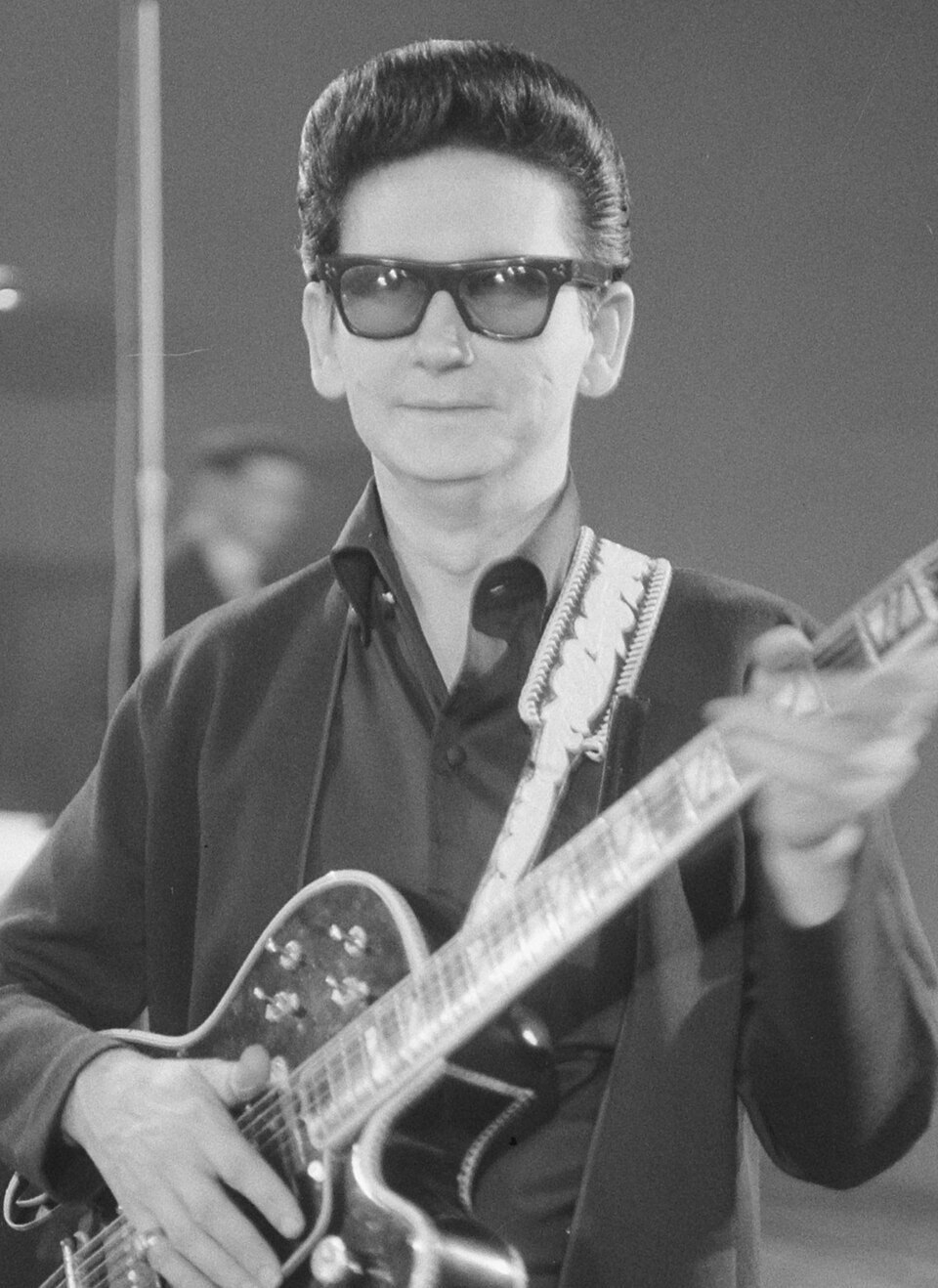
He Heard It in His Sleep: The Battles Behind Roy Orbison’s ‘She’s a Mystery to Me’
Most comeback records are acts of will. “She’s a Mystery to Me” was an act of sleep. In June 1987, in a London hotel room in the middle of U2’s Joshua Tree Tour, Bono fell asleep with the soundtrack of David Lynch’s film Blue Velvet turning over and over on repeat — a soundtrack that contained one Roy Orbison song, the 1963 dream-ballad “In Dreams”. When he woke the next morning there was a tune in his head that he was certain must have come off that record. It had not. It was new, and it was not his. It belonged, in some way he could not explain, to a 51-year-old singer from Texas whom the American record business had spent twenty years forgetting, and who would be dead within eighteen months.
That is the first battle behind this song: it had to fight its way out of another man’s dream, across a generation gap, through the wreckage of the saddest career in rock and roll, and onto tape before time ran out. Roy Orbison’s life had been marked by losses that would have silenced almost anyone — a wife killed on the road, two sons lost to fire, a homeland audience that drifted away and left him playing to half-empty rooms. The comeback that finally lifted him in 1987 and 1988 was real, but it was a race, and everyone around him could hear the clock. “She’s a Mystery to Me”, written by Bono and The Edge, produced by Bono, and recorded at A&M Studios on September 15, 1988 — less than three months before Orbison’s death — became the title-giving heart of Mystery Girl, the most successful American album of his life, an album he never lived to see released. This is the story of how a song dreamed beside a film soundtrack became the last great mystery of Roy Orbison.
Told He Would Never Make It
The song’s singer had been fighting the industry’s idea of him since before he had an industry. Orbison grew up in Wink, Texas, studied geology briefly because oil-field work was the sensible plan, and fronted a local band, the Wink Westerners, before forming the Teen Kings and landing, in 1956, at Sam Phillips’ Sun Records in Memphis. Sun had just lost Elvis Presley and Phillips was hunting for a successor; Orbison, who had seen Presley perform in Texas in 1954 and been stunned by him, arrived with a rockabilly record, “Ooby Dooby”, that climbed to number 59 and sold some 200,000 copies. It was a start. It was not what he wanted.
What Orbison wanted, even then, was to sing emotional ballads — the big, trembling, operatic kind. Phillips wanted rockabilly of him, and when Orbison presented a ballad he had written, “The Clown”, Sun producer Jack Clement delivered the verdict that would hang over the first act of his career: he told Orbison he would never make it as a ballad singer. Orbison kept pitching his ballads to other singers instead. In April 1958 the Everly Brothers recorded his “Claudette” as the B-side of their hit “All I Have to Do Is Dream”, and the song reached number 30 in March 1959. The royalties bought the most expensive new pink Cadillac in Odessa. The money was spent, the marriage to Claudette strained by touring, and Orbison was soon broke and living with his parents in Wink — a songwriter whose best song belonged to somebody else, a ballad singer officially informed that ballads were not his future.
The future arrived in 1960 at Monument Records, when Orbison and Joe Melson wrote “Only the Lonely”. Short of money, Orbison first tried to pitch it to Elvis Presley — he turned up in Memphis early one morning, but Presley did not want to see him at that hour — so Orbison recorded it himself, at RCA’s Nashville studio, with engineer Bill Porter building the mix in a then-unheard-of way, from the top down: close-miked backing voices in front, the rhythm section soft behind them, and in the middle a falsetto note that biographer Alan Clayson said “came not from his throat, but deeper within”. The record reached number two in America and number one in Britain and Australia. When Presley finally heard it, he bought a whole box of copies to give to his friends. The ballad singer had been right all along; it had only taken the business four years, one Cadillac and total ruin to find it out.
Orbison told Rolling Stone in 1988 that somewhere between “Ooby Dooby” and “Only the Lonely” his voice “kind of turned into a good voice”. His peers put it less modestly. Bob Dylan wrote of him: “With Roy, you didn’t know if you were listening to mariachi or opera. He kept you on your toes… He sounded like he was singing from an Olympian mountaintop. His voice could jar a corpse.” Dwight Yoakam called it “the cry of an angel falling backward through an open window”. Elvis Presley, who had declined the early-morning pitch meeting, called Orbison’s the greatest and most distinctive voice he had ever heard. Remember those judgements. They explain why, three decades later, the biggest band in the world would stop in its tracks when this man walked into a room.
The Wilderness Years
To understand what the song had to rescue, you have to stand for a moment in the ruins. In the first half of the 1960s Orbison had been one of the biggest recording stars in the world, a man whose operatic ballads — “Only the Lonely”, “Running Scared”, “Crying”, “It’s Over”, “Oh, Pretty Woman” — sold in the millions and made him, for a stretch of 1963 and 1964, the only American artist who could top the British charts in the teeth of the British Invasion. His voice was routinely described in terms usually reserved for opera singers and angels. Barry Gibb, remembering his first hearing of “Crying”, put it plainly: “That was it. To me that was the voice of God.”
Then the disasters arrived, and they did not stop. Orbison and his wife Claudette shared a love of motorcycles, and on June 6, 1966, riding home from Bristol, Tennessee, Claudette was struck by a pickup truck in Gallatin, Tennessee, and killed. She was 25. Two years later, on Saturday, September 14, 1968, Orbison was in England, playing a show in Birmingham, when word reached him that his home in Hendersonville, Tennessee, had burned down and his two eldest sons, Roy DeWayne and Anthony King, had died in the fire. He was a widower at 32 who had now buried two of his children. Grief stopped his songwriting cold; for a long while he simply could not write.
The hits stopped too. Through the 1970s Orbison changed labels and kept recording, and his records kept failing in the United States even as they sometimes succeeded abroad — “Penny Arcade” spent weeks at number one in Australia, “Too Soon to Know” reached number three in England — but at home the rooms emptied. On his fortieth birthday in April 1976 he played the Cincinnati Gardens to a mostly empty hall. Biographer Peter Lehman would later write that Orbison’s disappearance had a strange fittingness to it: since it was never clear where he had come from, nobody much noticed where he had gone. He was just gone.
And yet the voice never left, and neither did his admirers. Younger stars kept carrying his songs back into the charts — Sonny James took “Only the Lonely” to number one on the country chart, Nazareth and then Gram Parsons and Emmylou Harris remade “Love Hurts”, Glen Campbell scored with “Dream Baby”. Bruce Springsteen closed concerts with Orbison songs and opened his own most famous album with an act of homage, “Thunder Road” name-checking “Roy Orbison singing for the lonely”. The industry had forgotten Roy Orbison. Musicians had not.
A Voice in the Blue Velvet Dark
The rescue began, improbably, in a movie theatre. David Lynch’s Blue Velvet, released in 1986, built some of its most disturbing scenes around Orbison’s “In Dreams” — the song of the “candy-colored clown”, lip-synched in the film by Dean Stockwell’s character Ben into an industrial work light held like a microphone, while Dennis Hopper’s Frank Booth demanded to hear it again and again. Orbison had not been consulted in any way that prepared him for what he saw; watching the film in a theatre in Malibu, he was, by his own account, mortified. But touring with the footage afterwards changed his mind. “I really got to appreciate what David gave to the song, and what the song gave to the movie,” he said, “how it achieved this otherworldly quality that added a whole new dimension to ‘In Dreams’.” The use of the song in Blue Velvet is widely credited with greatly helping his comeback, and it put his voice — floating, haunted, unmistakably from somewhere else — back in front of exactly the audience most likely to revere it.
In January 1987 came the formal absolution. Orbison was inducted into the Rock and Roll Hall of Fame, and the man who inducted him was Springsteen, who closed his speech by reaching back to Born to Run: “I wanted a record with words like Bob Dylan that sounded like Phil Spector — but, most of all, I wanted to sing like Roy Orbison. Now, everyone knows that no one sings like Roy Orbison.” Orbison asked Springsteen for a copy of the speech. He said the honour made him feel “validated”. The same year brought induction into the Nashville Songwriters Hall of Fame, a new deal with Virgin Records, a greatest hits release, and the first serious preparations for an album of new songs — his first album of all-new material in what would become a decade.
A few months after the Hall of Fame ceremony, Orbison and Springsteen met again on a stage: the all-star concert at the Cocoanut Grove nightclub in Los Angeles, filmed in black and white and broadcast by Cinemax in January 1988 as Roy Orbison and Friends: A Black and White Night. Jackson Browne, T Bone Burnett, Elvis Costello, Tom Waits, Bonnie Raitt, Jennifer Warnes, James Burton, JD Souther and k.d. lang all stood behind him. Lang later recalled how humbled Orbison seemed by the turnout: “Roy looked at all of us and said, ‘If there is anything I can ever do for you, please call on me.’ He was very serious. It was his way of thanking us. It was very emotional.” The concert is now regarded as a landmark of his career. By the middle of 1987, Roy Orbison was no longer a memory. He was a cause — and causes attract songwriters.
Sleeping with the Soundtrack
It was into this charged moment that the song arrived, by the strangest route of any in Orbison’s catalogue. U2 were in London in June 1987, deep into the Joshua Tree Tour, the run of shows that was turning them into the biggest band in the world. Bono, their 27-year-old singer, was having a restless night. He put on the Blue Velvet soundtrack — the CD had been given to him by The Edge’s wife — and slept with it playing on repeat, Orbison’s “In Dreams” circling through the room hour after hour.
He woke with a tune in his head. His first, entirely reasonable assumption was that it was simply another track from the soundtrack, something his sleeping brain had filed away. Then he checked himself: it was not on the record. It did not exist yet. The melody had assembled itself overnight out of pure Orbison — the drifting, dream-logic phrasing, the lullaby surface over a dark undertow — and Bono, to his credit, recognised both what it was and whose it was. He wrote down the basic structure of the song before it could evaporate.
Later that same day, at the band’s pre-concert soundcheck at Wembley Arena, he sang the unfinished song to the other members of U2, who agreed that it sounded like a Roy Orbison song. Bono has retold the episode on camera, in the documentary In Dreams: The Roy Orbison Story, and it loses nothing in his telling: he woke for the soundcheck after the late night with the soundtrack, carrying a tune he was convinced was another Orbison recording, and only on examination realised it was something his sleeping mind had composed in Orbison’s style — in his idiom, in his emotional accent, almost in his voice. There the matter might have rested — a curiosity, a homage hummed once at a soundcheck and forgotten. Instead, that night, fate took a hand in the most literal way available to it. After the concert, unannounced, Roy Orbison himself walked into U2’s backstage area.
The Visitor Backstage
The surviving accounts agree on the essentials, and the essentials are wonderful. Orbison had come to see the band — this man in black, 51 years old, a quarter-century past his chart prime, turning up without ceremony to pay a call on the biggest young band in the world. Bono, perplexed and plainly thrilled, played him the song from the dream. One version of the aftermath, preserved in accounts of the Mystery Girl sessions, has Orbison subsequently asking Bono if he would like to write a song either with him or for him. It is worth pausing on the humility inside that sentence. Orbison was not a supplicant; he was one of the most imitated singers alive. But he had spent twenty years being told, in the only language the business speaks — sales — that his time was over, and he had learned to accept tribute in whatever form it came, including the form of a melody a young Irishman had dreamed at the sound of his own voice.
The two men worked on the song again in mid-November 1987, in Los Angeles. By then the comeback machinery was fully engaged: the Black and White Night concert had been filmed, the Virgin deal was in motion, and Orbison was gathering material and producers for the new album. Bono and The Edge finished their song for him — a slow, swaying ballad about a woman who could not be reached or read, who walked through the narrator’s life like weather. Its chorus held the line that would outlive everything else about the project: “She’s a mystery to me, she’s a mystery girl.”
Consider the fit, because it is the heart of the matter. Orbison’s whole art had been built on mystery — the motionless figure in dark glasses, the voice that seemed to arrive from inside a locked room, the songs full of dreamers, clowns, lonely rooms and unreachable women. Bono had not written a pastiche. Sleeping inside Orbison’s own music, he had dreamed in Orbison’s grammar, and the result was a song that Orbison could sing as if he had carried it around unwritten since 1963.
An Album Crowded with Admirers
The record that would carry the song had been taking shape since the summer of 1987. According to The Authorized Roy Orbison, recording for Mystery Girl began in July 1987 at Ocean Way Studios in Hollywood with “(All I Can Do Is) Dream You”. Jeff Lynne, another lifelong admirer, began writing with Orbison in Los Angeles over Christmas 1987, and out of those sessions came “You Got It”, written by Lynne, Orbison and Tom Petty together and cut in April 1988 in the garage studio of Heartbreakers guitarist Mike Campbell. All through 1988 the sessions ran in parallel with the making of Traveling Wilburys Vol. 1, the supergroup album Orbison was recording with Lynne, Petty, George Harrison and Bob Dylan — a project on which rock’s aristocracy treated the quiet Texan not as a guest but as a presiding elder.
The producer’s chair on Mystery Girl was shared among Lynne, Campbell, T Bone Burnett and Orbison’s wife Barbara, and the Heartbreakers played on much of the album. Elvis Costello contributed “The Comedians”, carried over from his own Goodbye Cruel World, its lyric lightly feminised in Orbison’s performances to “Comediennes”. It was the most talent-dense room Orbison had ever recorded in — and it had been a decade since his last album of all-new material, 1979’s Laminar Flow, and longer still since anyone had expected one to matter. The album took its name from the Bono and Edge song’s chorus. Executive logic had nothing to do with it: of everything recorded, the dream song was the one that named the whole enterprise.
Lefty Wilbury
All through the Mystery Girl sessions, a second project kept pulling Orbison’s admirers into the same room. In early April 1988 George Harrison was in Los Angeles needing a B-side for a European single from his album Cloud Nine. Jeff Lynne was in town producing tracks for Orbison and for Tom Petty. Over dinner with Lynne and Orbison, Harrison explained his problem; Orbison, hearing that it sounded like fun, offered to help. Short of a studio, they borrowed Bob Dylan’s garage in Malibu, collected Petty on the way, and cut Harrison’s song “Handle with Care” in a day, Dylan manning the barbecue before joining in on the lyrics. The track was judged far too good to bury on a B-side, so the five of them became a band: the Traveling Wilburys, disguised as half-brothers, Harrison as Nelson, Lynne as Otis, Dylan as Lucky, Petty as Charlie T. Jr. — and Orbison, gloriously, as Lefty Wilbury.
Traveling Wilburys Vol. 1 was released in October 1988 and became a phenomenon in its own right, certified triple platinum in the United States and later nominated for Album of the Year at the Grammy Awards. It was the only Wilburys album to feature Orbison, and the final album of his to be released in his lifetime; he would be dead less than two months after it appeared. Its importance to the Mystery Girl story is not merely chronological. For a singer who had spent the 1970s playing to empty seats, the Wilburys put him back where he had started — inside a working band of equals, except that these equals happened to include a Beatle and Bob Dylan, and they treated the quiet man in black not as a heritage act but as the best singer any of them knew. “Lefty” was a joke name. The seniority was real.
September 15, 1988
“She’s a Mystery to Me” was recorded on September 15, 1988, at A&M Studios in Hollywood, with Bono producing. The way it was made honoured Orbison’s oldest studio principle: in his 1960s prime he had refused the splice-editing then becoming standard, insisting on recording his songs in single takes with all the instruments and singers together in the room, and the Mystery Girl sessions, for all their modern gloss, kept faith with that ethic — a band, a singer, a song, played. The personnel list reads like a small parable of the comeback itself: the new generation quite literally holding the record up around the old master. Orbison sang and played electric guitar. Bono played electric guitar. Benmont Tench, of the Heartbreakers, played piano. Howie Epstein, also a Heartbreaker, played bass. Jim Keltner, the session drummer behind half the great records of the era, kept time. And The Edge — a guitarist famous for building cathedrals of echo — is credited, with a modesty that borders on the comic, with “cheap strings”.
The finished track runs four minutes and sixteen seconds, and its production is an act of restraint. Where Orbison’s early-1960s classics had climbed from whisper to operatic climax on rising strings and massed drama, this record sways. The band rocks gently and stays there, verse folding into verse, while the lyric circles a woman who gives nothing away — and over it all, Orbison sings with the patience of a man who has stopped needing to prove the range. The drama is in the holding back. Critics would later notice exactly this: Rolling Stone’s Michael Azerrad heard echoes of U2 in the song and of Bono in Orbison’s phrasing, but judged the chorus’ singing style distinctly Orbison’s own. Pitchfork heard the years in the voice — “wrinkles”, it said, that only added “texture and authority”.
Built Like a Dream, Not a Single
The song’s shape is worth examining, because it breaks the rules Orbison himself wrote. His classic hits were feats of architecture that ignored pop’s verse-chorus scaffolding entirely: “In Dreams” runs through seven distinct movements without repeating a section, “Running Scared” simply repeats its whole body over and over to build dread toward one climactic high note, and “Crying” doubles back through its own structure with every part altered. Orbison, who said he never learned how to write standard songs, built each hit as a miniature opera engineered to detonate at exactly one point.
“She’s a Mystery to Me” refuses all of that. There is no detonation. The record settles into its slow, side-to-side sway and stays inside it, the verses unfolding like a man talking himself around a room he cannot leave, the title line returning the way unanswered questions do. Cash Box heard the difference and filed it as a flaw — “more rambling than the usual pointed material Roy excelled at” — but rambling is precisely the subject: this is a narrator circling a woman he cannot read, and the music walks in the same circles. What keeps it from drifting away is the singing. Azerrad, in Rolling Stone, caught the transaction exactly: the phrasing could pass for Bono’s, but the chorus was unmistakably Orbison’s — the difference between a man performing longing and a man whose entire career had been longing, set to music. Pitchfork’s later judgement that the “wrinkles” in the 52-year-old voice added “texture and authority” points the same way. The young writers supplied a dream. Only Orbison could make it sound remembered.
It also matters that the song is a confession of helplessness, because helplessness was Orbison’s great subject and the one his imitators could rarely fake. From “Only the Lonely” onward, his narrators do not conquer, charm or outwit the women in his songs; they watch them leave, they dream them back, they lose. Bono, asleep inside the Blue Velvet soundtrack, had absorbed that posture along with the melodies — his mystery girl is a direct descendant of the girl in “In Dreams” who vanishes with the dawn, except that she never even has to leave. She is gone while she is still in the room.
Nobody in the studio that September day could have said it aloud, but the session fell inside the last eleven weeks of Orbison’s life. The album was completed in November 1988, and the schedule had been punishing — recording, the Wilburys, touring, always touring. Around that time Orbison confided to Johnny Cash that he had been experiencing chest pains and would need to do something about his health.
Released into a World Already Mourning
He did not get the chance. On December 6, 1988, two days after performing a concert in Highland Heights, Ohio, Roy Orbison died of a heart attack. He was 52. The album he had spent a year and a half assembling — the record that was supposed to announce his full return — became a posthumous release by default.
Mystery Girl was released by Virgin on January 30, 1989 in Britain and February 7 in the United States, and the public response was unlike anything Orbison had known since 1964. The album peaked at number five on the Billboard 200 — the highest position of his entire career on the American album chart — and at number two in Britain. On April 8, 1989, he became the first deceased musician since Elvis Presley to hold two of the top five albums in America simultaneously, the Traveling Wilburys at number four and Mystery Girl at number five. “You Got It”, the first single, reached number nine on the Hot 100, his first American top twenty hit since “Oh, Pretty Woman”. In Britain, on the chart dated February 11, 1989, Mystery Girl sat at number two while the compilation The Legendary Roy Orbison sat at number three — a dead man occupying two of the top three places, outsold by no living singer that week.
“She’s a Mystery to Me” followed as the album’s second single in March 1989. It was not the commercial engine “You Got It” had been, but it travelled widely and well: number 27 in Britain, number five in Ireland, number 17 in Australia, number 19 in the Netherlands, number 30 in New Zealand, and in the United States number 23 on Billboard’s Adult Contemporary chart and number 26 on the Mainstream Rock chart. The notices were the kind the song’s makers must have hoped for. The BBC’s Chris Jones called it “a true rarity”. AllMusic judged it a highlight of the album, a haunting ballad that was a perfect showcase for Orbison’s vocal talent, and the Deseret News went furthest of all, naming it “perhaps the best song on the album”. Even the dissent was gentle: Cash Box found it “more rambling than the usual pointed material Roy excelled at”, but conceded “it’s still a strong offering”.
The album around it drew the same mixture of admiration and unease at the circumstances. New York Times critic Stephen Holden praised Mystery Girl across the board, writing that “the singing, songwriting and production do a superb job of bringing Orbison up to date without diluting his haunted hyper-romantic fervor”, and singled out Costello’s “The Comedians” as the outstanding song. In the Chicago Tribune, David Silverman worried aloud that “the publicity and fanfare have threatened to cheapen the album, reducing it to novelty status while directing attention away from its rightful distinction as one of Orbison’s finest works — a comeback to match his legendary status”. Billboard called the record a fitting testament to the glory of his voice. The consensus, in other words, matched the chart positions: this was no posthumous cash-in. It was the comeback album, arriving one funeral too late.
The Video He Never Saw
Because Orbison had died before the single’s release, its promotion fell to a music video in which the singer could not appear — and the solution its director found has become part of the song’s legend. The video was directed by David Fincher, then a rising commercials-and-videos craftsman years away from his feature-film fame, and it aired first in April 1989. Two versions were made, and both were broadcast by MTV, though one far more often than the other.
Both versions build toward the same image: a woman departing on an aeroplane, watched by someone who cannot stop her. In the better-known cut, the woman is leaving with a rich lover, and the watcher — the song’s helpless narrator — is present only as a faceless figure glimpsed mostly in close-ups of black cowboy boots: the late singer conjured out of footwear and shadow, haunting his own video like the voice on the record haunted the radio. In the alternate version, the ending twists the story — the departing “woman” is revealed to be a pre-adolescent girl, an older woman, apparently her mother, arriving at the gate as the plane readies for takeoff; the girl leaves the plane and reunites with her in tears. The same actress plays the pursued woman in one version and the pursuer in the other. And the Mystery Girl herself, in both versions, is played by Ali Hewson — Bono’s wife, the woman who had given Bono the Blue Velvet soundtrack that started everything. The circle the song draws around its makers is almost embarrassingly complete: dreamed from Orbison’s voice, written by a husband, embodied on screen by his wife, sung by a man who was gone before the cameras rolled.
Why It Endures
Why does this one last? Partly because of what it refused to do. The comeback industry of the 1980s usually handled its returning legends with nostalgia and varnish — old hits reheated, dignity preserved at the price of relevance. “She’s a Mystery to Me” did the opposite. It was a brand-new song by the most contemporary songwriters imaginable, and yet it asked nothing of Orbison except the thing he had always done: stand still, in the dark, and sing about a woman he could not reach as if the fate of the world turned on it. The song’s restraint is its argument — that the voice Barry Gibb called the voice of God did not need the operatic scaffolding anymore, that at 52, weathered and wrinkled, it could carry a record by presence alone.
Partly it endures because the story never really closed. The song kept surfacing: bundled onto the 1992 British CD reissue of the “Crying” duet with k.d. lang, carried onto the 25th anniversary edition of Mystery Girl in 2014 — an edition that also premiered “The Way Is Love”, a cassette demo his sons completed with producer John Carter Cash, as if the family were still answering the record a quarter-century on. And in 2018 it reached a new generation entirely when it was featured in the film Aquaman, underscoring the scene of Arthur Curry and Mera arriving in Sicily — the dream song from the Blue Velvet soundtrack appearing inside another filmmaker’s reverie, thirty years later.
The official world kept tidying up the story after his death. In 1989 Orbison was inducted, posthumously, into the Songwriters Hall of Fame — joining the Rock and Roll Hall of Fame and Nashville Songwriters Hall of Fame inductions of 1987 — and he would receive a Grammy Lifetime Achievement Award and five other Grammys across his career. Rolling Stone placed him at number 13 on its list of the hundred greatest singers of all time. Fine honours, all earned. But honours are not why people still play this record.
There is a remark of Orbison’s, given to Rolling Stone in that same final year of 1988, that reads now like the record’s own epitaph. Asked about the instrument that had carried him from the Wink Westerners to the Wilburys, he said: “I liked the sound of [my voice]. I liked making it sing, making the voice ring, and I just kept doing it.” Consider what “just kept doing it” had to survive — Sun Records telling him ballads would never sell, a wife dead at 25, two sons gone in a single night, a decade of American indifference, a fortieth birthday played to empty seats. He kept doing it through all of it, in single takes, in dark glasses, standing perfectly still, and in the end the world’s loudest young band came to him — one of them arriving, literally, with the song already dreamed. “She’s a Mystery to Me” is what that persistence sounds like from the far side: not a victory lap, not a nostalgia piece, but a great singer accepting one last impossible song and making it sound inevitable.
But mostly it endures because it is the precise point where two eras of popular music touched without either one condescending to the other. A young band at its commercial zenith did not sample Roy Orbison, or duet with his ghost, or embalm him in tribute. Their singer simply fell asleep inside the sound of him and woke up holding a song that was his — and then had the grace, and the luck, to be standing backstage-adjacent when Orbison walked in and asked to hear it. Orbison, for his part, did the bravest thing a legend can do: he accepted a song from his own imitators and sang it as if he had written it in 1961. “She’s a mystery to me”, he sings, about the woman in the song. Listening now, it is impossible not to hear the line travelling the other way — the whole record business, and then history itself, looking at the quiet man in black it had discarded and confessing that he had been a mystery to them all along.