The B-Side That Outran Its Own A-Side: The Battles Behind Roy Orbison’s ‘Candy Man’
In the summer of 1961 Roy Orbison could do no wrong — almost. He was in the middle of one of the great runs in pop history: “Only the Lonely”, “Blue Angel” and, that June, his first American number one, “Running Scared”. His next single, released in mid-July while “Running Scared” was still on the charts, was built around a ballad of such overwhelming sorrow that it would become one of the most famous recordings of the century. Buyers who took the record home and flipped it over, however, found something else entirely on the other side — a loose, grinning, harmonica-driven blues come-on called “Candy Man”, written by a woman who had co-written “Lollipop” and a Greenwich Village folkie who had never had a hit, and named, though nobody at the record company seems to have minded, for old New Orleans slang for a pimp.
The flip side then did something B-sides were not supposed to do. “Candy Man” entered the Billboard Hot 100 in the first week of August 1961 — a week before the A-side it was attached to — and stayed on the chart for fourteen weeks, climbing to number 25 and becoming Orbison’s first B-side ever to chart in America. It launched the career of a twenty-year-old harmonica player, travelled to England where Orbison personally handed it to a beat group who took it into the British top ten, resurfaced as a country hit more than twenty years later, and stayed in Orbison’s stage show for the rest of his life. This is the story of the battles behind the song that was never meant to be the point of the record — against the A-side that was supposed to bury it, against its own disreputable title, and against the melancholy legend of the singer himself, who turned out to have a bluesman hiding inside the operatic balladeer all along.
A Phrase with a Past
“Candy man” was old language before it was ever a hit title. In the blues world the figure had been circulating for decades: Mississippi John Hurt, the Mississippi songster whose gentle fingerpicking concealed a repertoire full of sly double meanings, recorded “Candy Man Blues” for Okeh Records back in 1928, and sang “Candy Man” for the rest of his career. In street slang, meanwhile, the term carried a specific and unsavoury meaning — the man who lives off a woman, her protector and exploiter, the one who keeps her in treats and takes the money. Any songwriter picking the phrase up in 1960 was picking up thirty years of blues tradition and a whiff of the demimonde along with it.
There is a pleasing historical coincidence buried here, too. Hurt himself, after decades of obscurity, was rediscovered during the folk revival of the 1960s, recording albums for Vanguard Records and appearing on Pete Seeger’s television show Rainbow Quest — and his latter-day fans, the record notes, particularly liked his ragtime songs “Salty Dog” and “Candy Man”. So in the very years when Orbison’s “Candy Man” was climbing the charts and crossing the Atlantic, the phrase’s oldest famous owner was back in front of audiences singing his own. The candy man had been passing from hand to hand for forty years before Ross and Neil ever wrote the words down. He would keep passing.
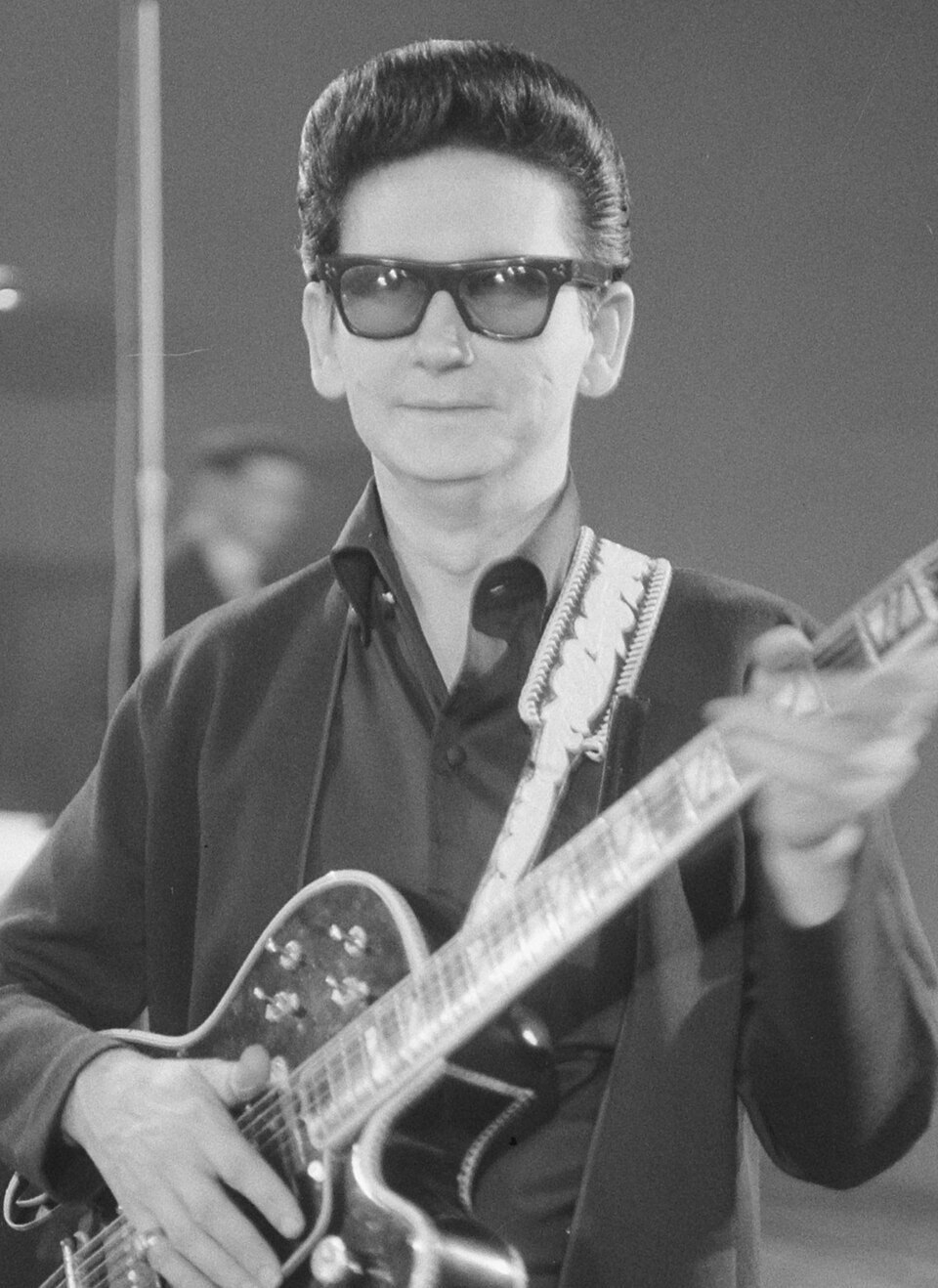
That double inheritance is exactly what makes the Orbison record interesting. Nothing about Roy Orbison in 1961 suggested the street corner. His public self was already fixed: the still figure, the darkening glasses, the voice that climbed from a murmur to an operatic climax while the man himself barely moved. His hits were monuments of romantic suffering — a lonely man, a frightened man, a man about to cry his heart out in front of an orchestra. The idea that this singer’s biggest summer would include a record demanding, in effect, to be somebody’s candy man — grinning, harmonica wailing, Boots Randolph’s saxophone honking behind him — seemed to belong to some other artist’s catalogue. Getting it from the writers’ notebooks to Orbison’s record took an unlikely chain of people, and each link in the chain had its own small fight on its hands.
The Lollipop Writer and the Folkie
The Café Wha? deserves a word of its own, because in 1961 there was no more concentrated acre of ambition in American music. The basement club on MacDougal Street was the folk revival’s clearing house, a room where unknown singers played for passing-the-hat money while publishers, managers and other singers listened from the tables. To be paired as a writer there was to be handed a lottery ticket in the business’s own headquarters. Ross was the ticket’s experienced half; Neil was its wild card.
The chain began in Greenwich Village, at the Café Wha?, where a publishing company paired two of its writers who could hardly have been less alike. Beverly Ross was a professional: she had already co-written “Dim, Dim the Lights” for Bill Haley & His Comets — which is to say she had been writing hits since rock and roll’s first wave — and “Lollipop”, the fingertip-popping trifle that became an international hit for the Chordettes. Sweetness, in various forms, was her established trade; she had been selling confectionery to the charts for years before Neil ever suggested the word “candy”. Fred Neil was something else — a folk singer and songwriter who had been writing and recording for years without a comparable success, a Village fixture with a deep voice, a bluesman’s instincts and, though nobody knew it yet, one of the most covered songbooks of the coming folk-rock era; a decade later his “Everybody’s Talkin’” would become a worldwide hit for Harry Nilsson by way of the film Midnight Cowboy.
Knowing that Ross had “Lollipop” on her résumé, Neil decided he wanted to write a “candy song” with her, and he arrived with the title ready: “Candy Man”. His explanation of it, as Ross later recalled, was pure New Orleans street terminology — in New Orleans, he told her, the prostitutes’ pimps are what the women call their “candy man”. Ross was not particularly pleased with the provenance. But she liked the title, and she was determined to have another hit, so the two of them performed a small act of lyrical laundering that is itself a tidy lesson in how pop music sanitises the blues: they kept the hook and rewrote the meaning, “giving the title an affectionate, cute definition lyrically rather than the sleazy actual meaning it derived from”.
The song they produced is exactly that laundering made audible. Orbison’s candy man is no predator; he is a shameless, cheerful beggar for affection, a man advertising himself as the sweetest thing a woman could pick, strutting through the lyric while a harmonica answers him like a second, hornier voice. The sleaze survived only in the title, where it worked as spice. It is worth noting what an essentially Orbison problem this was: his whole art consisted of taking unbearable feelings and delivering them in unbearably beautiful form. Ross and Neil, without ever meeting him at this point, had written him a record that hid its low origins inside a sugar coating.
It helps to understand the economy the song was born into. In the publishing world of 1961, pairings like Ross and Neil’s were industrial policy: publishers matched writers the way studios matched actors, hoping a proven commercial hand would steady an unproven talent, and a song, once accepted, earned its writers money from every copy of the record sold — whichever side of the record it sat on. The B-side of a hit single was not a charity slot. It was one of the most contested pieces of real estate in the business, a royalty stream attached to somebody else’s success, and publishers fought to place their copyrights there. A song about a candy man, written by a hitmaker and a hopeful, was not drifting toward Roy Orbison by accident. It was being marched there, through the demo studio and the publisher’s office, by people who understood exactly what the flip of an Orbison single was worth in the summer of 1961 — and who also understood that Orbison, a writer himself, was the hardest possible sell.
A Demo, a Publisher, a Producer
Songs in 1961 did not reach singers by magic; they travelled hand to hand, and “Candy Man” travelled well. When Ross ended her publishing contract, she took the song to her friend Aaron Schroeder, who had recently started his own publishing company, January Music. Schroeder heard it and loved it, and rather than merely filing the lead sheet he sent Ross and Neil into a studio to cut a proper demonstration record. Then he carried that demo to the man who mattered most for any song hoping to become a Roy Orbison record: Fred Foster, the founder of Monument Records and the producer who had built Orbison’s sound.
Foster’s judgement at that moment deserves respect, because he had every reason to refuse. Orbison was not an interpreter for hire; he wrote or co-wrote almost all of his own top-ten hits, working with Joe Melson on the anguished, architectural songs that were remaking pop music. Between 1960 and 1966, twenty-two of his singles would reach the Billboard top forty, and the persona they built was consistent to the point of severity. An outside song — a novelty-flavoured blues written by a “Lollipop” alumna and an unknown folkie, cheerful where Orbison was desolate — cut directly against the brand at the very moment the brand was conquering. Foster cut it anyway. And the timing he chose was either madness or genius: he scheduled it at the session immediately following the most demanding recording of Orbison’s career.
The Hottest Run in Pop
It is worth reconstructing exactly where Orbison stood when Foster said yes, because no singer in America had more to lose. “Only the Lonely” in 1960 had taken him from broke ex-rockabilly to number two in America and number one in Britain and Australia, and the follow-ups had held the line: “Blue Angel”, a more complex song again, reached number nine in the United States, and “I’m Hurtin’” reached number 27. He toured relentlessly, often alongside his Hendersonville neighbour Patsy Cline, two of the era’s loneliest voices sharing a bill. The records he and Melson built in those months had a recognisable grammar — a vulnerable man, a feared loss, a structure that climbed and climbed toward a single overwhelming climax.
The purest example was the single immediately before “Crying”. Orbison and Melson’s “Running Scared” — a man terrified his girl is about to leave him for another — required a final high note that Orbison could not reach in falsetto without his voice cracking. Producer Fred Foster’s solution was to put him in the corner of the studio and surround him with coat racks, an improvised isolation booth, because the orchestra could not play softly enough for him to sing under it. Unhappy with the first two takes, Orbison abandoned falsetto on the third and sang the climactic high A in his natural voice, so astonishing everyone present that the musicians stopped playing. Foster remembered it simply: “He did it, and everybody looked around in amazement. Nobody had heard anything like it before.” Weeks later “Running Scared” became his first number one on the Billboard Hot 100.
That was the summit from which Foster now proposed to descend — deliberately — into a harmonica blues written by strangers, scheduled for the day after the “Crying” session. Read uncharitably, it was a producer wasting his golden singer’s momentum on filler. Read properly, it was a producer who understood something the market would take decades to say out loud: that Orbison’s gift was not the high notes but the conviction, and conviction works at any tempo, in any mood, on either side of a record.
Two Days in Studio B
On June 26, 1961, at RCA Victor’s Studio B in Nashville, Orbison recorded “Crying” — the Orbison–Melson ballad that begins in near-whisper and builds, section upon section, to a climax that has made grown listeners weep for sixty years. Critic Dave Marsh would memorably describe the finished record as a “rock-bolero” of “blaring strings, hammered tympani, a ghostly chorus, the gentle strum of a guitar, [and] a hint of marimba” — the full orchestral apparatus of romantic catastrophe, deployed in a single song. The next day, June 27, in the same room, with substantially the same musicians, Orbison stripped nearly all of that apparatus away and recorded “Candy Man”: no strings, no tympani, no ghostly chorus — a harmonica, a saxophone, a piano and a beat. The two days belong together. They are the before-and-after photographs of a singer demonstrating, on consecutive afternoons, the entire width of what he could do.
Read the personnel as a portrait of Nashville at its zenith. On guitars: Harold Bradley, the most recorded guitarist of his era; Scotty Moore, who had been Elvis Presley’s original guitarist; and Boudleaux Bryant, who with his wife Felice had written half the Everly Brothers’ catalogue and was here moonlighting as a rhythm player. Bob Moore played bass, Buddy Harman drums, Floyd Cramer — the slip-note piano stylist — played piano, and Boots Randolph added saxophone. It is the Nashville A-Team in full dress, and into this room full of legends walked the session’s most consequential beginner: a twenty-year-old harmonica player named Charlie McCoy.
“Candy Man” is built around McCoy’s harmonica — it takes the record’s signature riff, answers Orbison’s lines, and generally behaves like the second lead instrument on a record by the most celebrated voice in the building. The article of record on the song is blunt about cause and effect: the success of “Candy Man” helped boost McCoy’s career. It did rather more than help. McCoy became Nashville’s utility man, the first-call multi-instrumentalist who played on Elvis Presley film soundtracks, on records by Johnny Cash, Chet Atkins, Waylon Jennings and Loretta Lynn, whose harmonica would open George Jones’ “He Stopped Loving Her Today”, and whose New York sessions with Bob Dylan helped persuade Dylan to come and make Blonde on Blonde in Nashville. He was inducted into the Country Music Hall of Fame, and in the standard roll of his iconic recordings, “Candy Man” stands first in the list — ahead of them all, the B-side did that. Nashville nicknamed him the “utility man” for the range of instruments he could be trusted with, and the utility extended back to Orbison himself: when Orbison cut the biggest record of his life three years later, “Oh, Pretty Woman”, the saxophone on it was Charlie McCoy. The kid who had talked back to the Big O on a harmonica in 1961 had become part of the furniture of the man’s sound.
The sessions also fit Orbison’s own working faith. In the 1960s he refused the splice-editing that was becoming studio standard and insisted on recording his songs in single takes, with all the instruments and singers together in the room. “Candy Man”, with its live, jostling groove — harmonica, saxophone, piano and guitars all leaning on the same beat — is exactly the sound of that faith: a performance, not an assembly. One day after singing the loneliest ballad in his catalogue, Orbison stood in the same spot and played the fool for love, in one room, in real time, and both records are true.
The structural contrast between the two days’ work is the final joke. Orbison’s own songs famously ignored the standard pop blueprint — “Crying” runs through its sections and then runs through them again, altered, like a man re-arguing his case to a closing door, and Orbison cheerfully admitted that he had never actually learned how to write a standard-structure song. “Candy Man” is a standard song, as plain in construction as he never managed to be: verse, hook, harmonica, repeat, out. The master of the miniature opera spent June 27, 1961 proving he could also do the ordinary thing extraordinarily — lean on a beat, trade lines with a harmonica, and make three minutes of formula sound like a Saturday night.
The Flip Side Fights Back
Monument released the single in mid-July 1961, with “Crying” as the A-side and “Candy Man” tucked behind it. The timing was crowded — “Running Scared” was still in the charts — and the label’s expectations were pinned, reasonably enough, on the ballad. The public, as it turned out, wanted both records, and wanted the B-side first.
“Candy Man” entered the Billboard Hot 100 in the first week of August, a full week before “Crying” itself appeared on the chart — the tail leading the dog onto the field. It stayed for fourteen weeks and reached its peak of number 25 in the first week of November. On the rival Cash Box Top 100 it entered in the third week of August, lasted sixteen weeks and peaked at number 34 in the second week of September. It was, as the record books note, Orbison’s first B-side ever to make the American charts. Radio had a mechanism for this: disc jockeys flipped the record, audiences requested the flip, and a song the label had treated as ballast became half the reason the single existed.
Note, too, the small mystery in the numbers: “Candy Man” peaked higher on Billboard (number 25) than on Cash Box (number 34), a reminder that the two charts weighed sales and airplay differently and that the flip’s strength was in shops and jukeboxes as much as on the radio — people paying, coin by coin and copy by copy, for a song they had supposedly already bought by accident. And the release had carried a risk the label simply absorbed: with “Running Scared” still selling, a new Orbison single could have split his own audience. Instead the two records overlapped like relays, one champion handing the season to the next, and the B-side outran them both onto the chart.
The A-side, for its part, hardly suffered from sharing. “Crying” reached number one on the Cash Box chart for a week in October 1961 and peaked at number two on the Billboard Hot 100, with Billboard ranking the record as the number four song of the whole year; it would eventually enter the Grammy Hall of Fame and the upper reaches of Rolling Stone’s 500 greatest songs list. The pair together make one of the great double-sided statements in pop: the same singer, recorded on consecutive days, offering the public despair on one side and appetite on the other — and the public insisting, against the label’s plan, on honouring both. For all its success, “Candy Man” was not included on any of Orbison’s studio albums; its first LP appearance came on the compilation Roy Orbison’s Greatest Hits in August 1962, a quiet official admission that the throwaway had become part of the canon.
“You Can Make This a Dancer”
The song’s second life began, fittingly, in Orbison’s own hands, and in the one country where his standing never wavered. When Orbison toured Britain in the spring of 1963 he did so as top billing over a support act called the Beatles — the tour sold out in an afternoon — and though Beatlemania was clearly the coming thing, the older man’s stagecraft humbled the newcomers nightly. On the opening night Orbison chose to go on first, then simply stood there, motionless, and played fourteen encores, until Lennon and McCartney were physically holding him back from returning for more while the crowd chanted “We want Roy!” Ringo Starr remembered the band listening backstage in Glasgow to “the tremendous applause he was getting. He was just standing there, not moving or anything.” Through the tour the acts became friends — the Beatles admired his work, and Orbison formed a particularly strong bond with George Harrison, a friendship with consequences a quarter-century away. As Billboard later summarised, in a 68-week period beginning in August 1963 Orbison was the only American artist to score a number-one single in Britain, and he did it twice. This was the kingdom in which “Candy Man” would be reborn — and its king was personally handing out songs.
Orbison crossed the Atlantic twice in 1963, returning for another British tour that autumn, and it was in this period — the season of his maximum British power — that the handover happened. Touring Britain, he fell in with Brian Poole and the Tremeloes, one of the bright young beat groups then cresting the British beat boom. The Tremeloes’ own ascent had been built on American material expertly re-cut for British dancers: they had charted in July 1963 with “Twist and Shout”, then topped the British chart with the Contours’ “Do You Love Me”. Nobody in Britain was better qualified to receive an American R&B obscurity and return it as a dance record — and nobody understood that better than the man who had recorded the original. In the tour coach, Orbison played them his version of “Candy Man” — Poole remembered it as “slower and more bluesy” — and then, mid-performance, delivered the instruction that transformed the song’s fate: he suddenly told the group, “you can make this a dancer”, and played it faster.
It is a lovely reversal. The American master, in the back of a British tour bus, personally remixing his own B-side for the youngsters — slowing nothing down for nostalgia’s sake, but hearing, in a song two years old, the beat record it could still become. Poole’s group took the gift and the advice together. They recorded “Candy Man” at Decca Studios in London on January 8, 1964, and the session produced one of British beat’s favourite studio anecdotes: seeking a very dry snare-drum sound and defeated by the primitive multitrack equipment of the day, they borrowed a trick passed down from Norman Petty, who had used a matchbox on records by the Crickets. Drummer Dave Munden taped a matchbox to his knee and drummed on it with one stick, the microphone carefully placed to catch the papery crack.
The lesson took. Later in 1964 the Tremeloes repeated the trick almost exactly, exhuming another obscure B-side — the Crickets’ ballad “Someone, Someone” — and taking it to number two in Britain. Flipping other people’s records over had become their method, and the method had been taught to them, in a coach, by the most obliging teacher imaginable. Where other stars guarded their catalogues, Orbison treated his as common land, and British beat music is measurably richer for it.
Released on January 24, 1964, with “I Wish I Could Dance” on the flip, the Tremeloes’ “Candy Man” became the group’s third British top-ten hit: it peaked at number six on the official UK chart and stayed on the listings for thirteen weeks, from February into the end of April, and reached number eight in Ireland. The British press heard the fun in it — Don Nicholl in Disc noted the “very catchy count” and the mood that would have “customers chanting along in company”, while Record Mirror found Brian Poole singing “with more than a touch of R&B in the delivery”. Orbison, whose own version had peaked at number 25 in America as somebody else’s B-side, had now effectively written himself a British top-ten single without recording a note of it — except that, being Orbison, he had not written it at all. He had done something rarer: he had given it away, with instructions.
Everybody’s Candy Man
Once a song escapes, it belongs to whoever can carry it, and “Candy Man” proved unusually portable. Bobby Vee recorded it with the Ventures; Dion recorded it; the Hollies recorded it; Wanda Jackson — rockabilly’s fiercest female voice — recorded it; Brian Hyland recorded it. The two most telling covers, though, came from the men who had been inside the original record all along.
Fred Neil, the co-writer who had never had the hit, finally sang his own song on his 1965 debut solo album, Bleecker & MacDougal — the Greenwich Village folkie reclaiming the candy song for the Village, a few years before “Everybody’s Talkin’” made his name permanent and long before he withdrew from the business almost entirely, spending much of his last thirty years working for the preservation of dolphins. And Charlie McCoy, the twenty-year-old whose harmonica had carried the original, covered “Candy Man” on his own debut album, The World of Charlie McCoy, in 1968 — the session man stepping out front with the record that had made him employable.
Why did this particular song travel so well, when dozens of Orbison’s bigger records stayed stubbornly his? Because “Candy Man” makes no impossible demands. The great ballads require that voice — the range, the crescendo, the controlled hysteria — and every singer who attempts “Crying” is measured against a ghost. “Candy Man” requires only nerve and rhythm. A beat group could speed it up, a country duo could harmonise it, a rockabilly queen could snarl it, because what the song sells is not virtuosity but attitude: the strut in the title, the grin in the harmonica part, the oldest come-on in the blues dressed in new clothes. It is the most democratic record Orbison ever made, and democracy, in pop, is a kind of immortality.
The song’s commercial story, though, had one more verse, and it arrived from country music. In 1984, Mickey Gilley and Charly McClain released “Candy Man” as a duet, and the old B-side climbed to number five on Billboard’s Hot Country Singles chart and number three on Canada’s RPM country chart — twenty-three years after a disc jockey first flipped the Orbison record over. The duet format quietly completed the song’s long act of laundering, too: what Fred Neil had named for a pimp, and Ross had rewritten as a valentine, was now a flirtation traded line for line between a man and a woman, the come-on answered in kind. By 1984 there was nothing left of the street corner at all — only the strut, the sweetness and the hook, which had outlived every meaning ever attached to them. Ross and Neil’s sanitised street slang had by then been a pop hit, a British beat hit and a country hit. Few B-sides in history can show a passport with that many stamps.
The Song That Never Left the Stage
Through all of it, Orbison himself refused to treat the song as a relic. “Candy Man” stayed in his live set for decades, sandwiched between the operatic ballads, and the surviving documents show what it did there. At his Austin City Limits appearance in 1982 — a landmark taping, the first bona fide legend to grace that stage — “Candy Man” sits in the running order among “Only the Lonely”, “In Dreams”, “Blue Bayou”, “Crying” and “Running Scared”, the designated moment when the man in black lets the room breathe and grin. And on September 30, 1987, at the Cocoanut Grove in Los Angeles, he played it at the comeback summit of his life: the Black and White Night concert, filmed for Cinemax, with Bruce Springsteen, Elvis Costello, Bonnie Raitt, Tom Waits, k.d. lang, JD Souther, James Burton and T Bone Burnett arrayed behind him. That performance — Orbison, 51 years old and months from the end, swaggering through a B-side from 1961 while the greatest backing band ever assembled for a television special keeps the groove — is the film above, preserved on his official channel. Nothing in it suggests a man performing an obligation. It suggests a man enjoying the part of himself the ballads never showed.
The Black and White Night story even contains a second “Candy Man” hiding inside it. After the audience went home that night in 1987, the band stayed and played on — an after-hours “secret concert”, filmed until the cameras ran out of film in the middle of “Uptown”, whose takes of “Dream You”, “The Comedians”, “Claudette” and “Candyman” were sought after by diehard fans for years before finally being released with the re-edited Black & White Night 30 edition. And when that anniversary edition was sequenced for vinyl, “Candy Man” was placed in the running order among “Mean Woman Blues” and “Ooby Dooby” — the Sun-era rockers, the young Roy’s company. The archivists, like the singer, filed it where it belonged: not with the operas, but with the fun.
That, in the end, is the deepest of the song’s battles: it fought the legend of Roy Orbison himself, and won a permanent place inside it. The legend says he was the loneliest voice in pop, a motionless tragedian, an angel falling backward through a window. “Candy Man” is the documentary evidence of the other Roy — the Sun Records rockabilly who toured drive-in rooftops, the blues lover who grew up on the music the song’s title came from, the performer who could ride a harmonica riff and sell a come-on with a straight face and perfect time. Every era of his career kept voting for it: the jukebox public in 1961, the beat groups in 1964, the country charts in 1984, and Orbison’s own setlists to the very end.
Why It Endures
“Candy Man” endures because it is proof of range disguised as a throwaway. The machinery of 1961 pop insisted it was nothing — the back of the record, the space-filler behind a masterpiece, an outside song by writers from another world. Every constituency that actually encountered it disagreed: the disc jockeys who flipped the single, the chart compilers who logged fourteen weeks of sales, the British kids who danced to it, the country audience that bought it again in 1984, and the all-star admirers who, in 1987, treated playing it as a privilege.
There is an irony folded inside all of this that Orbison, of all people, was best placed to appreciate. He was one of the great songwriters of his generation — he wrote or co-wrote nearly all of his own top-ten hits, and the industry eventually put him in three songwriters’ halls of fame. Yet two of the most durable entries in his legend were written by other people and arrived sideways: in America, a B-side by a “Lollipop” writer and a folkie; in Britain, a top-ten hit he never even released as a single there, handed over in a tour coach with a tempo suggestion. The writer who insisted on authoring his own myth kept being enlarged by the songs he merely adopted, interpreted and gave away. Perhaps that is the last battle the record won — against the very idea that an artist’s legacy is what he writes. Sometimes it is what he recognises.
There is a final symmetry worth savouring. Beverly Ross and Fred Neil took a phrase that meant something sleazy and, by their own account, gave it “an affectionate, cute definition” — they sweetened the candy man. Roy Orbison then did with the song exactly what he did with everything he touched: he made the sweet surface carry more feeling than it was designed to hold, joy in this case instead of grief, appetite instead of loss. The A-side of that single asked the world to cry with him, and the world did, and still does. The B-side asked the world to want something, out loud, with a harmonica playing — and the world, given half a chance, did that too. It just needed somebody to flip the record over. In 1961 a disc jockey did it, in 1964 a beat group did it, in 1984 a country duo did it, and in 1987 a nightclub full of rock royalty stood behind the singer while he did it himself, one more time, for the cameras. Somebody always has.