The Rebuttal at the End of the Record: The Battles Behind Supertramp’s ‘Child of Vision’
The biggest album of Supertramp’s career does not end with a hit. It ends with an argument. After forty minutes of the most polished, tuneful, radio-ready music the band ever made — after “The Logical Song,” “Goodbye Stranger” and “Take the Long Way Home” — Breakfast in America closes with “Child of Vision,” a seven-and-a-half-minute track that opens with a churning Wurlitzer figure, delivers a stern lecture about money, television and the modern soul, and then abandons words altogether for a long instrumental duel between the band’s two songwriters: Roger Hodgson’s electric piano circling a melody while Rick Davies’ grand piano strides across it, the two men playing side by side and, increasingly, past each other.
That closing duel has become the most analysed passage in the Supertramp catalogue, because everyone who knows the band’s story hears it as a document. Hodgson wrote and sang “Child of Vision” as his answer to Davies’ opening track, “Gone Hollywood” — a look, as he put it, at how Americans live. But he also confessed that there was a slight possibility he had subconsciously had Rick Davies in mind while writing the lyrics, and with that one admission, the album’s last song became its most honest one: a critique of a whole civilisation that may also be one partner’s open letter to the other, delivered on an album so successful — six weeks at number one in America, more than twenty million copies sold — that the letter was heard by much of the world. This is the story of the battle inside that song: between two writers, two pianos, and two irreconcilable ideas of what success was doing to them.
The Album That Nearly Confessed
The most revealing fact about Breakfast in America is the album it nearly was. Before the concept settled, the record was going to be called Hello Stranger, and its organising idea was the relationship between Davies and Hodgson themselves — a back-and-forth conversation between the band’s two writers, an album about the partnership, made by the partnership. The title song of that abandoned version was a Davies composition. In the end, the band chose fun over confession: Hodgson has said they picked the title Breakfast in America because it was a fun title that suited the fun feeling of the album, and the record was dressed in one of the great sleeves of the era, with New York’s skyline rebuilt from breakfast dishes and a waitress posing as the Statue of Liberty.
But the abandoned concept never quite left the record. Listen to the released album with Hello Stranger in mind and the conversation is still there, barely disguised. Davies opens the album with “Gone Hollywood,” a striver’s tale of Los Angeles ambition. Hodgson closes it with “Child of Vision,” a reply from the far end of the same city and the same success. Between those poles the two men trade songs — five Hodgson compositions and five Davies compositions on the standard account of the album’s writing — in an alternation so even it looks less like sequencing than diplomacy.
The members of Supertramp have always insisted that the album’s recurring American imagery — in the title track, in “Gone Hollywood,” in “Child of Vision” and on the sleeve — was coincidence rather than satire, Hodgson comparing the misunderstanding to the way Crime of the Century is perpetually misread as a concept album. The insistence is worth taking seriously and also worth setting beside the evidence: three of the album’s songs, beginning, middle and end, are about the United States and what it does to the people who chase its promises. Whatever the band intended, “Child of Vision” was written from inside the American success machine, by an Englishman who had just moved to California, about the spiritual price of the life that machine was now offering him — and, just possibly, about the bandmate who seemed rather more comfortable with the price.
The Sleeve That Sold the Sermon
The album’s cover deserves its chapter in this story, because it performed the same trick as the closing track, in reverse. Designed by Mike Doud and photographed by Aaron Rapoport, the sleeve shows the skyline of Manhattan rebuilt from the apparatus of an American diner — egg boxes, crockery, cutlery, a salt cellar for a skyscraper — while a waitress, played by actress Kate Murtagh and costumed in the pose of the Statue of Liberty, raises a glass of orange juice in place of the torch. Through an aeroplane window frame, the band sit at a table with breakfast laid before them: five Englishmen, newly landed, contemplating the edible republic. The package won the Grammy Award for Best Album Package, and it remains one of the most recognised sleeves of its decade.
The wit of the cover is that it is not a satire either — or not only a satire. Like the album, it loves the thing it is teasing. The breakfast skyline is affectionate, marvellously made, a toy city built by people dazzled to be there. That double register is the whole record in miniature, and it is precisely the register of “Child of Vision,” which does not sneer at the televised, well-fed America it describes but worries over it, the way you worry about a friend. When listeners took the album for a satire on the United States, they were responding to a real edge in the work; when the band denied the satire, they were defending a real affection. The closing track is where the edge and the affection finally have it out — and, characteristically, the argument is settled not by the lyric but by the playing that follows it, three minutes of a band enjoying itself in the country it was busy questioning.
There is one more joke buried in the presentation. The album that the band insisted was not about America opens with Hollywood, is named for an American meal, ends with a meditation on Americanised souls, and was recorded in Los Angeles by a band that had moved there. Coincidence, as Hodgson maintained, can carry a great deal of freight. “Child of Vision” simply carries the most: it is the moment the dazzled tourists of the sleeve stop smiling for the camera and say what five years in the promised land had taught them.
Two Men, Ten Songs, One Credit Line
As with every Supertramp album of the era, all ten songs on Breakfast in America are contractually credited to Davies and Hodgson jointly, and as usual the credit conceals more than it reveals. The two men wrote separately, as they always had — Hodgson has described how the pair conceived the album’s theme jointly but wrote their songs apart — and the division of labour on this record is unusually well documented. Hodgson’s management has identified his five: “The Logical Song,” “Breakfast in America,” “Take the Long Way Home,” “Lord Is It Mine” and “Child of Vision.” Davies’ five include “Gone Hollywood,” “Goodbye Stranger,” “Oh Darling,” “Just Another Nervous Wreck” and “Casual Conversations.” Hodgson has even credited Davies with contributions inside his own songs, such as the vocal harmony on “The Logical Song” — a reminder that the wall between the two writers, while real, was never quite total.
The joint credit was not merely a vanity arrangement. It was the legal architecture of the partnership, and like all architecture it channelled the weather. While the band was together, it enforced a rough equality: no matter whose song became the single, both writers’ names were on it. It also meant that when the partnership eventually broke, the question of who had actually written what — and who therefore owned the future of the songs — would have to be reconstructed from memory, management statements and sleeve notes. “Child of Vision” is a small masterpiece of this ambiguity. Hodgson wrote it and sang it; the label said Davies and Hodgson wrote it; the album’s closing instrumental passage is, audibly, the two of them together. All three versions are true, and the tensions among them are the song’s biography.
By 1978, when the album was recorded, the writers’ personal divergence was becoming structural. Hodgson, who had settled in California, was deep in the spiritual searching that had already produced “Babaji” and the title track of Even in the Quietest Moments… Davies, the older of the two, remained the band’s anchor in the observable world — blues, bars, strivers and jokes. Hodgson’s searching had long been a source of irritation to Davies, and the irritation ran both ways: Hodgson increasingly experienced the machinery of a hit band as a threat to the very clarity his songs were seeking. Breakfast in America was made by two men who still needed each other professionally and were running out of things they agreed about privately. The miracle is not that the album contains the argument. The miracle is that the argument sounds like joy.
Bookends: The Opener and Its Answer
Hodgson has been explicit about the pairing at the heart of this story. He has said that “Child of Vision” was written to be an equivalent to “Gone Hollywood” — the album’s opening track, Davies’ song about a man who comes to Los Angeles to become a star. The equivalence is architectural: Davies opens the door of the album and Hodgson closes it; Davies shows the dream arriving and Hodgson audits what the dream costs. And the audit is not gentle. Where “Gone Hollywood” ends with its hero becoming the talk of the Boulevard, “Child of Vision” addresses someone who has everything the Boulevard can give and finds the speaker asking, in effect, what any of it is for.
The opener itself had already survived one round of the band’s internal battles before recording began. Davies’ original lyrics for “Gone Hollywood” were more bleak than the version released, and under pressure from the other band members he rewrote them into something more optimistic and commercial. It is a telling episode: the band as an institution consistently sanded its darker edges toward the light, and Davies — the supposed cynic — consented to the sanding. Hodgson’s closer, by contrast, seems to have passed into the album with its sternness intact. The fun album ends with its least fun song, and nobody, apparently, asked him to cheer it up. Perhaps by the time the closing track was sequenced, the argument it contained was one the whole band recognised — or perhaps seven minutes at the end of side two was simply the traditional place where Supertramp let a writer say the unsayable, as “Fool’s Overture” had done two years before.
There is a deeper symmetry still. “Gone Hollywood” is about a man who wants to be looked at. “Child of Vision” is about a man who cannot stop looking — at screens, at possessions, at the shimmering surfaces of the good life — and has lost the ability to see. Davies’ hero chases the world’s attention; Hodgson’s subject is drowning in it. Placed at either end of the biggest album of 1979, the two songs frame the decade’s central bargain with unusual precision, and it took a band split down the middle to hold both ends of the frame.
The Song Hodgson Aimed at America
Hodgson has never hidden the target he admitted to. “Child of Vision,” he has said, looks at how Americans live — at a culture organised around the television set and the acquisition of things, in which a man can be rich in every measurable way and somehow absent from his own life. The lyric addresses its subject directly, and the address is intimate rather than journalistic: this is not a reporter’s America but a neighbour’s. The television is companion and teacher; money is the household god; the soul is the one possession not being accumulated. For a hit album released in March 1979, as punk and disco fought over the charts, it was an unfashionable message delivered in the most fashionable possible wrapping — a sleek, funky, utterly danceable groove.
Hodgson’s honesty about his qualifications is part of the song’s charm and part of its story. He confessed that when he wrote it, his familiarity with American culture was limited — he was an Englishman who had only recently made the United States his home, writing about a civilisation he was observing from the peculiar vantage of sudden, enormous success inside it. That outsider’s angle explains the lyric’s quality of astonished inventory: the song reads like a list of wonders and wastes compiled by someone who cannot quite believe the scale of either. The band’s relocation to Los Angeles in the late seventies hangs over the whole album, but nowhere more than here, in the reflections of a man who had got everything the city sells and was quietly itemising what it had cost him.
It should be said that Hodgson aimed the same audit at himself as readily as at anyone. His songs of the period return again and again to the suspicion that fame was a kind of elegant trap — “Take the Long Way Home,” on this very album, has been explained by its writer as a metaphor for the universal journey of self-discovery and the disappointing realities that overtake youthful idealism. “Child of Vision” is the sterner sibling of that song: where “Take the Long Way Home” mourns, “Child of Vision” accuses. The difference between them is the difference between a man talking to himself and a man talking to someone else. Which raises the question the song has carried ever since: who, exactly, is the someone else?
The Man He Might Have Meant
Hodgson’s own answer is one of the great hedges in rock history. He has said that the song was his equivalent to “Gone Hollywood,” an examination of American life — and that there is a slight possibility that he subconsciously had Rick Davies in mind while writing the lyrics. A slight possibility. Subconsciously. In mind. Every qualifier an artist can deploy is deployed, and yet the sentence exists, on the record, from the writer himself. Fans and writers have been driving a coach and horses through it for forty years, and it is not hard to see why. Davies was the Americanised half of the partnership by temperament if not by birth: the bluesman, the pragmatist, the one who seemed at ease in the world of deals and schedules the band now inhabited. If Hodgson was writing about a man who had embraced the televised, material America of 1979, the nearest available specimen was across the studio.
The responsible reading holds both possibilities at once, because the song was plainly written to do so. As social critique, it is one of the sharpest things on the album; as a message in a bottle from one partner to another, it explains the peculiar tenderness inside the sternness — the lyric does not hate its subject, it grieves for him, and grief implies love. What is certain is the asymmetry of the arrangement: the song is Hodgson’s, sung in Hodgson’s voice, expressing Hodgson’s philosophy, placed at the climax of an album whose credits insisted that everything was shared. “Child of Vision” is the sound of the joint credit line under maximum strain — one man’s sermon, carried into the charts on a vehicle with two names on the door.
Events gave the hedge a long afterlife. Hodgson left the band in 1983, and in the retellings that followed, the old songs were repeatedly re-litigated as evidence in the partnership’s trial by interview. Hodgson has long maintained that when he departed there was an understanding — he has described a spoken agreement — that the Davies-led Supertramp would not perform the songs he had written, and that the understanding was broken. Davies’ camp has disputed his account. However the rights and wrongs are tallied, the spectacle is the same one “Child of Vision” staged in 1979: two men, one body of work, and a disagreement about what it all meant that outlived the band itself.
An Audit, Not an Anthem
It is worth listening once more to how the lyric actually proceeds, because its method explains its durability. The song does not begin with America; it begins with an interrogation — a voice asking its subject, in the second person, who he thinks he is fooling. That direct address is a soul-music device, and Supertramp deliver it over a groove worthy of the comparison: the sermon is funky, the accusation dances. The charges, when they come, are domestic rather than geopolitical. The television is on; the money is counted; heaven can wait. Critics have sometimes heard a Christian severity in the song — a disdain for hedonism and the sins of Mammon, as one writer put it — and the hearing is fair: Hodgson’s spirituality, which elsewhere in his work is searching and gentle, is here almost judicial. The child of the title is defined by a kind of vision — the ability to see the world only as surfaces and prices — and the song grieves for the blindness it describes in the language of someone who suspects he is describing a temptation, not an enemy.
That suspicion is the key to the track. A purely contemptuous lyric would have dated with the seventies’ other sermons; “Child of Vision” survives because its anger is so plainly a form of concern, for its subject and for its author. Hodgson in 1979 was a rich man in a hit band, living in the capital of the dream factory, singing about what the dream factory does to a soul — and the song never claims he is immune. The “you” of the lyric keeps sliding toward “we,” and in the concert films of the period you can watch the audience receive it exactly that way: not as an attack from the stage but as a shared confession, shouted along with. If Davies was somewhere inside the song, as its writer half-admitted, then so was everyone who bought the album — which may be the truest explanation of why nobody involved, then or since, has ever managed to dismiss it as somebody else’s song.
Written on a Wurlitzer
Like “The Logical Song,” “Child of Vision” is built on the Wurlitzer electric piano — the grainy, barking keyboard that was Hodgson’s home instrument and Supertramp’s secret signature. The opening figure is pure Hodgson method: a rolling, eighth-note pattern, hypnotic and slightly melancholy, over which the song’s funk machinery assembles — Dougie Thomson’s bass, Bob Siebenberg’s drums, John Helliwell’s keyboards and winds — until the track has the momentum of a train. Hodgson wrote his songs at the Wurlitzer the way other writers use a guitar, alone, letting a riff circle until words arrived, and you can hear that origin in the finished track: the vocal sections feel less composed than discovered, a man thinking aloud over his own pulse.
The production, by the band with Peter Henderson, is the Breakfast in America sound at full stretch — every instrument burnished, the spaces between notes as considered as the notes. The album’s sessions, at the Village Recorder in Los Angeles in 1978, were famously meticulous: the band arrived with almost everything arranged. Nine of the ten songs were worked out before the sessions; the exception was “Take the Long Way Home,” the last song completed. Home demos on acoustic piano or Wurlitzer, then eight-track demos cut at Southcombe Studios in Burbank, had already settled the architecture of tracks like “Child of Vision” before the expensive rooms were booked. The polish that critics sometimes held against Supertramp was not an accident of budget. It was the sound of two perfectionists spending months making their argument airtight.
And yet, inside the airtight production, the closing track breathes differently from the rest of the album. The hits are sealed environments; “Child of Vision,” after its sung half, opens a window. What comes through the window is the oldest thing in the band: two keyboard players, playing.
The Duel at the End
Somewhere around the song’s midpoint, the words run out — and the most famous passage in Supertramp’s catalogue begins. Over Hodgson’s continuing Wurlitzer figure, a grand piano enters: Rick Davies, taking a long solo, his playing broader, bluesier and more architectural than his partner’s circling riff. The two instruments do not merge. The Wurlitzer keeps its pattern like a held opinion; the grand piano ranges across it like a counter-argument. Then, as the piano recedes, John Helliwell’s saxophone takes the melody away and the album dissolves into its fade. It is a three-way conversation conducted entirely without language, on a record where language had just failed to settle anything.
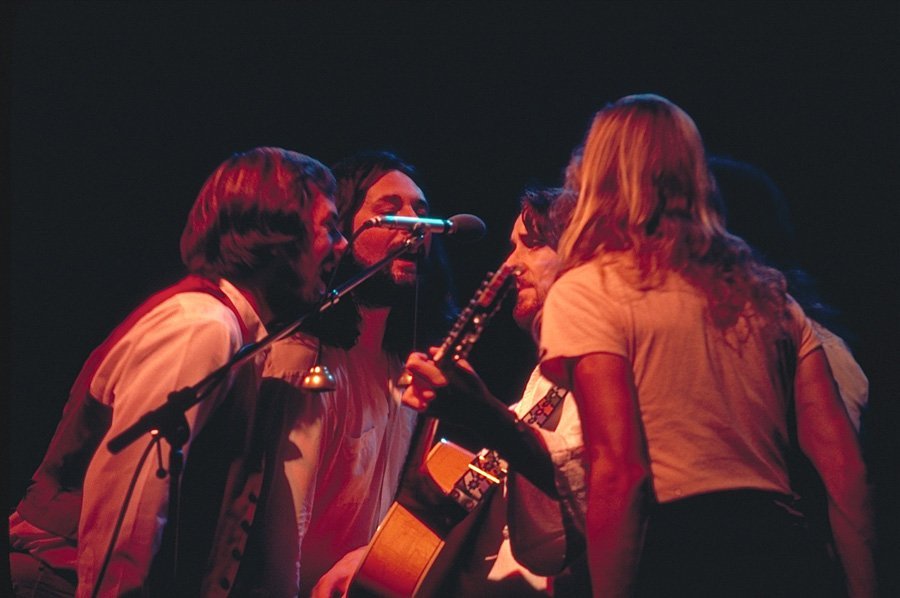
It is irresistible — and, on the evidence, not entirely fanciful — to hear the passage biographically. Hodgson has framed the song as his reply to Davies’ opener; the instrumental ending inverts the album’s etiquette, letting Davies have the last extended word after Hodgson’s lyric has had its say. The effect in concert was even more pointed: two men at two keyboards on the same stage, trading the closing minutes of the closing song, while twenty thousand people watched the partnership perform its own diagram. No rancour is audible. If anything, the playing is exuberant, even affectionate — which is what makes the biographical hearing so poignant. Whatever the song’s lyric was about, its ending is about two musicians who still, in 1979, completed each other.
Helliwell, characteristically, got the final sound. His saxophone coda came with a technical footnote he enjoyed retelling decades later: it was the only time in his Supertramp career, he explained in a 2020 interview, that he used the saxophone to trigger a synthesizer, so that the horn the listener hears is doubled by a synthesized voice breathing with it. There was no saxophone solo in the body of the song; after the piano passage, the sax takes over and carries the album out. Helliwell noted, with the satisfaction of a man whose smallest contributions turn out to be load-bearing, that he still hears “Child of Vision” on deep-track radio from time to time, and that it is always a welcome listen. The master of ceremonies had been given the curtain call.
Buried at the End of a Blockbuster
The commercial context of “Child of Vision” is difficult to overstate. Breakfast in America, released in March 1979, spent six weeks at number one on the American album chart, sold in the tens of millions — estimates of its worldwide total run past twenty million copies — and won two Grammy Awards, for its engineering and its packaging, while being nominated as Album of the Year. Its singles were inescapable: “The Logical Song” reached the American top ten, “Goodbye Stranger” and “Take the Long Way Home” followed, and the title track became a British top-ten hit. “Child of Vision” was never a single anywhere. It did not need to be. It rode at the back of one of the best-selling albums of its era, and was therefore heard, in full, by more people than most hit singles ever reach.
Placement, in the album era, was meaning. A closing track on a blockbuster was not a burial; it was an enshrinement, the song the listener carried out of the record and into the silence after it. Supertramp understood this grammar better than anyone — they had ended Even in the Quietest Moments… with “Fool’s Overture” — and they used it consistently: the closer was where the album showed its soul. “Child of Vision” is the soul of Breakfast in America: the moment the fun album stops smiling and says what it thinks. That the saying is followed by three minutes of wordless interplay only deepens the effect. First the sermon, then the sound of the congregation arguing happily among themselves.
The track also survived the band’s live machinery intact. On the 1979 tour it closed the album sequence in concert as it did on record, and the performance preserved on the Paris recordings from December of that year — the source of the live album Paris and, in restored and expanded form, the Live in Paris ’79 reissue — shows the closing duel working exactly as designed, the saxophone carrying the hall away. An album track with no single, no video and no chorus built for radio had become a concert institution by the sheer force of its placement and its playing.
The Handshake and the Lawsuits
The battles behind “Child of Vision” did not end when the tape stopped. Hodgson’s departure in 1983 divided the catalogue between the man who had written most of its biggest songs and the band that still carried the name, and the joint credit line — once the partnership’s constitution — became its most contested inheritance. Hodgson has said for decades that his exit rested on a spoken agreement about the songs; the Davies-led Supertramp’s continued performance of Hodgson compositions such as “The Logical Song” and “Take the Long Way Home” became, in his telling, a broken promise. Davies and his representatives have told the story differently. The dispute was never only about money. It was about whether the two names on the credit line described a merger or a marriage — and what, after the divorce, each party was owed.
The paperwork generated its own aftershocks. The royalty-sharing arrangement dating back to the band’s classic era — under which songwriting income was shared with the other members of the line-up — became the subject of litigation in the United States in the 2020s, when Helliwell, Siebenberg and Thomson sued over the withholding of royalties, and the fight climbed as far as a federal appeals court. However one assigns the rights in those proceedings, their existence proves the song’s underlying point from the other direction: the utopia of the joint credit, in which everything was shared and nothing was itemised, contained the seeds of forty years of accounting. Hodgson’s lyric asked what a man’s possessions were doing to his soul. The catalogue’s afterlife asked what the soul’s work was worth in possessions. Neither question has ever been answered to everyone’s satisfaction.
For the listener, the practical consequence was a divided stage. Two Supertramps effectively existed in the culture: Davies’ touring band, custodians of the name and the full catalogue; and Hodgson, touring under his own name with the songs he had written, “Child of Vision” among the deep cuts his audiences treasured. Rick Davies’ death in September 2025 closed the personal story with the partnership unreconciled in public — and sent listeners back, in enormous numbers, to the records where the two men still play together. A very large share of that listening begins at the hits and ends, as the album always intended, with the argument at the end of Breakfast in America.
The Deep Cut That Wouldn’t Die
A closing track with no single release has only one route to posterity: it has to be the song people play when the hits are finished. “Child of Vision” took that route and kept it. It was there at the road’s end of the classic band’s defining live document — the Paris concerts of December 1979, issued first as the double album Paris in 1980 and returned to, decades later, in the expanded Live in Paris ’79 editions that restored the full show, closing track included. Each generation of Supertramp reissue has re-presented it: the 2010 remaster programme for Breakfast in America, the deluxe editions with their period live material, the half-speed mastered vinyl of the peak-era albums. The sermon at the end of the fun album turned out to be one of the album’s most durable assets.
Hodgson took it with him. In his solo career, where the setlists are built from the songs he wrote for Supertramp, “Child of Vision” has remained a fixture — the deep cut his audiences ask for by name, the one that lets him restage the old duel with session players where Davies once sat. That it works without Davies is a tribute to the writing; that every listener hears the absence is a tribute to the recording. The Davies-led Supertramp, for their part, kept the name and the catalogue in front of arena audiences for years, so that the song existed, as everything in this band’s afterlife existed, in two versions at once: the letter and the reply, still touring in opposite directions.
Its reputation among musicians may be the surest sign of life. Helliwell’s fondness for it is on record; keyboard players cite the Wurlitzer figure; producers cite the room it leaves inside a dense mix. The track is regularly named, in polls and essays about the band, as the connoisseur’s Supertramp recording — the one you play to a sceptic who thinks the band was all jingles. There is a pleasing circularity in that. The album the group insisted was merely fun acquired, at its very end, the song that proves how serious they were; and the song that may have begun as one partner’s private worry about the other became the public’s favourite evidence that the partnership, at its best, was unmatchable.
Why It Endures
“Child of Vision” endures, first, as music. Strip away every layer of biography and it remains one of the great closing tracks of the album era: a funk groove of unusual elegance, a lyric sung with genuine urgency, and an instrumental second half that builds, breathes and dissolves with the confidence of a band that knew exactly how good it was. Album tracks are supposed to be the filler between the singles. This one is the reason listeners who bought Breakfast in America for “The Logical Song” were still playing the whole record decades later, and it is the track that musicians, Helliwell included, single out when they want to explain what the band could do.
It endures, second, because its warning aged into a description. Hodgson wrote about a civilisation falling in love with its screens and its possessions when the screen in question was a television set in the corner of the room. The song did not predict the smartphone; it did something better — it identified the posture, head bent toward the glowing box, wealth accumulating around an absent centre, that every subsequent device would inherit. Played today, “Child of Vision” does not sound like a period piece about 1979. It sounds like a letter that arrived early.
And it endures, finally, because of those last three minutes. The history of rock is full of bands whose members stopped speaking; it has far fewer recordings of the exact moment when speech was still possible and music was still a common language. In the closing passage of “Child of Vision,” Hodgson’s Wurlitzer holds its ground, Davies’ piano answers at length and with love, and Helliwell’s saxophone leads them both out of the song and out of the album, together. Whatever the lyric was accusing, whomever it was accusing, the playing refuses the accusation’s finality. The rebuttal at the end of the record turns out, on the deepest listening, not to be a rebuttal at all. It is the partnership’s last full conversation — and it is still going on, every time the needle reaches the end of side two.
That may be the deepest reason the song has outlived the circumstances that produced it. Plenty of albums end with a summary; this one ends with a relationship, caught in the act of being itself — divided in philosophy, united in craft, each man giving the other room to be heard. Supertramp would make richer albums by the ledger and bigger ones by the charts, but they never again made a record whose final minutes contain its whole story. “Child of Vision” is a sermon that dissolves into a duet, an accusation that dissolves into affection, a closing track that refuses to close. The battles behind it were real, and some of them were never settled. The song is what the battles were for.