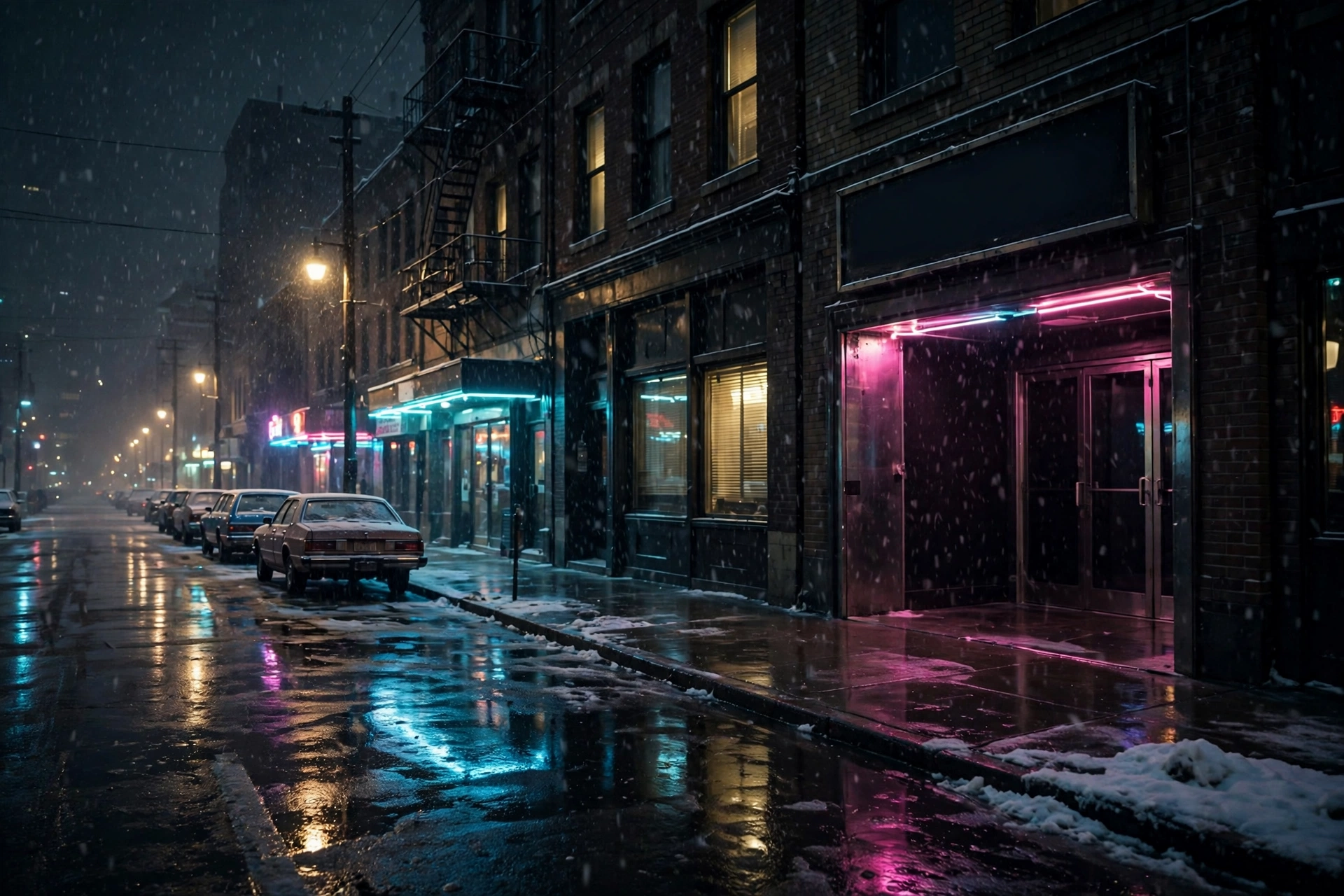
Close your eyes and imagine a city in winter. Snow on the sidewalks, cold air off the Mississippi, and inside a downtown club, a band playing music that sounds like summer in another country: drum machines snapping, synthesizers glittering, a guitar cutting through the beat like a knife. That contradiction — a cold Midwestern city producing some of the hottest, most danceable music of the decade — is the heart of the Minneapolis Sound, the musical world that Prince built in the early 1980s and that, for a few years, seemed to be coming out of every radio in America.
Minneapolis was not supposed to be a pop capital. In the late 1970s, the American music industry ran through Los Angeles, New York, and Nashville, and a young musician from Minnesota had to work harder to be heard. Prince turned that distance into an advantage. Working in Minneapolis studios, away from the industry’s daily pressures, he developed a sound that did not belong to any single genre or city. It took the rhythmic drive of funk, the guitar energy of rock, the melody of pop, and the electronic textures of the new wave, and fused them into something that sounded both futuristic and familiar. The result was music you could dance to, sing along with, and recognise within seconds, even on a car radio in a traffic jam.
The ingredients of the sound are worth describing, because they were so distinctive. At its centre was the drum machine, which gave the music a crisp, almost mechanical pulse, very different from the loose, live drumming of traditional funk bands. Over that pulse sat layers of synthesizers: bright, sometimes icy, sometimes warm, carrying melodies that a horn section might once have played. The guitar, when it appeared, was sharp and rhythmic, often playing short, punched phrases rather than long solos, though Prince himself could unleash a full solo whenever a song demanded it. The bass, when present, was often played on a synthesizer rather than a bass guitar, giving the low end a smooth, rounded quality. And over everything sat Prince’s voice, which moved between a soft falsetto, a conversational tone, and a full-throated shout, sometimes within a single line. Put together, the sound was polished but not cold, electronic but not robotic, and danceable without ever sounding like a formula.
What made it a “sound” rather than just one artist’s style was that Prince shared it. In the early 1980s, he wrote, produced, and played on records for other Minneapolis acts, giving them songs and a production style that carried his fingerprints. The Time, a funk band built around sharp suits, humour, and dance routines, became the most famous of these projects, with records that sounded like Prince’s own work filtered through a party band’s energy. Vanity 6, an all-female trio, carried the same electronic funk into a more pop direction. Sheila E., a percussionist and singer, brought the sound to a wider audience with her own hits in the mid-1980s. Each of these acts had its own identity, but listeners could hear the shared DNA: the drum machines, the synthesizers, the Minneapolis polish. For a few years, buying a record from any of these artists felt like buying another chapter of the same story.
The musicians around Prince were part of the story too. His own band, The Revolution, grew into a tight, versatile group that could move between funk, rock, and pop on stage without losing the thread. Members of The Time went on to become one of the most successful production teams of the decade, carrying lessons learned in Minneapolis into studios across the country. The clubs of Minneapolis, above all the downtown venue First Avenue, became legendary in their own right: the room where Prince and his circle tested new songs in front of a live audience, where a band could find out in one night whether a groove worked or fell flat. Fans who made pilgrimages to Minneapolis in the mid-1980s often headed straight for that club, hoping to stand in the room where the sound had been born.
The influence of the Minneapolis Sound spread quickly, and it can be heard in the pop and R&B records of the later 1980s, where drum machines, synthesizer bass, and crisp electronic production became the default rather than the exception. That is a common fate for a genuinely new sound: first it seems strange, then it seems everywhere, and finally it seems obvious, as if pop music had always sounded that way. But in the early 1980s, it was not obvious at all. It took a musician working far from the industry’s centres, with the confidence to blend genres that radio liked to keep apart, to make electronic funk sound warm, funny, and human all at once.
For fans, the Minneapolis Sound is also a memory of a place. Many listeners have never been to Minneapolis, but they carry a picture of it in their heads from the music: a cold city with hot clubs, a downtown of neon and snow, a community of musicians who dressed sharply, played hard, and treated pop music as both a joke and a serious art. That picture may be partly myth, as all musical myths are, but it captures something real about how Prince worked. He built a world around himself — a band, a circle of collaborators, a home studio, a favourite club — and then invited the rest of the country inside it.
So here is the question for you. When you hear that crisp drum machine beat and those bright synthesizers, do you think of Minneapolis, or does the sound just feel like the 1980s itself? Did you discover Prince first, or did you come to him through one of the Minneapolis acts around him? And if you ever visited First Avenue, or dreamed of doing so, what did the room feel like? Tell us, because for millions of fans, the Minneapolis Sound is not just a production style. It is proof that a whole musical world can grow in the city nobody was watching.
About the author: Tommy Hayes writes about the songs that defined America in the 1970s and 1980s. He grew up with a radio always on — in the kitchen, in the car, in a bedroom with posters on the wall — and he writes from that memory: what these songs meant then, and why they still matter now.
Keep reading:
- Purple Rain — The Album and the Film That Owned 1984
- When Doves Cry — The Hit With No Bass Line
- 1999 — The Double Album That Broke Prince Into the Mainstream
When Doves Cry
Prince · Original album era: 1984 · Official YouTube video
Played from the artist’s official YouTube channel. Availability may vary by country. Watch on YouTube ↗