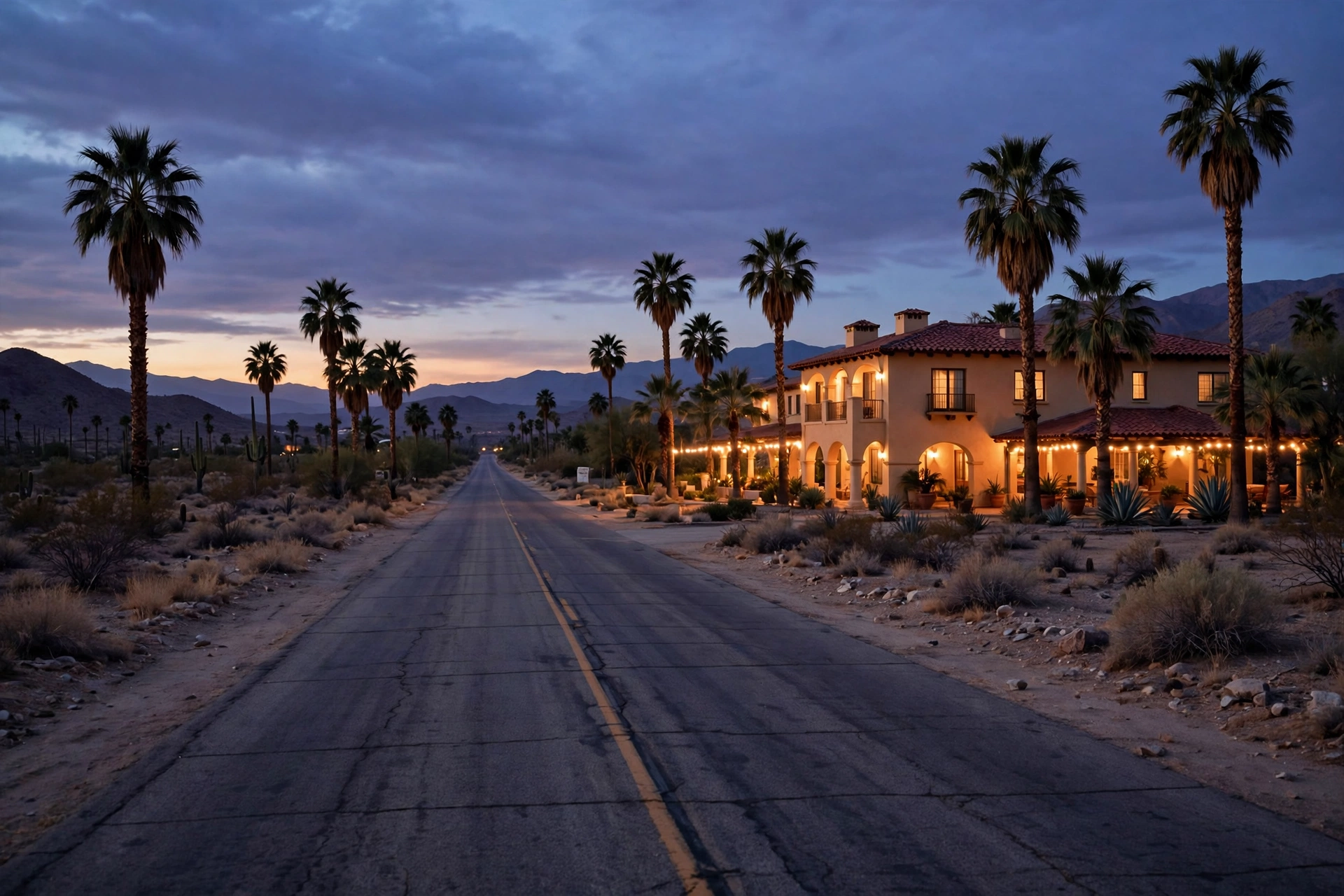
There is a hotel on the cover of the Eagles’ album Hotel California, and it is a real place — just not the place most listeners imagine. The photograph shows the Beverly Hills Hotel, its palm trees lit up against the dusk. It is a picture of glamour, not of menace, and that contrast is the whole point of the song.
For decades, listeners have tried to pin the song to a single literal location. One of the most persistent theories names the Camarillo State Mental Hospital in California, reading the song’s famous hotel as a coded version of the hospital. It is a vivid theory, and it is easy to see why it stuck: the song’s narrator checks in somewhere he can never leave. But the band has never confirmed it, and the evidence points elsewhere. The Camarillo reading remains what it has always been — a fan theory, not a confirmed fact.
What the band has said, repeatedly, is broader and, in its way, darker. “Hotel California” is a song about excess: about success, indulgence, and the price of a lifestyle that looks like paradise from the outside. The narrator arrives tired, is welcomed warmly, and slowly realises that comfort has become a trap. The hotel is not one building. It is the whole world of Los Angeles in the late 1970s — the parties, the deals, the applause — and the uneasy feeling that none of it can simply be walked away from.
The music tells that story as plainly as the words do. The song opens with a guitar figure that sounds like dusk settling over a highway, then builds, verse by verse, into something grander and more unsettled. Don Felder brought the original musical idea to the band; Don Henley and Glenn Frey shaped it into the finished song. That collaboration is part of why the track feels so layered: it is not one person’s vision, but three musicians pulling in the same direction, at least for one song.
Then comes the ending, and it is the part musicians still talk about. The closing guitar section is not a single solo but a duel: Felder and Joe Walsh trading lines, answering each other, pushing each other higher, until the song fades out mid-flight. It is one of the most celebrated guitar passages in rock, precisely because it sounds like a conversation — two players who know each other well enough to argue in notes.
The song arrived at a turning point for the band. Hotel California, the album, was the Eagles’ fifth studio record, released in December 1976, and the first to feature Joe Walsh as a full member. Walsh’s harder-edged guitar gave the band a new weight, and the album’s sound — polished, spacious, a little weary — captured a California that had moved past the sunny optimism of the early seventies. The band recorded in Miami and Los Angeles, working slowly over months, and the care shows: every harmony is placed, every guitar line has room to breathe.
It is also worth remembering how long the song is. At well over six minutes, it was far longer than a typical radio single of its era, and its structure is closer to a short story than to a pop chorus. There is no neat resolution, no final chorus that ties the meaning up. The song simply builds, wanders, and then dissolves into that long guitar conversation, as if the story itself cannot find a way out. Radio played it anyway, in full, because listeners demanded it — proof that a mysterious song can be more commercial than a clear one.
Over the years Henley has described the song, in interviews, as a journey from innocence to experience, and as a comment on the American dream as it looked from inside the music business: the wealth, the attention, the endless party, and the quiet realisation that success can become its own kind of confinement. That explanation fits the music better than any single address does. The hotel is not a building you can photograph. It is a condition — comfortable, seductive, and very hard to leave.
There is a pleasing irony in the song’s afterlife. A track about the hollowness of success became one of the most successful songs of its era, winning Record of the Year at the 1978 Grammy Awards and becoming a permanent fixture on classic rock radio. Listeners who first heard it as teenagers now play it for their own children, and each generation brings a new theory about what the hotel “really” is. That may be the song’s real secret: it was written vaguely enough, and honestly enough, that every listener finds their own version of the trap inside it.
Part of the confusion comes from the artwork itself. The front cover, photographed at sunset, shows a real hotel glowing warmly, while the music inside describes something far less welcoming. Listeners naturally try to join the two together, assuming the building on the cover must be the building in the song. But an album cover is a mood, not a map. The band chose an image of luxury at dusk because it captured the feeling they were writing about: beauty that is just beginning to darken. Once you see the cover that way, the song’s mystery stops feeling like a puzzle with a missing answer and starts feeling like the point.
So the next time the opening guitar figure starts, forget the hospital theory and forget the search for one true address. The Beverly Hills Hotel on the cover is real. The hotel in the song is something larger — a place you enter willingly, enjoy thoroughly, and discover, a little too late, that you cannot simply check out of. What is your version of that hotel? Tell us in the comments — and hear the full story, with the official track, in the first comment below.
About the author: Tommy Hayes writes about the songs that defined America in the 1970s and 1980s. He grew up with a radio always on — in the kitchen, in the car, in a bedroom with posters on the wall — and he writes from that memory: what these songs meant then, and why they still matter now.