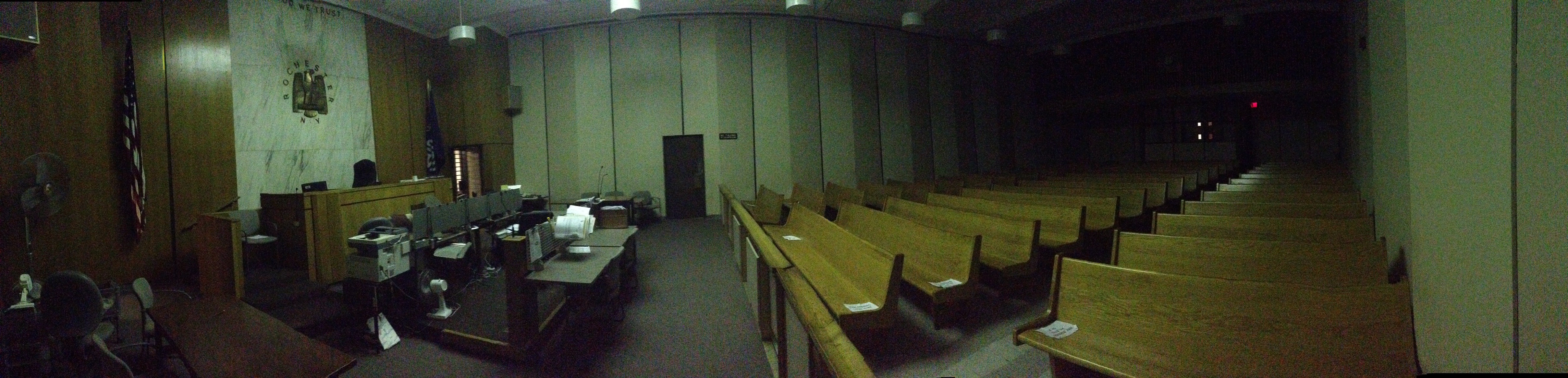
Photo: Bjengles3, CC BY-SA 4.0, via Wikimedia Commons.
Barbra Streisand as Claudia Draper, directed by Martin Ritt
Nuts, released in 1987 and directed by Martin Ritt, contains one of Barbra Streisand’s fiercest and least sentimental performances. She plays Claudia Draper, a high-priced call girl in New York who kills a violent client in self-defence and is then charged with manslaughter. Rather than face trial, her mother and stepfather, eager to avoid scandal, seek to have her declared mentally incompetent and committed to a psychiatric institution indefinitely. Claudia’s fight is therefore not only for acquittal but for the right to be judged as a sane, responsible adult — a premise that gives Streisand a role of unusual intensity and moral clarity.
The film, adapted by Tom Topor, Darryl Ponicsan, and Alvin Sargent from Topor’s stage play, is structured largely around a competency hearing. Claudia’s court-appointed lawyer, Aaron Levinsky, played by Richard Dreyfuss, initially doubts her, then comes to respect her intelligence and her refusal to play the role of a helpless victim. Opposing them are her mother Rose, played by Maureen Stapleton, and her stepfather Arthur Kirk, played by Karl Malden, whose respectable concern masks a long history of family damage, and the psychiatrist Dr. Herbert Morrison, played by Eli Wallach, who is convinced that Claudia’s defiance is itself evidence of illness. James Whitmore, as the judge, presides over a hearing that becomes a trial of Claudia’s character, her past, and her right to define herself.
Streisand’s Claudia is a revelation for viewers who know her primarily as a singer or a romantic star. She is angry, funny, profane, and exhausting — a woman who has learned to survive by talking fast, fighting hard, and refusing to be pitied. Streisand plays her without softening her edges: Claudia interrupts, she mocks, she weeps, and she testifies with a raw honesty that makes the courtroom scenes genuinely gripping. The performance is physically committed as well; Streisand researched the role by studying psychiatric patients and speaking with sex workers, and she brings a lived-in understanding of Claudia’s world that avoids both glamour and condescension. Her Claudia is not a symbol but a person, and that is why the film’s argument lands.
Richard Dreyfuss is an ideal counterpart. His Levinsky is weary, decent, and initially out of his depth, a public defender who has seen too many hopeless cases to expect a victory. As he listens to Claudia, his scepticism gives way to admiration, and their partnership — professional, combative, and ultimately trusting — provides the film’s emotional spine. The supporting cast is superb across the board: Stapleton’s Rose is heartbreaking as a mother whose love has curdled into control, Malden’s Arthur is chillingly respectable, and Wallach’s psychiatrist is neither a villain nor a fool but a professional whose certainty becomes a form of cruelty. The ensemble gives the hearing the weight of a real legal proceeding, not a theatrical exercise.
Martin Ritt, a veteran director whose career included Hud and Norma Rae, directs with a restraint that serves the material. He keeps the camera close, lets long scenes play without flashy cutting, and trusts his actors to carry the argument. The film’s origins as a stage play are evident in its dialogue-heavy structure, and Ritt does not disguise that theatricality; instead, he uses it, allowing the courtroom to become a space in which competing versions of Claudia’s life are tested. Flashbacks to Claudia’s childhood, including abuse by her stepfather, are handled with care, providing context for her anger without reducing her to a case history.
The film’s themes were ahead of their time in some respects and very much of their time in others. Its central question — who gets to decide whether a woman is sane? — connects to broader debates about women’s autonomy, mental health, and the legal system’s treatment of sex workers. Claudia’s insistence that she would rather stand trial for manslaughter than be declared incompetent is a radical claim: that dignity and self-determination matter more than safety or reputation. Streisand, who also produced the film and composed much of its music, clearly understood that claim personally, and her commitment to the project — she had campaigned for the role for years — is visible in every scene.
Commercially, Nuts was a modest success rather than a blockbuster, and critical opinion was divided, with some reviewers finding the film stage-bound and others praising Streisand’s performance as among her finest. She received a Golden Globe nomination for Best Actress, and the film has gained stature in retrospect as an example of a mainstream star using her power to make a difficult, adult drama. It also stands as a bridge to her later directing career: the seriousness, the attention to performance, and the willingness to tackle uncomfortable subjects would define The Prince of Tides and her subsequent work behind the camera.
For readers discovering Streisand through her musicals and romantic dramas, Nuts may come as a surprise — and that surprise is its value. It shows an artist in her mid-forties refusing to coast on past glories, choosing instead a role that demanded anger, vulnerability, and moral argument. Claudia Draper is not a likeable heroine in any easy sense, but she is an unforgettable one, and Streisand’s performance ensures that the audience, like the court, must take her seriously. In a career full of signature roles, Claudia stands as proof that Streisand’s greatest instrument was never only her voice, but her will.
One final note concerns the film’s place in the courtroom drama tradition. Unlike many legal films that build toward a triumphant verdict, Nuts builds toward a more modest and more meaningful victory: the recognition that Claudia is competent to face her own trial, with all its risks. That ending refuses easy catharsis, and it asks the audience to sit with an uncomfortable truth — that justice for a difficult, outspoken woman may begin not with acquittal, but with being heard. Streisand’s performance makes that argument without a speech about it, simply by insisting, scene after scene, that Claudia’s voice counts.