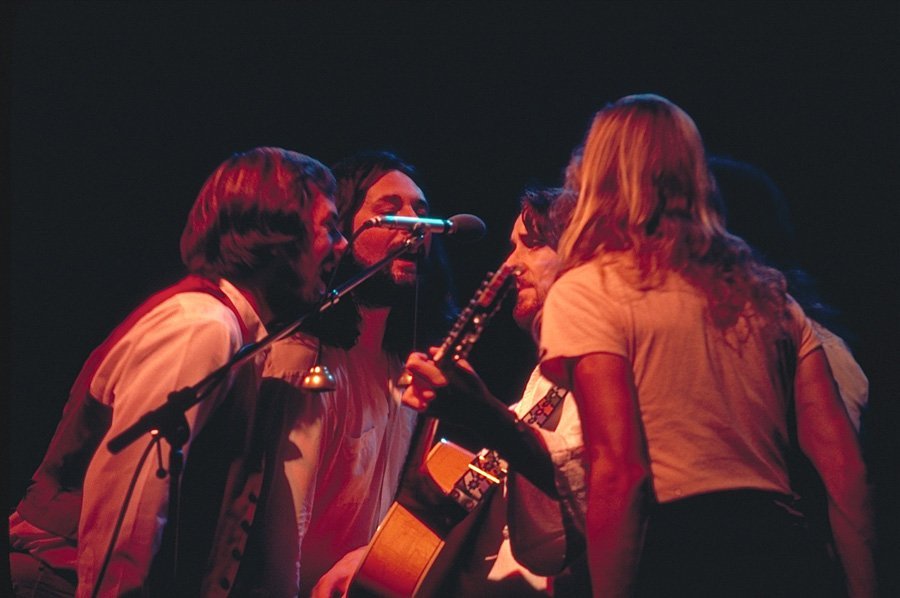
Every long-running band eventually faces the question of whether it can survive the loss of half its creative engine. For Supertramp, that question arrived in the spring of 1985, and the answer came in the form of a seven-minute opening track built — almost unbelievably — on a single chord. “Cannonball,” the lead single from Brother Where You Bound, was written and sung by Rick Davies, the keyboard player who now had to carry the band alone after the departure of co-founder Roger Hodgson. It is a song constructed like a dare: one chord, G minor, sustained for the entire track, with the interest supplied instead by rhythm, brass, piano figures and sheer momentum. Davies later explained the experiment with disarming simplicity: “I did it simply to see if it could be done.” It could — and the result became Supertramp’s last American Top 40 hit.

Life After Roger
Supertramp had been built, since 1969, on the creative tension between two very different songwriters: Davies, earthy and blues-rooted, and Hodgson, the high-voiced author of “Dreamer,” “Give a Little Bit” and “The Logical Song.” Together they had made Breakfast in America (1979) one of the best-selling albums of its era. But after the 1982 album …Famous Last Words…, Hodgson left to pursue a solo career, taking his voice, his guitar and half the band’s songwriting with him. Davies was left to explain the split to a confused public and to decide whether Supertramp continued at all.
He decided it would — as a four-piece, with himself handling all of the songwriting and lead singing. There were rumours that the new material began life as a Davies solo project, but the album that emerged, Brother Where You Bound, was unmistakably a band record, and a deliberately ambitious one. Rather than chasing the radio pop of Famous Last Words, Davies steered Supertramp back toward the progressive textures of Crime of the Century and Even in the Quietest Moments, most dramatically on the sixteen-and-a-half-minute title track, which featured guitar solos by Pink Floyd’s David Gilmour, rhythm guitar from Thin Lizzy’s Scott Gorham and readings from George Orwell’s 1984. A&M launched the album in May 1985 with characteristic theatre, previewing it to a hundred VIPs on an overnight Orient Express journey from Paris to Venice. But the record still needed a calling card — a single that told radio the band was alive. That job fell to the album’s opening track.
One Chord, On Purpose
“Cannonball” is a study in how much music you can make while refusing to change the harmony. The entire song sits in G minor; where a conventional rock track would move to a chorus chord, Davies instead shifts the arrangement — dropping instruments out, bringing the brass forward, letting the piano riff mutate and the rhythm section push harder. The album version runs 7:38; the single edit trimmed it to 4:59, and the song’s B-side on the standard single was “Ever Open Door.” For club play there was even a ten-minute instrumental version on the 12-inch release, a format that suited a track whose pleasures are rhythmic rather than melodic. Listen to the fade of the LP version and you will hear the brass section quote the old jazz tune “Topsy,” a wink from a band whose roots were always as much in jazz and R&B as in rock.
The personnel underline the new order. Davies plays piano and synthesiser and sings lead; John Helliwell contributes saxophone and, unexpectedly, glockenspiel; Bob Siebenberg drums and Dougie Thomson plays bass. With no full-time guitarist in the band, the guitar chair on the track is filled by session player Marty Walsh, and Doug Wintz adds trombone to the brass punch. The production is credited to Supertramp with David Kershenbaum. The promo video, directed by Steve Barron, took a stranger route still: a caveman dreams of pursuing his runaway cavewoman to modern-day Grand Junction, Colorado, where she has gone to watch the band rehearse the song — and wakes to find her beside him in the cave.
Not About Roger
Given the circumstances, listeners immediately read the lyric as a message to the departed Hodgson: a singer washing his hands of someone, demanding how they could be so untrue. Davies has consistently denied it. In a French radio interview, he explained that the words were aimed not at his former partner but at an unnamed concert promoter he remembered as less than perfect. The correction matters, because it changes the song from a public feud into something more characteristic of Davies — a working musician’s grudge, dressed up as a dance track. Whatever its target, the accusation gives the single-chord groove its edge: the harmony never moves on, and neither, the lyric suggests, does the singer.

The Weight on One Pair of Shoulders
It is worth pausing on what “Cannonball” was being asked to do. For fifteen years, Supertramp’s identity had rested on contrast: Davies’s gravel against Hodgson’s choirboy tenor, Davies’s pub-band grit against Hodgson’s spiritual yearning, the two men trading lead vocals sometimes within a single song. With Hodgson gone, the contrast had to come from somewhere else — and on “Cannonball” Davies found it in the arrangement itself, setting his solitary piano and voice against massed brass, saxophone and synthesised textures, and swapping melodic development for rhythmic argument. The burden of delivering every song on the album fell squarely on him, and the single had to prove, in under five minutes on the radio edit, that the trade had been worth making. That it succeeded on three different American charts at once — pop, rock and dance — suggests the proof landed. The song does not apologise for the missing partner, imitate him, or look backwards at all; it simply accelerates. A cannonball, after all, is not a subtle object: it is heavy, blunt and entirely committed to its trajectory, and as a title for the first statement of the post-Hodgson era it was honestly chosen.
The Chart Run
Released as a single on 29 April 1985, ahead of the album, “Cannonball” did exactly the job it was built for. Its American chart run was a model of steady momentum: it entered the Billboard Hot 100 in late May and broke into the Top 40 within three weeks, climbing to its peak of No. 28 in early July 1985 and holding there for a second week before descending, with twelve weeks on the chart in total, seven of them inside the Top 40. Rock radio liked it even more: the track reached No. 4 on Billboard‘s Mainstream Rock Tracks chart, one of the strongest rock airplay showings of the band’s career. And in a twist nobody would have predicted for a progressive rock band in 1974, it crossed over to the clubs, peaking at No. 9 on the Hot Dance Club Play chart. Elsewhere it reached No. 24 in Canada and No. 25 in Switzerland, with more modest showings in the Netherlands, Germany and Australia.
A&M had given the album an unusually theatrical launch — the Orient Express preview trip to Venice included the debut of an expensive film commissioned for the record — and the rest of Brother Where You Bound justified the ambition in its own way. It is a compact album of just six tracks, and Davies followed “Cannonball” with a second single, “Better Days.” According to the band’s then-label A&M, the album went Gold in 1985, even though the RIAA has never formally certified it — a fitting footnote for a record that succeeded on its own terms rather than by the industry’s usual measures.
The album followed it home respectably: Brother Where You Bound peaked at No. 20 on the UK Albums Chart and No. 21 on the Billboard 200 — a clear step down from the Breakfast in America era, but proof of life. As Davies later acknowledged, the warm response to the new material, “Cannonball” in particular, encouraged the band to undertake their first tour without Hodgson. A comeback that might have been an embarrassment instead became a working band’s second act.
The Last Top 40
History has given “Cannonball” a distinction its makers could not have intended: it remains Supertramp’s last US Top 40 single. The follow-up album, Free as a Bird (1987), made little commercial impression, and after a long hiatus the Davies-led band returned in later decades as a touring institution rather than a chart act. That makes “Cannonball” the closing entry in one of the most unlikely hit-making stories in rock — a band formed in 1969, written off by 1972, reborn with Crime of the Century, split in half in 1983, and still, in 1985, capable of putting a one-chord, seven-minute progressive-jazz workout into the American Top 30, the rock Top 5 and the dance Top 10 simultaneously. The cannonball, it turned out, was aimed at anyone who thought Supertramp was finished.