Andy Williams / Behind the Songs
The Shadow of Your Smile: The Oscar Winner He Made His Own
Tony Bennett had the hit — but Williams had the album, the evening, and the last word.

The record in context
The song began as an instrumental. Johnny Mandel wrote the love theme for Vincente Minnelli’s The Sandpiper (1965), the Elizabeth Taylor–Richard Burton drama, and lyricist Paul Francis Webster was brought in to give the melody words — Johnny Mercer had been considered first, but the job went to Webster, already a two-time Oscar winner. The result, “The Shadow of Your Smile,” won the Academy Award for Best Original Song and then the Grammy for Song of the Year, beating the Beatles’ “Yesterday” for the latter. It is one of the most honored film songs ever written.
The famous recording belonged to Tony Bennett, whose version — arranged and conducted by Mandel himself — became the definitive hit. So what was Andy Williams doing naming an entire 1966 album The Shadow of Your Smile after somebody else’s song? He was doing what he always did: recognizing a great melody, refusing to be intimidated by it, and making it sound like it had been written for his voice all along. This was his established method with the Oscar winners — he had done it with “Moon River,” he had done it with “Days of Wine and Roses” — and the Mandel-Webster theme fit the pattern perfectly: a film song of unusual harmonic sophistication, waiting for a singer with the technique to unfold it.
Williams’s version never tried to out-Bennett Bennett. Where Bennett’s reading is all jazz phrasing and masculine ache, Williams’s is smoother, more reflective — less the lover in the moment than the man remembering the moment years later. It is the difference between a diary entry and a memoir, and it gave the song a second life in the easy-listening world, where it became a staple of his concerts and television performances for decades.
Listen closely
Start with the melody’s first turn, because Mandel wrote something harmonically unusual for a pop song of the era — the tune keeps slipping into unexpected keys, like light moving through leaves. Listen to how Williams navigates those shifts: no hesitation, no showing off, just a voice gliding from one harmonic color to the next as if the modulations were the most natural thing in the world. This is what separated him from the average television singer. The song is genuinely tricky, full of intervals that would expose a weaker vocalist, and Williams sails through them with the ease of a man reading a familiar letter.
Then listen for Webster’s lyric, which is doing something subtle and lovely. “The shadow of your smile when you are gone” — the song is about absence, about loving the memory of a face rather than the face itself. Williams, whose whole style was built on warmth rather than heat, was the ideal interpreter for that idea. He sings it like a man looking at a photograph: tender, a little sad, completely composed. On the line “will color all my dreams and light the dawn,” his voice opens just slightly — not a belt, just a widening, like a window being raised an inch — and then settles back into the song’s reflective close.
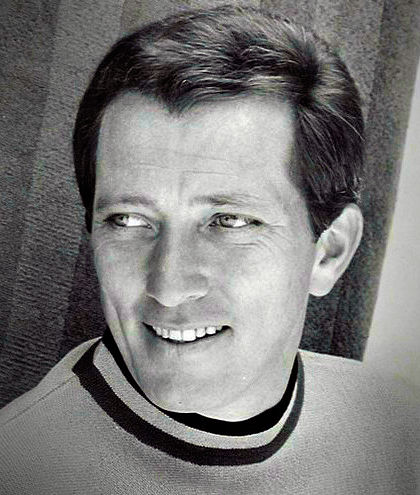
Finally, listen for what the song became in his hands: not a cover, but a companion piece. Bennett owned the hit; Williams owned the after-hours version, the one that plays in your head at midnight. He folded “The Shadow of Your Smile” into his repertoire the way you fold a favorite jacket into a suitcase — it simply went everywhere with him, because it fit. Decades later, when audiences heard those first notes, they thought of Andy Williams as readily as Tony Bennett. That is the quietest kind of conquest, and he specialized in it.
Put Williams’s version next to Tony Bennett’s and you hear two different philosophies of singing. Bennett bends the melody — he leans into notes, delays them, roughs up their edges with jazz phrasing, and the ache is in the friction. Williams does the opposite: he sings the line straight and true, holding each note at its center, and the ache is in the stillness. It is the difference between a hand gripping and a hand resting. Neither is better; they are two answers to the same question, which is what you do with a perfect melody. Bennett performs it. Williams inhabits it. And there is a case to be made that Williams’s stillness suits Webster’s lyric even more closely — a song about the shadow of a smile, after all, is about something seen indirectly, in soft light. His version is the one you play at midnight, when the day’s noise is gone and the memory is all that’s left.
Release and recording reference ↗
Artist discography ↗
Release context is sourced above. Listening observations are Past Tunes’ original interpretation, not quotations from the artist.
More from Andy Williams
The Oscar song he never released as a single, and sang for the rest of his life.
1963 / Behind the SongsCan’t Get Used to Losing You: The Rock-and-Roll Songwriters’ Crooner HitElvis and the Drifters’ songwriters wrote it; a crooner made it swing.
1963 / Behind the SongsDays of Wine and Roses: Two Oscars, One VoiceTwo Oscars for Mancini and Mercer, one definitive voice on the title song.
1963 / Behind the SongsIt’s the Most Wonderful Time of the Year: The Christmas Song That Waited Fifty YearsA modest seasonal album cut that took half a century to become a classic.
1964 / Behind the SongsAlmost There: The Almost-Number-One Britain Loved and America OverlookedAmerica barely noticed it; Britain took it to number two — a transatlantic near-miss.
1967 / Behind the SongsMusic to Watch Girls By: The Commercial Comeback Nobody PlannedA soda jingle turned into a pop hit — then a commercial turned it into a hit again.
1968 / Behind the SongsCan’t Take My Eyes Off You: The Crooner’s Cool CoverFrankie Valli’s tower of brass, rebuilt in velvet.
1971 / Behind the Songs(Where Do I Begin) Love Story: The Movie Theme That Brought Him Back to the Top 10The movie theme that carried a veteran crooner back into the Top 10.
1973 / Behind the SongsSolitaire: The Gambler’s ConfessionA gambler’s confession written by Neil Sedaka, delivered without a wink.