Andy Williams / Behind the Songs
Can’t Take My Eyes Off You: The Crooner’s Cool Cover
Frankie Valli’s tower of brass — rebuilt in velvet, at half the speed and twice the romance.
The record in context
The original was a skyscraper. “Can’t Take My Eyes Off You,” written by Bob Crewe and Bob Gaudio, was Frankie Valli’s 1967 solo smash — a record that starts as a tender ballad and then erupts, two minutes in, into one of the great brass explosions in pop history, with Valli soaring over it in full-throated falsetto. It reached number two in America and became the defining sound of blue-eyed soul at its most ecstatic. It is not, on paper, an Andy Williams song. It is loud, it is sweaty, it belongs to the street and the dance floor.
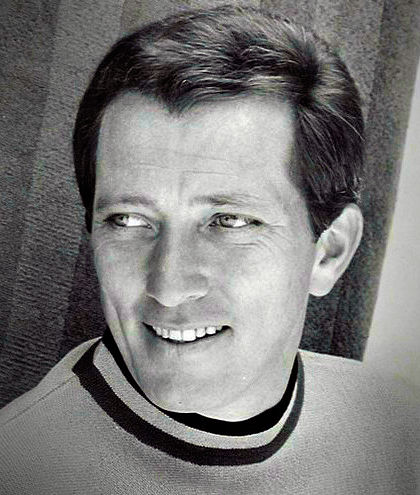
Williams recorded his version for the 1968 album Love, Andy, and the choice tells you everything about his confidence in that era. He was forty years old, a television institution, the host of the Grammys-to-be — and he was still listening to the radio. Where other crooners of his generation treated the new pop as a threat or a joke, Williams treated it as repertoire. He had done it with “Butterfly” in the rock-and-roll years; he did it again here, taking one of the defining hits of the late sixties and translating it into his own language.
The translation is the whole story. Williams slows the song down, cools it off, and turns Valli’s ecstatic shout into a lover’s murmur. His version never became an American single — it was an album track and a concert staple, and it charted in Britain, where his audience had always been more loyal to his interpretive side. But as a piece of musicianship, it is one of the most revealing records he ever made: proof that his style was not a limitation but a lens, and that almost any song in the world looked better through it.
Listen closely
Start with the tempo, because it changes everything. Valli’s version drives forward; Williams’s floats. He takes the song at a statelier pace, letting each phrase breathe, and the effect is to transform a declaration into a seduction. “You’re just too good to be true” — in Valli’s mouth it is a cry of disbelief; in Williams’s it is a quiet, confident observation, the sound of a man who has seen beautiful things before and is still stopped cold by this one. Listen for how he stretches the vowels, how “true” lingers just a beat longer than you expect. The romance is in the patience.
Then listen for what he does with the famous explosion. In the original, the middle section detonates — brass, drums, Valli’s falsetto climbing the walls. Williams refuses the detonation. His arrangement swells, certainly; the orchestra rises to meet the emotion. But he keeps his voice in its warm middle register, riding the wave rather than trying to outshout it. It is the most Andy Williams decision imaginable: where the song invites hysteria, he offers control, and the control turns out to be sexier. The famous “I love you, baby” refrain becomes less a shout from a fire escape than a whisper across a dinner table — and somehow it lands just as hard.

Finally, listen for what the cover reveals about the song itself. Strip away Valli’s brass and falsetto, and “Can’t Take My Eyes Off You” is revealed as a beautifully constructed ballad — a melody that works at any speed, in any temperature. Williams’s version is the proof. He didn’t steal the song from Frankie Valli; he showed that it was big enough for both of them. And in doing so he made a quiet argument for his whole career: that the crooner’s art was not the opposite of rock and soul, but another room in the same house.
The bravest moment comes in the famous “I love you, baby” section — the part where Valli’s original turns into a full-throated chant, brass blazing. Williams could have skipped it, or softened it into nothing. Instead he keeps it, and sings it the way he sings everything: warmly, steadily, at conversation volume raised just slightly, as if saying it directly to one person rather than shouting it to a stadium. It shouldn’t work. It works completely. The Love, Andy album was full of such translations — contemporary hits rendered in the Williams style — but this is the one that proves the method. A lesser interpreter would have been swallowed by the song’s famous arrangement. Williams simply refused to compete with it, and in that refusal found something the original never had: intimacy. Two men, one melody, two completely different love affairs.
Release and recording reference ↗
Release context is sourced above. Listening observations are Past Tunes’ original interpretation, not quotations from the artist.
More from Andy Williams
The Oscar song he never released as a single, and sang for the rest of his life.
1963 / Behind the SongsCan’t Get Used to Losing You: The Rock-and-Roll Songwriters’ Crooner HitElvis and the Drifters’ songwriters wrote it; a crooner made it swing.
1963 / Behind the SongsDays of Wine and Roses: Two Oscars, One VoiceTwo Oscars for Mancini and Mercer, one definitive voice on the title song.
1963 / Behind the SongsIt’s the Most Wonderful Time of the Year: The Christmas Song That Waited Fifty YearsA modest seasonal album cut that took half a century to become a classic.
1964 / Behind the SongsAlmost There: The Almost-Number-One Britain Loved and America OverlookedAmerica barely noticed it; Britain took it to number two — a transatlantic near-miss.
1966 / Behind the SongsThe Shadow of Your Smile: The Oscar Winner He Made His OwnThe Oscar-winning film theme he folded into his evening like a favorite jacket.
1967 / Behind the SongsMusic to Watch Girls By: The Commercial Comeback Nobody PlannedA soda jingle turned into a pop hit — then a commercial turned it into a hit again.
1971 / Behind the Songs(Where Do I Begin) Love Story: The Movie Theme That Brought Him Back to the Top 10The movie theme that carried a veteran crooner back into the Top 10.
1973 / Behind the SongsSolitaire: The Gambler’s ConfessionA gambler’s confession written by Neil Sedaka, delivered without a wink.