Johnny Cash / Behind the Songs
I Walk the Line: The Vow He Hummed Into History
Written backstage in under an hour as a pledge to his young wife — and the record that made Johnny Cash a star.
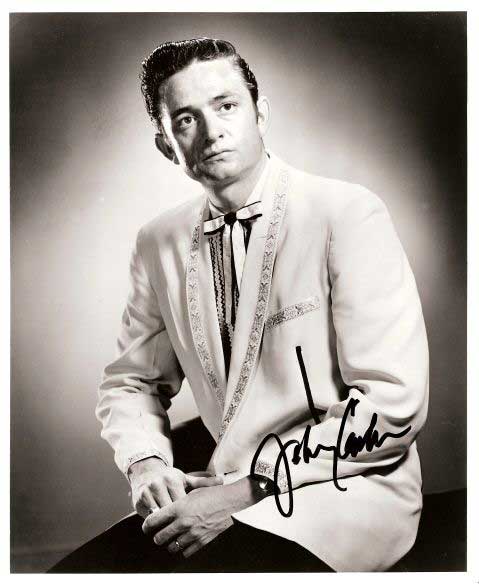
The record in context
In 1956 Johnny Cash was twenty-four years old, a Sun Records artist from Memphis with two modest hits behind him, a young wife at home, and the road stretching out in every direction. He had met Vivian Liberto in 1951 — she was seventeen, he was in Air Force basic training in San Antonio — and after three weeks of dating and three years of love letters while he served in Germany, they married on August 7, 1954, a month after his discharge. Now he was touring constantly, newly famous, surrounded by everything a young man on tour is surrounded by. Backstage in Gladewater, Texas, sometime that spring, he sat down and wrote a song in under an hour. “I suppose I was laying out my pledge of devotion,” he said later. He heard it as a slow ballad. His fellow traveler Carl Perkins heard the lyric and told him the title was sitting right there in it: “I Walk the Line.” And Sam Phillips, the Sun Records founder producing the session, heard it and wanted it faster — much faster. Cash argued, then gave in. The argument is the reason the record exists in the form we know.
The session took place on April 2, 1956, at Sun Studio in Memphis, and it could hardly have been simpler. No drummer, no piano, no embellishment — just the Tennessee Two: Marshall Grant on upright bass and Luther Perkins on lead guitar, the two mechanics Cash’s older brother Roy had introduced him to after his discharge. With no snare drum available, Cash slipped a piece of paper under his guitar strings near the tuning pegs to get a percussive snap — the famous boom-chicka-boom, a freight-train rhythm made from almost nothing. Phillips captured it dry and close, the voice right in your ear. The single was released on May 1, 1956, with “Get Rhythm” on the B-side — a pairing that now looks like the two halves of the Cash personality on one small disc: the moral vow on the A-side, the joyful shuffle on the flip.
What happened next was the making of Johnny Cash. “I Walk the Line” went to number one on the country chart and stayed there for six weeks, crossed over to number seventeen on Billboard’s Best Sellers in Stores pop chart, remained on the charts for more than forty-three weeks, and sold over two million copies. It was his first number one — the record that turned a promising Sun rockabilly singer into a star, the one that would follow him for the rest of his life. The honors accumulated over the decades: induction into the Grammy Hall of Fame in 1998, a place in the Rock and Roll Hall of Fame’s 500 Songs That Shaped Rock and Roll, and in 2014 the number-one spot on Rolling Stone’s list of the 100 greatest country songs of all time. Cash re-recorded it four times across his career — in 1964, live at San Quentin in 1969, for the 1970 film soundtrack, and in 1988 — but nobody, including Cash himself, ever improved on the Sun original. In 2005 the Hollywood biopic of his life took its title from it. A pledge of devotion written in under an hour became the most famous vow in country music.
There is an irony the song has carried ever since, and it’s worth sitting with. The vow was written for Vivian — “I keep a close watch on this heart of mine” — and the marriage did not survive the fame it helped create. The endless touring, the pills, the closeness with June Carter: Vivian filed for divorce in 1966, and years later she titled her memoir I Walked the Line, the past tense doing all the work. Cash would spend the rest of his life singing a pledge of fidelity to a woman he had left, in front of audiences who knew the whole story. That tension — the vow and the failure, the line walked and the line crossed — is part of why the record still feels so heavy. It isn’t a love song. It’s a man making a promise in public and daring himself to keep it.
Listen closely
Start with the chord progression, because it’s the strangest thing on any 1956 country record, and it came from a malfunction. Years earlier, stationed in Germany with the Air Force, Cash had a reel-to-reel tape recorder. Some of his buddies borrowed it, and when he played it back he heard guitar runs that had been recorded in one direction and played back in the other — backwards, circling, with a haunting organ-like quality. He filed the sound away in his memory. It crawled back out as the circling, off-kilter progression of “I Walk the Line” — chords that seem to orbit rather than resolve, learned from a machine running the wrong way. Most country songs of the era used three chords and went home. This one wanders, and the wandering is the point: it sounds like a man thinking his way through a promise, one step at a time.
Then the famous key changes — the song’s party trick and its soul. There are five verses, and the key changes between every single one: up and up through the keys, then back down, with the final verse landing a full octave below where the first began. Before each verse, Cash hums the new root note — a soft, almost private little hum, the most human sound on the record. Years later, performing it on his television show, he explained it with the least mystical answer in show business: “People ask me why I always hum whenever I sing this song. It’s to get my pitch.” No grand theory, no artistic statement — just a singer navigating a modulation no country artist had attempted, using a hum as his compass. Listen for those hums. They’re the sound of a man doing something difficult and refusing to pretend it’s easy.

Now the rhythm section — all two pieces of it. Luther Perkins plays with his palm muting the strings, producing the “boom-chicka” chug, while Marshall Grant’s bass walks underneath and Cash’s paper-muted guitar supplies the snare snap. It’s the freight-train sound, and on this record it’s doing narrative work: the train is steadiness itself, relentless, unvarying, the musical equivalent of the vow in the lyric. Against that rigid pulse, Cash’s vocal is strikingly calm — a deep baritone stating facts rather than pleading. “I keep my eyes wide open all the time.” He doesn’t sing it like a man tempted; he sings it like a man who has decided. The tension between the churning rhythm and the still voice is the entire drama of the record, and Sam Phillips was right about the tempo: at ballad speed it would have been a hymn, but at this clip it’s a march — a man walking, as promised.
Finally, listen to the lyric as a whole, because it’s doing something quietly radical. Most 1950s love songs were about devotion as a feeling; this one is about devotion as a discipline. “You’ve got a way to keep me on your side / you give me cause for love that I can’t hide / for you I know I’d even try to turn the tide.” Every verse is a restatement of the same contract, and the key changes keep raising the stakes — each verse a little higher, a little harder, until the final verse drops an octave, exhausted, home. It’s a love song structured like an endurance test. And Cash sings the last verse — back where he started, an octave down — like a man who kept the promise for exactly as long as the song lasts. Three minutes of fidelity, perfectly kept, and then the record ends, and real life resumes. That’s why we still listen: not because the vow held, but because for two minutes and forty-five seconds, it absolutely did.
Release and recording reference ↗
Release context is sourced above. Listening observations are Past Tunes’ original interpretation, not quotations from the artist.
More from Johnny Cash
A freight-train rhythm from Sun Records that made a 23-year-old the voice of every inmate in America.
1963 / Behind the SongsRing of Fire: The Song That Came to Him in a DreamJune Carter’s forbidden-love confession, her sister’s flop single, and the mariachi horns Johnny dreamed.
1967 / Behind the SongsJackson: The Duet That Made a Marriage SingJune and Johnny sparring on record in 1967 — two voices that couldn’t stay away from each other.
1969 / Behind the SongsA Boy Named Sue: The San Quentin ShowstopperShel Silverstein’s barroom poem, roared before 2,000 inmates, and a number-two pop smash.
1970 / Behind the SongsSunday Mornin’ Comin’ Down: The Song the Network Didn’t WantKris Kristofferson’s hungover hymn, sung on ABC television with the drug lyric intact.
1971 / Behind the SongsMan in Black: The Reason for the BlackIn 1971 he explained the wardrobe — and turned a stage costume into a moral statement.
1979 / Behind the SongsGhost Riders in the Sky: The Cowboy Song He Was Born to SingA 1948 western standard, reborn in 1979 by a voice like thunder on the prairie.
2002 / Behind the SongsHurt: The Farewell in the Ruined MansionA Nine Inch Nails song, a decaying house full of memories, and the most devastating video ever made.
1965 / Behind the SongsThe Long Black Veil: The Murder Ballad He Sang From Beyond the GraveAn innocent man chooses the gallows over the truth.