All We Hear Is…: The Battles Behind Queen’s ‘Radio Ga Ga’
In the back of a car in Los Angeles, a three-year-old boy listened to a song he did not like on the car radio and delivered his verdict in the mangled English of toddlerhood: “radio ca ca”. His father, who happened to be the drummer in one of the biggest rock bands on earth, heard something his son did not intend — he heard a title, a rhythm and an argument. Within months that playground insult had become “Radio Ga Ga”, a synthesizer-driven lament for the golden age of radio that climbed to number one in nineteen countries, rebuilt Queen’s career at the moment it was wobbling, and produced the most famous piece of audience choreography in rock history: tens of thousands of hands raised over tens of thousands of heads, clapping in perfect time, at a concert staged to feed a starving continent. It is one of the great improbable journeys in pop — a song about an old medium, written by the band member least associated with hit singles, nearly kept for a solo album, and reconstructed by a singer who saw, before anyone else, exactly how big it could be.
The battles behind it ran in every direction at once. “Radio Ga Ga” had to survive its own band first: it began as Roger Taylor’s private experiment, locked away with a drum machine for three days, and only became a Queen record because Freddie Mercury dismantled it and rebuilt it while its author was away on a skiing holiday. It had to fight the times it was born into, because it was a defence of radio released into the teeth of the MTV revolution, by a band who were themselves pioneers of the music video — and it did so, perversely, with the most electronic arrangement Queen had ever put on a single. It had to fight the critics, who heard a great rock band surrendering to the synthesizer. And in Britain it had to fight Frankie Goes to Hollywood, whose “Relax” sat on top of the chart like a stone and would not move. That it won nearly all of those fights — and turned the one it lost, in America, into a thirty-year slow victory — is why the song still opens stadium shows four decades later.
Radio Ca Ca
The phrase came first, and it came from a child. Taylor was living and working in Los Angeles in 1983 when he heard his three-year-old son Felix react to a song playing on the radio that the boy disliked. The toddler’s garbled judgement — “radio ca ca” — stuck in his father’s ear. Taylor was a drummer who had grown up, like everyone of his generation, with radio as the central nervous system of pop music: the comedy, drama and science fiction programmes, the voices coming out of the dark, the sense of a whole country listening to the same thing at the same time. By 1983 that world was visibly dying. Television had long since overtaken radio as the dominant medium, and now MTV, launched in 1981, was busy doing to the record business what television had done to the wireless — making the image matter as much as, or more than, the sound.
Taylor understood the shift from the inside, which is what gives the song its tension. Queen were not innocent bystanders in the video age; they had effectively helped invent the modern pop promo a decade earlier. Yet here was Taylor, provoked by his own son’s contempt for a radio song, finding that what he wanted to write was an elegy. “Radio Ga Ga” is a nostalgic defence of the radio format, framed as a commentary on television overtaking radio’s popularity and on how listeners once gathered around the wireless for a favourite comedy, drama or science fiction programme. It also addressed, head on, the advent of the music video and MTV, which was then competing with radio as the key medium for promoting records. Taylor put the anxiety plainly: “That’s part of what the song’s about, really. The fact that they [music videos] seem to be taking over almost from the aural side, the visual side seems to be almost more important.”
The lyric he built reaches deep into radio’s own mythology for its evidence. “Through wars of worlds, invaded by Mars” summons Orson Welles’s 1938 broadcast of H. G. Wells’s The War of the Worlds, the night radio proved it could panic a nation. “You’ve yet to have your finest hour” borrows the most famous sentence Winston Churchill ever spoke into a microphone, from his House of Commons speech of 18 June 1940. Taylor was stacking the case for the defence: radio had terrified America, rallied Britain, raised his generation. The ga-ga chorus — meaningless, infantile, closer to baby talk than to poetry — was the sound of what he feared it was all shrinking into.
Three Days Locked in a Studio
Having heard the phrase, Taylor did what he had learned to do with an idea he did not want to lose: he shut himself away with it. He locked himself in a studio for three days with a synthesizer and a LinnDrum drum machine, writing and developing the song alone. The tools matter. This was not a song sketched on an acoustic guitar or hammered out at a piano; it was assembled out of electronics — a Roland Jupiter-8 synthesizer, programmed drums, a Roland VP-330 vocoder colouring the voices — by a drummer thinking like a producer. The ga-ga refrain, the pulsing sequenced bass, the chant-like backing vocals: all of it was in the architecture from the beginning, because the song was quite literally built on machines.
At that point, “Radio Ga Ga” was not necessarily a Queen song at all. Taylor initially thought the track would suit his solo album — he was then working on Strange Frontier, his second record away from the band. The turning point came when the rest of Queen heard it. John Deacon, the band’s bassist and its quietest hitmaker, wrote a bassline for it. And Freddie Mercury, whose instincts for a hit were the most reliable instrument Queen owned, reconstructed the track, convinced it could be a big one. Mercury’s intervention was so thorough that the finished record is as much his arrangement as Taylor’s composition — yet the song remained credited to Taylor alone, because Mercury had acted as arranger rather than co-writer. It was a generous, very Queen arrangement of affairs: the drummer kept the credit, the singer took the song apart and put it back together stronger.
Then Taylor did the most trusting thing a songwriter can do: he left. He took a skiing holiday and let Mercury polish the song’s lyrics, harmony and arrangements in his absence. When the sessions proper began at Record Plant Studios in Los Angeles in August 1983 — the first and only time Queen ever recorded in North America — the band built the master on Mercury’s reconstruction. Fred Mandel, the Canadian session keyboardist who had played with Queen on the Hot Space tour, programmed the Jupiter-8’s arpeggiated synth-bass parts and contributed synthesizer arrangement and programming. Taylor sang all the backing vocals himself and ran his voice through the vocoder throughout; Brian May, the band’s guitar orchestrator, contributed a solo played with a glass slide, a brief flare of old-school Queen inside the machine music. The result was a record that sounded like the future while pleading for the past — and that contradiction was entirely the point.
A Eulogy Played on Machines
Listen closely to the finished record and the argument is embedded in the sonics. The foundation is not a drum kit but Taylor’s LinnDrum, ticking with metronomic indifference, while the bass — the part Deacon had devised as a line for a human bassist — was substantially realised through Fred Mandel’s programming of the Roland Jupiter-8, its arpeggiated synth-bass pattern looping beneath everything like a transmission that never stops. Over that grid, the band layered the human evidence: Mercury’s lead vocal, warm and pleading; a choir of backing vocals sung entirely by Taylor, stacked until one drummer sounded like a crowd; and the Roland VP-330 vocoder, smearing the title phrase into something half-sung, half-broadcast, as if the radio itself were answering.
That division of labour was new for Queen. The album’s credits for the track read like a manifesto of the band’s electronic period: Mercury on lead vocals, synthesizer and sampler; Taylor on acoustic and electronic drums, drum machine, vocoder, sampler and synthesizer; Mandel on synthesizer arrangement and programming; Reinhold Mack engineering. Brian May, whose layered guitars had defined the band’s sound for a decade, appears in the song essentially for one gesture — the glass-slide solo, a siren-like wail that cuts across the machinery like a voice from the band’s own past breaking into the frequency. Even Deacon, whose bassline was the song’s melodic spine, found his instrument partly absorbed into the synth architecture on the record, however fiercely he would reclaim it on stage.
The production was not a compromise imposed on the song; it was the song’s meaning, engineered. A record mourning the human intimacy of radio was delivered in the coldest, most automated language pop had yet developed, and the friction between the two is what makes it ache. When the vocoder intones the title, the listener hears the future Taylor feared: music as signal, voices as data. When Mercury then soars over it, unmistakably flesh and blood, the listener hears the rebuttal. Queen had spent the Hot Space period being accused of letting the machines win. On “Radio Ga Ga”, they made the machines testify for the prosecution and the defence at once.
A Comeback Built on a Graveyard
To understand why Queen gambled their comeback on their drummer’s synth record, you have to look at the hole they were in. Their previous album, Hot Space (1982), a lean into funk and dance music, had met a divided reaction and broken the band’s momentum, especially in America. In 1983 Queen did something they had never done: they stopped. A proposed South American tour collapsed amid equipment and promotional problems. Brian May went off to record the Star Fleet Project with Eddie Van Halen and friends. Taylor and Mercury began their solo albums. For the first time since the early 1970s, it was possible to wonder whether Queen had a future at all.
When the band reunited in August 1983 to make their eleventh studio album, everything had changed around them. They had nullified their recording deal with Elektra for the United States, Canada, Australia and Japan, and signed with EMI worldwide — The Works would be their first album for EMI, and their first to be released in the US by Capitol Records. The sessions split between the Record Plant in Los Angeles and Musicland Studios in Munich, running from August 1983 to January 1984. There were distractions: their manager Jim Beach offered them the soundtrack to the film The Hotel New Hampshire, the band agreed, found the film eating the album’s time, and let the project fall through; only Mercury’s “Keep Passing the Open Windows” survived onto the record. As recording began, Taylor gave the album its title and its mission statement in one sentence: “Let’s give them the works!”
The album they made was a deliberate restoration — the re-emergence of May and Taylor’s rock sound after the Hot Space experiment, but with the era’s electronics kept in the frame rather than banished. And by November 1983, before the album was even finished, the band had made their boldest decision: the first single would be “Radio Ga Ga”. It was the first time in Queen’s career that a song individually credited to Taylor had been chosen as the A-side of a single in their home country. The comeback would be led not by a Mercury ballad or a May rocker, but by the drummer’s elegy for radio, built on a drum machine. It was a risk that only makes sense once you hear how completely Mercury believed in it.
Fritz Lang, Gas Masks and a Favour Owed
If the song worried that video was swallowing music, Queen answered by making the most ambitious video of their career to that point — one that borrowed its imagery from a masterpiece of silent cinema. David Mallet’s video for “Radio Ga Ga” is built around footage from Fritz Lang’s Metropolis (1927), the German expressionist science fiction film whose cityscapes and machine halls had defined the visual idea of the future for half a century. The band are shown travelling through Metropolis and performing in a stylised recreation of its underground machine rooms, intercut with a family in wartime Britain, donning gas masks, taking shelter — and passing the time by listening to the radio. It was the song’s argument rendered in pictures: in the darkest hour, the wireless is what a family gathers around. At the end, the words “Thanks to Metropolis” appear on screen.
Getting that footage involved one of the strangest rights negotiations in pop history. The video was filmed at Carlton TV Studios and Shepperton Studios in London between 23 and 24 November 1983 and January 1984. Giorgio Moroder, the disco producer, was at the same time preparing a restored re-release of Metropolis with a contemporary rock soundtrack, and a trade was made: Mercury’s solo song “Love Kills” was used in Moroder’s version of the film, and in exchange Queen were granted the rights to use footage from it in the “Radio Ga Ga” video. But the exchange was not the end of it. Queen still had to buy the performance rights to the film from the copyright holder of the time — the communist government of East Germany. Somewhere in the transaction history of a Queen single sits a payment to the German Democratic Republic for the right to quote a film made in 1927.
The video received heavy rotation on the music channels and was nominated for Best Art Direction at the 1984 MTV Video Music Awards — an outcome rich in irony, since the song it promoted was partly a complaint about MTV’s takeover. But its most consequential invention was small and physical. In the choruses, the band clapped overhead in rhythm, a simple double-clap gesture anyone could copy. Audiences did. The clapping sequence that would soon become the song’s public signature was copied from the video, and it turned a lament into a ritual: from then on, “Radio Ga Ga” would not merely be heard at concerts. It would be performed by the crowd.
Number Two, Behind a Song Radio Wouldn’t Play
The single was released in January 1984, with May’s “I Go Crazy” — a song written in 1981 and recorded during the Hot Space sessions, then shelved — as its B-side. Around most of the world, “Radio Ga Ga” was an immediate and enormous hit: it reached number one in nineteen countries, among them Belgium, Denmark, Finland, Ireland, Italy, the Netherlands, Portugal and Sweden. For a band whose future had been an open question a year earlier, it was a restoration in a single stroke.
Britain, though, gave Queen a fight they could not quite win. The single entered the UK chart on 4 February 1984 and climbed to number two, where it stayed for two consecutive weeks from 11 February — unable to dislodge “Relax” by Frankie Goes to Hollywood. There is a pleasing symmetry in the blockage. “Relax” had become a phenomenon partly because the BBC’s radio establishment had tried to suppress it; it was the record radio would not play, sitting at number one. Immediately beneath it sat “Radio Ga Ga”, a record pleading radio’s case, kept off the top by the very notoriety that proved how much power radio still had to make and break songs. Phil McNeill of Number One magazine had predicted the outcome almost exactly, reasoning that no DJ could resist a record with “radio” in the title, and that the video pulled out enough expensive stops to push it to the top. He was right about everything except the final place.
The single’s formats tell their own story about 1984. Alongside the standard seven-inch, Queen issued a twelve-inch carrying an extended version of “Radio Ga Ga” and a full instrumental version — the club format of the era, designed for DJs, the very priesthood of the medium the song was defending. There is something fitting in the idea of the record being handed, in its longest form, to the people who talked over records for a living: Taylor’s elegy was partly addressed to them, the voices between the songs who had raised his generation, and the extended mix gave those voices a longer stretch of his band to introduce.
In the United States the story bent the other way. The single entered the Billboard Hot 100 on 18 February 1984 and peaked at number 16 on 7 April — respectable, but short of an American breakthrough, and freighted with a significance nobody knew at the time: “Radio Ga Ga” would be Queen’s final original single to reach the US top forty in Freddie Mercury’s lifetime on that chart. The band’s American decline, which the Works campaign could slow but not reverse, would deepen when the video for the follow-up single, “I Want to Break Free”, met a negative reaction in the States; Queen decided not to tour North America at all, and surrendered their position as one of the biggest-selling acts in the US. The pattern of the rest of their career was set by this single’s split result: colossal everywhere on earth except the one market that had once mattered most. The Works itself, released on 27 February 1984 in the UK, spent 94 weeks on the UK Albums Chart — the longest run of any Queen studio album — and sold over six million copies worldwide, with Europe leading the way.
“Someone Still Loves You”: The Argument in the Lyric
For all its machinery, the song’s real weapon is its tenderness. Taylor does not lecture radio; he talks to it, the way you talk to an old friend who has fallen on hard times. The verses describe the new world with weary precision — the shows and the stars consumed on video “for hours and hours”, a culture that “hardly needs to use its ears” as music changes through the years — and then the lyric does something genuinely unusual in pop: it reassures its subject. “Radio, someone still loves you.” The chorus’s baby talk, the ga ga and goo goo and blah blah, is not contempt for radio’s audience but a portrait of what the culture was being reduced to, set against that one plain sentence of devotion. It is a love song, addressed to a medium.
That is why the Churchill and Welles references are more than clever period colour. They are the witnesses Taylor calls to prove that the friend in the dock was once a giant: the voice that held a country together in its finest hour, the broadcast that panicked America from a Mercury Theatre microphone. Radio had been the twentieth century’s first mass intimacy, the box in the corner that spoke to millions as if to one. Taylor, born in 1949, had grown up inside that intimacy, and so had his audience — which is precisely why the song connected with people far beyond Queen’s fanbase. It was not nostalgia for a format. It was grief for a way of listening together, released at the moment music television was teaching the industry to sell to the eyes first.
The song’s descendants understood the argument even when they borrowed only its surface. When Lady Gaga took her name from it, she took the devotion as well as the nonsense syllables — her career, for all its visual maximalism, has been built on treating her audience as a congregation gathered around a voice. And when thousands of people at a Queen + Adam Lambert show perform the clap today, they are enacting the lyric’s thesis without knowing the words: the listener, addressed directly and trusted with a part to play, answers. Radio taught pop that lesson first. Taylor just wrote it down before the lesson was forgotten.
The Critics Fire Back
Success did not protect the song from its own side. The critical argument about “Radio Ga Ga” was really an argument about what Queen were allowed to become. Stewart Copeland of The Police, reviewing the single for Record Mirror, wrote that Queen had adopted the current “synthesizer sound” rather than remain “true to their form”, and wondered whether he was listening to “a Duran Duran clone group or a Japan clone group”, adding that Mercury’s singing “sounds like Bryan Ferry”. Charles Shaar Murray, in the NME, concluded that the song “just sounds like a lot of old noises borrowed from newer groups”. Writing in Number One in April 1984, guest writer Thomas Dolby — himself a synthesizer man, which makes the verdict stranger and sharper — called the song “banal”, and declared that “it’s terrible when such a talented band spend so much time making awful records”.
Read those reviews now and what stings in them is the accusation of betrayal: a guitar band, one of the great guitar bands, had made a hit out of sequenced bass, vocoder and a drum machine, and had the nerve to make it a complaint about modern media besides. The defence, mounted over the years, is that the electronics are the subject, not a surrender — that Taylor deliberately wrote a song about electronic media in the language of electronic media, and that the warmth the critics missed is located exactly where Taylor put it: in the voices, the choir of Taylors chanting the chorus, and in Mercury’s lead vocal pleading with an old friend not to die. Andy McCluskey of Orchestral Manoeuvres in the Dark, a man who knew something about synth-pop, gave the retrospective verdict from the other camp: he called “Radio Ga Ga” Queen’s best song, “a victory for the righteous side of electronic music”.
History has mostly settled this argument in the song’s favour, but the contemporary reviews matter because they mark the first of the song’s afterlives: before it was a stadium ritual, it was a controversy about authenticity. Queen had been accused of many things in the 1970s — excess, pretension, camp — but never of sounding like other people. “Radio Ga Ga” was the record that forced the question of whether a legacy band in 1984 should preserve its sound or argue with its era. They chose the argument.
The Song That Taught Stadiums to Clap
Queen began performing “Radio Ga Ga” on The Works tour in 1984, and it never left the show again. From 1984 to their final concert with Mercury in 1986, the band played it at every concert, positioned as the last song of the main set before the encores — the summit of the evening rather than a souvenir in it. The staging played with the lyric’s radio drama: Mercury would sing “you had your time” in a lower octave, reshape “you had the power, you’ve yet to have your finest hour”, while Taylor sang the pre-chorus in the high octave. On bootleg recordings from the era you can even hear John Deacon providing backing vocals — one of the very few occasions on which the famously silent bassist ever sang in concert. The song, in other words, had become enough of an occasion to draw a voice out of the one member of Queen who never sang.
Live versions from the 1984–85 tour were recorded and filmed for the concert films Queen Rock in Rio and Final Live in Japan, and the South American and Brazilian crowds in particular took to the clapping with a fervour that startled even the band. What the video had choreographed, the stadiums industrialised. Two hands above the head, on the beat, thousands of people moving as one body: the gesture was so simple and so visible that it stopped being accompaniment and became the performance. A song written in mourning for the communal experience of radio had accidentally invented a new one.
It is worth pausing on how unlikely this was. Ballads become singalongs; rockers become encores. But “Radio Ga Ga” was a mid-tempo electronic record about an obsolete medium, with a chorus of baby talk. Its transformation into the definitive Queen crowd moment happened because the song, beneath the elegy, is built like a rally: a verse that addresses an old friend directly, a pre-chorus that rises like a warning, and a chorus that hands the audience its lines and its movements at the same time. Taylor, the drummer, had unconsciously written for the one instrument he understood better than anyone in the band — the crowd’s sense of time.
Live Aid: Seventy-Two Thousand Pairs of Hands
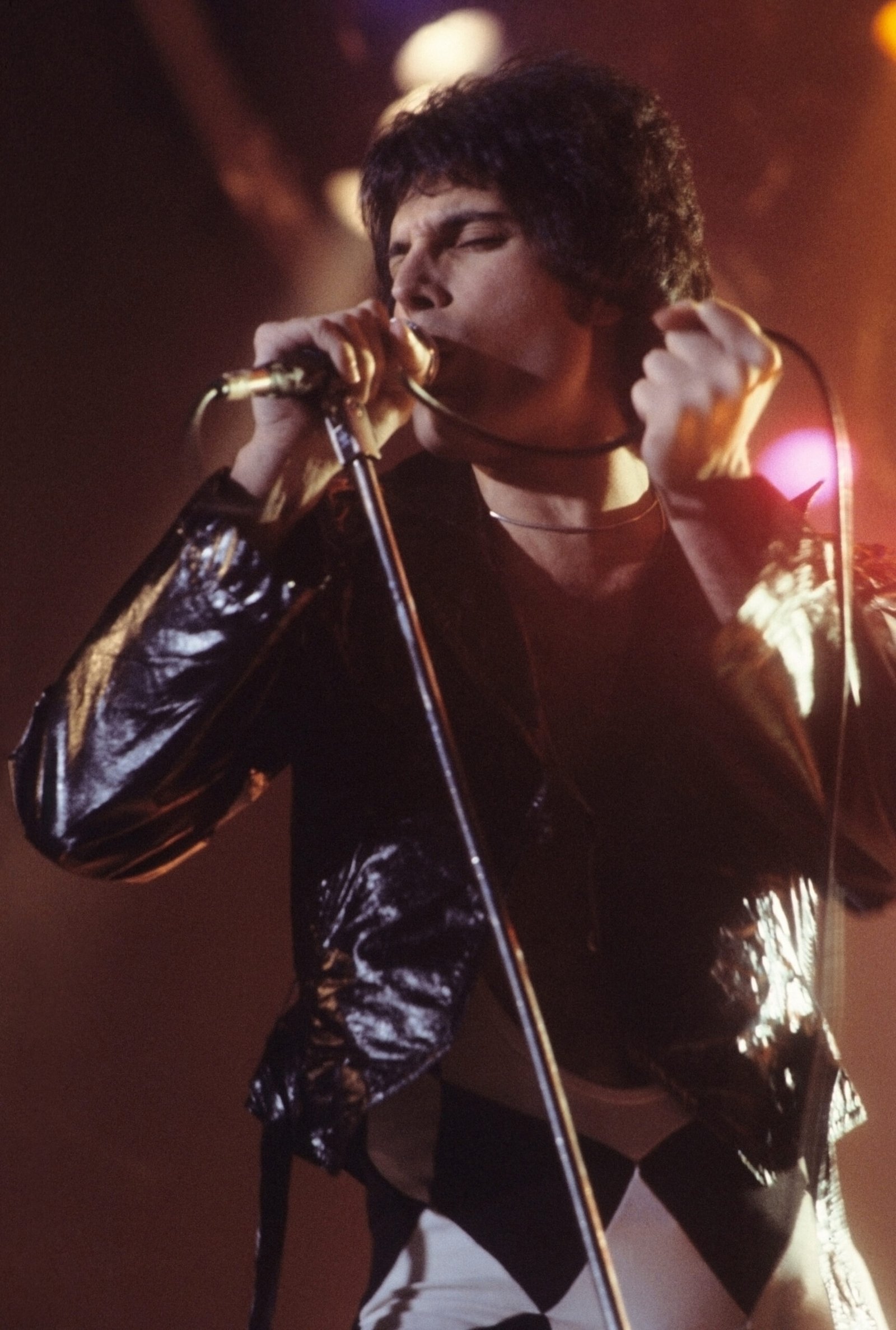
On 13 July 1985, Queen walked onto the stage at Wembley Stadium for Live Aid, the global concert for Ethiopian famine relief, as a band many had quietly written off — too unfashionable for the synth-pop present, too theatrical for the rock establishment. What followed is routinely called the greatest live performance in rock history, and “Radio Ga Ga” was its centrepiece. Queen played a shorter, faster version of the song as the second number of their set, straight after “Bohemian Rhapsody”, with Mercury singing all the high notes. At the choruses, 72,000 people clapped in unison, hands raised over their heads exactly as the video had taught them, and the aerial television shots of that synchronised crowd became the defining images of the entire day.
Consider what had happened to the song by that moment. A toddler’s gibberish had become a synth single; the synth single had become a chart hit; the hit had acquired a gesture from its own video; and the gesture, performed by 72,000 people at once and broadcast to a vast global television audience, had become proof of life — for the band, and for the communal, broadcast-age togetherness the lyric was mourning. The deepest irony of “Radio Ga Ga” is that its finest hour arrived on television, in the largest shared broadcast moment of the decade. Radio’s elegy was redeemed by the very medium it feared, in the most public way imaginable. When people who know nothing else about Queen imitate the band, they do not play air guitar. They raise their hands and clap, twice, over their heads. That is this song’s doing.
The afterglow carried straight into the final chapter of the Mercury era. A year later, on the Magic tour of 1986, Queen returned to Wembley twice, and the performance of “Radio Ga Ga” on 12 July 1986 was recorded for the live album Live at Wembley ’86. By then the clapping was no longer a feature of the show; it was a contract. The audience arrived knowing its part, and the band’s last great stadium summer was, in part, conducted by a song their drummer had nearly kept for himself.
After Freddie
Mercury’s death in November 1991 could have retired the song; instead, it became one of the principal vessels through which Queen’s music continued to be performed. At the Freddie Mercury Tribute Concert at Wembley Stadium on 20 April 1992, Paul Young performed “Radio Ga Ga” with the surviving members — a passing of the microphone that acknowledged the song as communal property. A decade later, at the Party at the Palace concert for Queen Elizabeth II’s Golden Jubilee in 2002, “Radio Ga Ga” opened Queen’s set, with Taylor himself on lead vocals and Phil Collins on drums: the drummer finally singing his own song at a palace, in front of a crowd doing his clap.
The song has been a fixture of every Queen incarnation since. On the Queen + Paul Rodgers tour of 2005–2006 it was sung by Taylor and Rodgers, a version officially recorded at the Hallam FM Arena in Sheffield on 5 May 2005 for the live album Return of the Champions. On the Rock the Cosmos tour of 2008, Rodgers sang it alone. And it remained in the show throughout the Queen + Adam Lambert era, including the Rhapsody tour of 2019–2024, where a singer born the year The Works was being recorded led arenas through a ritual devised before MTV had finished its third year on air. Few songs in the Queen catalogue have been so thoroughly adopted by every generation of the band’s own afterlife.
Its influence leaked outward, too, in one especially famous direction. The American singer Stefani Germanotta built her stage identity in the late 2000s and has explained that her name derives from this song: she “adored” Queen, and they had a hit called “Radio Ga Ga” — “That’s why I love the name”. Lady Gaga, the biggest pop star of the video-and-streaming age, is named after a record that worried video was killing music’s soul. Taylor could not have written a better punchline for his own song if he had tried.
Covers, Samples and a Slovenian Radio Show
The song’s recorded afterlife is as various as its live one. The American band Electric Six covered “Radio Ga Ga” on their second album, Señor Smoke (2005), recasting it as deadpan electro-rock; Brian May was reportedly a fan of their version. In 2023, the British rapper Che Lingo sampled the song for his single “My Radio”, on which Queen and Roger Taylor were credited as co-lead artists — a formal acknowledgement that the sample was not decoration but the record’s foundation. In Britain, the song’s position was consolidated early: it was placed on the compilations Greatest Hits II and Classic Queen, the two collections through which millions of younger listeners first mapped the band’s second decade.
The strangest tribute may be the most literal. In Slovenia, a satirical radio programme actually named Radio Ga Ga, hosted by Sašo Hribar, used the song for its opening and closing from its first broadcast in 1989 until its final broadcast on 8 September 2023, days before Hribar’s sudden death. For thirty-four years, a song nostalgic for radio’s golden age was the sound of an actual radio show beginning and ending — the medium answering its own elegy, weekly, for a third of a century. That is not the afterlife of a normal hit single. It is the afterlife of a song that became infrastructure.
Why It Endures
Every element of “Radio Ga Ga” was a risk that the era should have punished. It was written by the drummer, built on a drum machine, sequenced like a synth-pop record, released as a comeback single by a band accused of losing their way, and devoted to the sentimental proposition that radio — a medium its young listeners were abandoning — had not yet had its finest hour. Thomas Dolby called it banal; the NME heard borrowed noises; Frankie Goes to Hollywood kept it at number two; America let it stall at number sixteen and moved on. On paper, it is a footnote with a good chorus.
Instead it became the song Queen are physically remembered by. The reason is hidden in the song’s own lyric, which turned out to be a prophecy misread by everyone, including its author. Taylor wrote “you’ve yet to have your finest hour” as a plea to radio, a hope that the old medium’s best days were not behind it. What actually had its finest hour still to come was the song itself: at Wembley in 1985, in a sea of raised hands; at the tribute concert in 1992; in a Slovenian studio for thirty-four years; in the name of the century’s defining pop star. “Radio Ga Ga” endures because it solved, by accident, the problem it was complaining about. Television had broken the old togetherness of everyone hearing the same voice at the same time — so Taylor wrote a song that made everyone in a stadium move at the same time, and let television carry the picture of it around the world. All we hear is radio ga ga. All we see, still, is the crowd answering back.