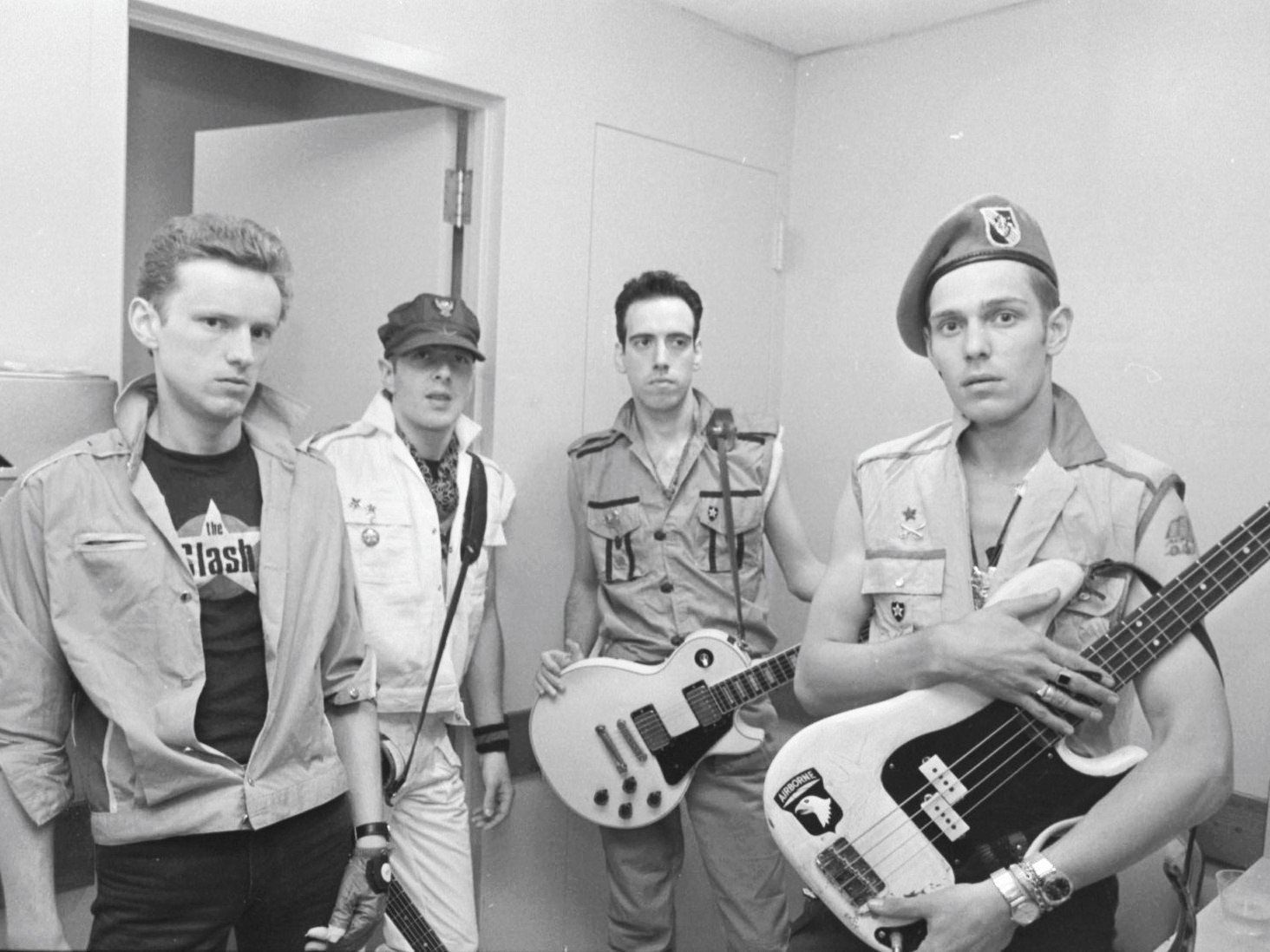
Bowie Played Backwards: The Battles Behind The Clash’s ‘Bankrobber’
It is the gentlest act of defiance The Clash ever released: a loping, sun-warmed reggae song about a bank robber who never hurt anybody, sung like a lullaby by a man whose father was, in real life, a diplomat. “Bankrobber” was recorded in two days in Manchester in February 1980, produced by a Jamaican radio legend the band had picked up on tour, and then — this is where the battle begins — refused by their own record company. The head of CBS UK listened to the gentlest act of defiance The Clash ever released and announced that it sounded like “all of David Bowie’s records played backwards.” The UK would not have it. So the Dutch released it instead, the imports flooded in, British fans bought it anyway, and the label that had buried it was forced, blushing, to put it out itself — at which point it climbed to No. 12 in the charts. The band’s revenge was complete except for one thing: the row killed the most ambitious plan of their career, a scheme to release a single every month for a year, and “Bankrobber” ended up as the only one that escaped.
The battles behind “Bankrobber” are not the usual Clash battles. There is no riot in this song, no barricade; its enemies are a calendar, a contract and a record-company chairman arguing with the band at Heathrow Airport while his dog waited with his chauffeur. But the stakes were the band’s whole philosophy. By 1980 The Clash had decided that the album-tour-album treadmill was a trap, that music should move at the speed of Jamaican sound systems and 1960s pop — fast, cheap, constant — and “Bankrobber” was the test case: an outlaw ballad cut on the road with Mikey Dread, priced to move, meant to be the first of twelve. That it became a hit anyway, by smuggling, is the most Clash outcome imaginable. This is the story of the song the label tried to bury, and of the two teenagers standing outside a Manchester studio who heard the drums through the wall and walked in — a pair of future Stone Roses, catching the exact moment when one generation of Manchester music handed something to the next.
A Single a Month
To understand why “Bankrobber” mattered so much to the men who made it, you have to understand what The Clash were trying to escape. In December 1979 they had released London Calling, a double album of such range and confidence that it had detonated the last of the “punk band” framing around them. The orthodox next move was the one the industry had scripted since the sixties: tour the album until it stopped selling, retreat, write for a year, return. The Clash had spent their whole career resenting that script. Their manager’s office wall and their interviews alike were full of the alternative gospel: the Jamaican model, in which producers like Lee Perry and Coxsone Dodd had fed the dancehalls a continuous stream of singles, music as news rather than monument; and the British pop model of their own childhoods, when the Beatles and the Stones had lived on the charts single by single, month by month.
So the band made a proposal that was modest in everything except its implications. Through 1980, they would release a single a month — twelve standalone 45s, recorded fast, sold cheap, keeping the band permanently present in the shops and on the radio in the spaces between albums. It was a plan about economics as much as art: singles were how working-class kids actually bought music, and the stand-alone 45 was punk’s original format, the one on which the band themselves had debuted. It was also, unavoidably, a challenge to CBS, for whom the album was the unit of account and a dozen one-off singles was a dozen small risks instead of one big one.
Paul Simonon, the band’s bassist, later gave the plan’s epitaph in the band’s own oral history, The Clash by The Clash: “We decided that we wanted to release a single a month, and the first one we put forward was ‘Bankrobber.’” The choice of first exhibit was deliberate. The song was new, it was ready, it had been road-tested, and it was reggae — the sound at the very centre of the band’s private listening, offered to the label as proof that the singles scheme would not be a parade of punk leftovers but a living, changing music. If CBS blessed “Bankrobber,” the year would follow. The band took it to the top of the company. The top of the company took one listen, and reached for the most magnificently dismissive sentence in the history of A&R.
The 16 Tons Tour
The song had been born where the plan was born: on the road. In January 1980 The Clash set out on a British tour they named, with typical magpie wit, the 16 Tons Tour, after the old Merle Travis coal-miner’s lament — “another day older and deeper in debt” being a chorus the band, still paying off their famous £100,000 advance against every expense they incurred, may have felt in their bones. The tour mattered to the “Bankrobber” story for one specific reason: the opening act. Night after night, before the band came on, the crowd was warmed up by Mikey Dread.
Mikey Dread — born Michael Campbell in Port Antonio, Jamaica — was one of the most important figures in reggae’s second decade. His late-night programme Dread at the Controls on the Jamaica Broadcasting Corporation had revolutionised Jamaican radio, playing dub and roots with a DJ’s showmanship, and by the end of the seventies he had relocated to Britain, where his records and his reputation travelled the same reggae circuit that The Clash had been absorbing since their beginnings. Don Letts, the DJ at the Roxy club whose reggae sets had educated the first punks when there were barely any punk records to play, was the human link between the two worlds — as he had been since 1976. The Clash’s love of reggae was the oldest thing about them: it predated their record deal, their fame, nearly their name, and by 1980 it had long since stopped being an influence and become a working method.
It is worth registering where the band stood as the tour began, because it explains both their confidence and the label’s alarm. In Britain they were, by the turn of 1980, something close to statesmen: London Calling had been received not as a punk record but as a major work, the kind that crosses a band over from a movement to an institution, and in America — the market that had refused their debut outright three years earlier — the ground was finally shifting under them. A band in that position proposing to spend the year issuing one-off singles was proposing, in effect, to behave like newcomers again: hungry, monthly, unbothered by the album cycle on which institutions are supposed to run. The Clash meant it as liberation. A record company could be forgiven for hearing it as a fire alarm. The tour itself had the feel of a victory lap conducted at working temperature — theatres rather than arenas, the new album’s sprawl compressed nightly into two hours, and, in the support slot, a Jamaican broadcaster with a record box and a microphone, softening the room up for a headliner whose next move he was about to produce.
By the time the 16 Tons Tour rolled into Manchester at the start of February, “Bankrobber” was already in the world in embryo. Joe Strummer had composed most of it himself, under the unglamorous working title “Bank Robbing Song,” and the band had debuted it live the previous December, during their Christmas shows in London — the song arriving, from the first, as a piece of road music rather than studio architecture. The tour schedule offered a pause in Manchester, and Manchester offered a studio. What happened next was the singles plan enacted in miniature: no months of writing camp, no star producer flown in, just a working band, its tour support in the producer’s chair, and two days.
Two Days in Manchester
The sessions took place on 1 and 2 February 1980 at Pluto Studios in Manchester, and their economy is the first thing to grasp about the record. Two days, one song — though as it turned out, one song in several forms. The band on the record is the classic line-up at its most relaxed: Strummer singing lead, Mick Jones on guitars and sound effects, Simonon’s bass carrying the whole construction, Topper Headon drumming with the elastic precision that made him the group’s secret weapon in every rhythm they attempted. Mick Gallagher, the keyboard player whose organ and piano had become part of the band’s touring machinery, added ARP synthesizer and piano. And in the control room, singing backing vocals and producing, was Mikey Dread — a Jamaican radio star directing a British rock band through a reggae song in a Manchester studio in the middle of winter. In 1980, that sentence was still capable of raising eyebrows. Inside The Clash’s world, it was simply Tuesday.
The record they made is a study in restraint. “Bankrobber” does not hurry. It settles into its groove the way dub settles — bass first, everything else arranged around the space the bass leaves — and Strummer sings it not as an anthem but as a story told to a child, which is, structurally, exactly what it is: a father explained to a son. Where the band’s punk records had been all attack, this was all sway. Jones’s guitar arrives in little liquid phrases and echoes; sound effects drift at the edges; Dread’s voice moves in and out of the mix like a man talking from the next room. Nothing in the performance announces that it was cut by the most confrontational band in Britain. That was rather the point of the exercise: the singles scheme was supposed to show the range of the thing, a different room of the house every month.
Personnel and method both pointed the same way — toward Jamaica. Dread was not hired to sweeten a rock record; he was the authenticating presence, a producer whose whole career was the culture the band had been studying for five years. He would stay in the band’s orbit through the year, contributing to the marathon sessions that became Sandinista! — where his voice opens the album’s world like a radio tuning in — but “Bankrobber” was the pure collaboration, the one where the student band and the teacher made a record as equals. Nobody at Pluto Studios that weekend was thinking about chart positions. They were thinking about whether the label would let it out at all, and the omens from London were not good.
There was also, though nobody could have known it, an audience outside the building. Manchester in February 1980 was a city whose own musical future was being assembled in bedrooms and rehearsal rooms across town, in the long shadow of Joy Division and the Factory organisation. Two of that future’s principal architects were about to walk into Pluto Studios by accident, drawn by the sound of Topper Headon’s drums through a wall — and their eyewitness account of the session would become one of the most retold creation stories in Manchester music. First, though, the song has to be reckoned with on its own terms: a ballad about a robber, written by two men whose fathers had been, in their different ways, nearly the opposite of outlaws.
My Daddy
The lyric of “Bankrobber” is so simple that critics have twice made the mistake of reading it as a document. “My daddy was a bankrobber, but he never hurt nobody; he just loved to live that way, and he loved to steal your money.” The song proceeds as a kind of folk parable: some men are born to the nine-to-five, some to the run; the singer, surveying his father’s life and his own, chooses the rambling inheritance over the desk. It is sung without a snarl anywhere in it — a lullaby of an outlaw song, closer in spirit to the folk and country ballads Strummer loved, to Johnny Cash’s men in black and the old ska and bluebeat story-songs, than to anything on the band’s first two albums.
The literalists were waiting. Strummer’s father, Ron Mellor, was a Foreign Office diplomat — the singer had spent parts of his childhood in Tehran, Cairo, Mexico City and Bonn, about as far from a getaway car as a British boyhood could be — and commentators of the time curtly pointed out that the “daddy” of the song was therefore a fiction, as if that settled something. It settled nothing, but the correction missed a genuinely remarkable fact standing right beside it. Mick Jones — who shared the songwriting credit and whose fingerprints are all over the record’s arrangement — once told Daniel Rachel, for the interview collection The Art of Noise, that the outlaw father might be his own: “I think my dad was a bank robber’s assistant. There was talk of him driving getaway cars. He was a cab driver, but he drove for other people.” The song sits, in other words, between two fathers: the diplomat who made the lyric invention, and the cab driver who may have made it true.
Once you know that, the song’s emotional geometry sharpens. “Bankrobber” is not reportage and not quite fantasy either; it is the two songwriters pooling their inheritances — class being the oldest subject in The Clash’s catalogue — and building a figure for the man who refuses the wage. In the Britain of 1980, with unemployment climbing toward the levels that would define the decade, the refusal carried a charge the charts rarely touched. The bankrobber hurts nobody; he simply declines the arrangement. That is why the song’s sweetness is not a softening of the band’s politics but a refinement of them: the enemy is never a person in this song, only a way of life, and the verdict arrives in the closing advice to run to the hills and live among the animals rather than die in the trap. It is “White Riot”’s argument translated into a parable — the same refusal, at walking pace, in a major key.
Craft deserves a word here, because “Bankrobber” is also a quiet landmark in the band’s development as record-makers. Punk had taught them compression; reggae taught them space, and you can hear the lesson being applied in real time — in Headon’s willingness to let a beat breathe, in Simonon’s melodic confidence at the centre of the mix, in the way Jones’s production instincts, increasingly the band’s studio compass, use echo as an instrument. The song would not be the band’s last word in dub — within the year Sandinista! would sprawl across six sides of it — but it is the cleanest single demonstration of what the genre gave them: room to be tender without being soft.
The Teenagers at the Door
The most famous footnote to the Pluto sessions involves two Manchester teenagers who were not supposed to be there. Ian Brown and Pete Garner — schoolfriends, soul boys, and, though neither knew it yet, the future singer and a future early member of the Stone Roses — had heard a rumour that The Clash were recording somewhere in the city. Walking through the centre of Manchester, they heard drumming they recognised: Topper Headon, rehearsing or tracking behind the walls of Pluto Studios. They loitered. Headon emerged from the studio — and, in the version Brown has told ever since, invited the pair inside.
What they saw was a hit record being made at conversational volume: the biggest band in the country cutting a reggae single in two days, with a Jamaican legend at the desk, treating two gatecrashing kids as guests rather than intruders. John Robb preserved the full account in his history The Stone Roses and the Resurrection of British Pop, and the anecdote has hardened into one of those load-bearing stories through which British music explains itself to itself — the punk generation, at the height of its powers, holding the studio door open for the generation that would eventually replace it. Brown has never forgotten it, and the line from that afternoon to the Stone Roses’ own fusion of groove, sway and Manchester certainty is not hard to draw. A decade later, the band Brown fronted would make records in which the space and swing of music like “Bankrobber” — rather than the attack of music like “White Riot” — was the foundation of everything.
The story does double duty in the “Bankrobber” legend because it proves, from outside the band’s own mythology, what the sessions actually felt like: open, quick, unguarded, a working band rather than a corporation. This was the energy the singles plan was designed to bottle and sell monthly. Within weeks, that energy would meet the one part of the system it could not charm — the front office at CBS — and the contrast between the studio door standing open in Manchester and the boardroom door closing in London is the whole battle in a single image.
David Bowie Played Backwards
The band duly presented “Bankrobber” to CBS as the first of the twelve. The response, preserved by Simonon in The Clash by The Clash, deserves to be quoted in full because no paraphrase improves it: “We decided that we wanted to release a single a month, and the first one we put forward was ‘Bankrobber.’ But the head of the record company didn’t like it. He said it sounded like David Bowie backwards, which I didn’t understand. So the UK record company wouldn’t release it. But the Dutch did, and it was then imported, which made the UK company release it. But it stopped our flow of putting out a single a month.”
Unpack that and you find three separate defeats for the band inside one victory. The first defeat was aesthetic: Maurice Oberstein, the formidable chairman of CBS UK — a man who would shortly become one of the most powerful figures in the British industry — listened to the record his most valuable act had made with a Jamaican producer and heard, or affected to hear, nonsense. The second was procedural: the dispute escalated into a full-scale row at Heathrow Airport, where, as the band’s account has it, Oberstein — accompanied by his dog and his lady chauffeur — refused point-blank to countenance twelve singles in a year, while the band argued that one single in twelve months was what his policy actually delivered. The third defeat was the plan itself. When “Bankrobber” finally emerged, it emerged alone: CBS had conceded a single song and vetoed the scheme, and the band never revived it, pouring the year’s overflow instead into the thirty-six tracks of Sandinista! — an album so excessive it reads, among other things, like twelve singles’ worth of invention crammed into one format out of spite.
The mechanism of the victory, though, was pure Clash. Denied a British release, the record came out in the Netherlands; Dutch copies flowed into Britain as imports, exactly as the band’s own debut album had once flowed into America; demand made the refusal look absurd; and CBS UK capitulated, issuing “Bankrobber” domestically on 8 August 1980. For its first British life, the single was available on import only — a major band’s new single, bought by its own fans through the import racks like contraband. There is a rich irony in the route: the label had made the record rare, and the rarity made the record. The import trade, which the industry regarded as a leak in its pricing system, functioned here as a referendum, and the referendum went against the chairman.
The Heathrow row, as the band told it, has the quality of a scene written for them: the chairman in transit with his dog and his chauffeur, the musicians arguing repertoire at an airport like a delegation at a border. But strip away the theatre and the argument was the same one the band had been having with CBS, in one form or another, since the first year of the deal — a running dispute about who decided what The Clash released and when. The company had form in the matter from the band’s earliest singles onward, and the band had form in answering it on record. What was new in 1980 was the scale of the ask. Previous fights had been over individual releases; this one was over the shape of a whole year, and Oberstein’s refusal was accordingly total. Twelve singles meant twelve arguments like this one. He settled for one. It is worth asking why CBS fought so hard over so gentle a song. Part of the answer is arithmetic: singles were loss-leaders, albums were profit, and a band proposing to invert the ratio was proposing to cost the company money in a currency of visibility the company could not bank. Part of it was control: a monthly single is a monthly negotiation, a permanent low-grade war over repertoire of exactly the kind the band had already fought — and would fight again — over release decisions. And part of it, Simonon’s bafflement still ringing down the years, was taste. “David Bowie backwards” is not an argument; it is the sound of an executive declining to have one.
Robber Dub and the Twelve-Inch That Never Was
The casualties of the CBS veto included the record’s most adventurous form. In Jamaican practice, a hit 45 was only the beginning of a record’s life: the dub version — the rhythm stripped, echoed and rebuilt by the engineer — was where the music’s future was tested, and Mikey Dread duly made one for “Bankrobber.” “Robber Dub” is a full “Dread at the Controls” treatment: Strummer’s parable dissolved into bass, echo and fragments of voice, the story becoming weather. It was scheduled to appear on a 12-inch single of “Bankrobber” — the format in which British reggae and disco records then lived their longest lives. CBS declined to release the 12-inch at all. The dub was shelved.
What rescued “Robber Dub” from the vault was geography again. In October 1980 the band’s American label issued Black Market Clash, a 10-inch compilation gathering B-sides and rarities for the US market, and on it “Bankrobber” appeared fused with “Robber Dub” into a single track of six minutes and sixteen seconds — the song and its shadow, exactly as Jamaican practice intended, smuggled into the catalogue under the flag of a stopgap compilation. British fans, once again, bought the American artifact to get what their own label had refused them. The dub finally stood alone in 1994, when the expanded Super Black Market Clash gave “Robber Dub” its own track listing at last — fourteen years after Dread mixed it, a small monument to the versioning culture the band had tried, and failed, to import wholesale into British pop in 1980.
The episode matters beyond discography trivia because it shows the singles battle in its purest form. The band were not merely asking CBS to release more records; they were asking it to release records the Jamaican way — version upon version, the song as a renewable resource, the B-side and the dub as art rather than filler. The label’s refusal of the 12-inch was a refusal of that philosophy in miniature. British pop would come around to it within a few years — the 12-inch remix became the decade’s default format, and dub’s techniques seeped into everything from post-punk to hip-hop to the mainstream chart single — but in the spring of 1980, at CBS, it was still possible to hear the future as a reason to say no.
Rockers Galore
If the dub was the song’s shadow, the B-side was its diary. The flip of the “Bankrobber” 45 was “Rockers Galore… UK Tour,” and it is not “Robber Dub” under another name — a confusion the reissues have had to untangle ever since. Over the same rhythm, Mikey Dread steps to the microphone and delivers a new vocal entirely: a toast — the Jamaican DJ’s art of riding a rhythm with spoken commentary — celebrating life on the road with The Clash, the tour rendered as dispatches from inside the caravan. It is at once a B-side, a tour souvenir and a document of the collaboration itself: the producer stepping out of the control room and onto the record, the support act reviewing the headliners in their own grooves.
“Rockers Galore” also completes a triptych that makes the “Bankrobber” package, in its full scattered form, one of the most conceptually complete singles of the era: the song, the dub and the toast — the three classic faces of a Jamaican single — assembled by a British punk band and a Jamaican broadcaster in a Manchester studio, then dispersed by a reluctant label across two compilations and an import trade. That the pieces were eventually gathered (the toast resurfaced on the 2006 Singles Box, which restored the 45s to something like their intended dignity) is gratifying. That gathering them took twenty-six years is the battle’s score-line.
There is a footnote of film to add. To promote the single, Don Letts shot a low-budget video intercutting the band at work in the studio with a piece of street theatre: the band’s roadies — Garry Baker, Topper Headon’s drum technician, and road manager Johnny Green — dressed in hats, long coats and gangster masks, staging a mock bank robbery outside a bank on Lewisham High Street. The local police, unimpressed by the distinction between a film shoot and a felony, pulled the pair in for questioning. Mick Jones’s retrospective verdict is the funniest line in the whole saga: “They were standing outside a bank in Lewisham High Street wearing hats, long coats, and masks like gangsters from an American movie, and the police pulled them because they thought they looked dodgy. As if robbers would be that stupid!” The video means that the only bank robbery “Bankrobber” ever actually provoked was a pretend one, committed by the crew, interrupted by the same Metropolitan Police whose other ranks had faced Strummer at the Notting Hill Carnival four years earlier. The Clash’s outlawry was always semiotic. The paperwork kept treating it as real.
And when the single finally reached television, the battle followed it there too. The Clash famously would not mime, and Top of the Pops famously required it; when the programme featured “Bankrobber” in August 1980, the nation watched the resident dance troupe Legs & Co perform a routine to it while the band stayed away. A reggae parable about refusing the nine-to-five, interpreted through formation dancing on prime-time BBC One: the British music industry of 1980 in a single image, and the band’s point about the machinery — made, once again, by the machinery itself.
No. 12, on Import
The numbers, when they came, were the band’s vindication and their indictment of the label in one figure. “Bankrobber,” released in Britain on 8 August 1980 after its life as an import, climbed to No. 12 on the UK Singles Chart — this for a non-album reggae single that the chairman of the label had dismissed as backwards Bowie, sold without television, without the band’s presence on the country’s chart programme, and against an active institutional reluctance that had delayed it for six months after recording. It reached No. 14 in both Ireland and New Zealand. For context: it out-charted most of the band’s canonical punk singles had ever done, and it did so as a song with no album to lift it and no campaign behind it — only imports, word of mouth, and the loyalty of the audience the band had been insisting, all along, actually existed.
The afterlife was slower and longer than the chart run. RocknRolla, Guy Ritchie’s 2008 London crime film, built one of its signature sequences around the song — the robber’s son grown up, singing his father’s song across the generations — returning “Bankrobber” to a mass audience nearly three decades on and fixing it, for many younger listeners, as the definitive Clash deep cut. The covers tell the same story from inside music: Audioweb took it back into the UK Top 20 in 1997, reaching No. 19 with a rock-reggae reading that treated the song as a standard; Chumbawamba — The Clash’s heirs in the specific tradition of British chart agitprop — recorded it a cappella in 2005, stripping it to the folk song it always secretly was; Jesse Dayton cut it in 2019; and Tom Morello performed it acoustically in 2020 for a tribute to Strummer, the song completed as parable, passed hand to hand.
The song’s deepest legacy may be the scene outside the studio door in Manchester, because it describes the record’s real function in British music: a relay. Everything the band had absorbed — Jamaica’s versioning culture, the sound-system economy, the idea of the single as an event rather than an advertisement — was, in February 1980, being demonstrated live to the two teenagers who would carry Manchester’s next era. The Stone Roses’ whole catalogue rests on groove, patience and space, on songs that roll instead of charge; it is not fanciful to hear those virtues traced back through a wall at Pluto Studios to Topper Headon’s drums. Songs pass things on. “Bankrobber,” a song literally about inheritance — about what a father hands to a son — performed the same office in fact that it describes in fiction.
It also never entirely left the band’s own story. Because it sat outside the studio albums, “Bankrobber” became a connoisseur’s Clash record — the one that proved the reggae was not decoration, the one that showed what the band sounded like when nobody was asking them to be the voice of a generation: five men and a Jamaican producer in a Manchester studio, playing a lullaby for outlaws at walking pace. The greatest-hits machinery eventually caught up with it, as it catches up with everything. But its route there — refused, exported, imported, vindicated — remained the purest example of the band’s central, career-long discovery: that when the official channels closed, the audience could be reached by smuggling, and usually was.
Why It Endures
“Bankrobber” endures because it won its battle and lost its war, and you can hear both outcomes in the record. The battle was the single itself: doubted, delayed, released by a foreign office of the label and carried into the Top 20 by the fans it was supposedly unsuited for. The war was the plan behind it — the monthly single, the permanent present tense, the Jamaican model of pop as a continuous conversation — and the plan died in an airport argument with a man, a dog and a chauffeur, unresurrected even after its test case triumphed. British pop eventually adopted nearly everything the plan stood for, from the standalone single strategy to the dub version as standard equipment; it just did so without The Clash’s name on the paperwork. The song stands as the working prototype of a future its makers were not permitted to build.
It endures, too, because of what it proved about the band. The Clash of legend are a shouting band, and “Bankrobber” is the record that demonstrates how much of their power was in the listening — in reggae absorbed so deeply it could be played without costume or quotation marks, in a story-song sung softly enough to be sung to a child. Strummer’s outlaw father, who never hurt nobody, turned out to be one of the most durable figures in the catalogue: the working man who declines the deal, ancestor of every Clash character who ever chose the road over the desk. And behind the song stands its second, accidental legacy — two teenagers in a Manchester doorway, a drummer’s hospitality, a door left open. The battles behind “Bankrobber” were fought against a label, a format and a calendar. The song won the only way Clash songs ever won: by going around.