Every great career has a day that divides the before from the after, and for Aretha Franklin that day was 24 January 1967, in a small studio in Muscle Shoals, Alabama. She arrived there as a gifted singer with a decade of work behind her and no breakthrough to show for it. She left the next morning with a finished hit on tape, a second song half-finished, and a session in ruins. She never recorded at FAME Studios again. The album that made her the Queen of Soul had to be rescued, finished hundreds of miles away in New York, by flying the same Alabama musicians north to a studio they had never worked in. That strange combination — a triumph and a collapse inside a single day — is the real beginning of the Aretha Franklin the world remembers, and it is a more revealing story than the crown that came afterwards.
It is also a story that has to be told with care, because the night that ended the session has been retold so often that the retellings now disagree with each other. They disagree about which horn player was involved, about what was said, about whether shots were fired, and about how long the silence that followed lasted. Where the accounts conflict, this article says so, rather than picking the most dramatic version and presenting it as fact. What is not in dispute is the shape of the story: a singer at a crossroads, a producer with a plan, a band that found a groove in hours, a quarrel that stopped everything, and a rescue in New York that turned one day’s work into a career.
The singer who could not buy a hit
To understand why a trip to a small Alabama town mattered so much, it helps to remember how unlikely Aretha Franklin’s stardom looked at the end of 1966. She was not a newcomer. She had been singing since childhood in Detroit, in the New Bethel Baptist Church where her father, the Reverend C. L. Franklin, was pastor, and she had learned piano by ear and sung solos in church before she was a teenager. At fourteen she was travelling with her father’s gospel caravan. A gospel album followed in 1956, when she was still a teenager, and by 1960, at eighteen, she had signed to Columbia Records, one of the great American labels, to make secular pop music.
Columbia, however, never quite knew what to do with her. The label gave her standards, ballads, and polished pop arrangements, and the records that resulted were admired by musicians and largely ignored by record buyers. By the mid-1960s she was earning a good living from live work — nightclubs and theatres paid well — but her records were not selling in the numbers Columbia expected. The label’s own later judgement, in the words of executive John Hammond, was that Columbia had not understood her gospel background and had failed to bring that side of her singing out. She recorded nine Columbia albums, and by the time her contract came up for renewal in November 1966, the company was owed money because sales had fallen short of expectations. She chose not to renew. At twenty-four, one of the greatest voices in American music was, in commercial terms, back at the beginning.
That is the context in which Jerry Wexler enters the story. Wexler was a co-founder of Atlantic Records and a producer with a long record of working with Black artists — Ray Charles and Ruth Brown among them — and he had a clear idea about what Franklin needed. Where Columbia had tried to smooth her into a pop singer, Wexler wanted to build her records around the two things Columbia had underused: her gospel feeling and her piano playing. He persuaded her to sign to Atlantic, reportedly with a promise of more artistic control, and he set about finding her a sound. His plan was not to bring her to New York and surround her with session players she did not know. It was to take her south, to a room and a band that already knew how to make the kind of records he wanted her to make.
Why Muscle Shoals, and why FAME
The room was FAME Studios, at 603 Avalon Avenue in Muscle Shoals, Alabama, in the north-west corner of the state, on the Tennessee River. FAME stood for Florence Alabama Music Enterprises. Its founder, Rick Hall, had built the studio from almost nothing: a small room above a drugstore in Florence, then a converted tobacco warehouse, then, with the proceeds of an early hit, the purpose-built building on Avalon Avenue that opened in 1962. By the mid-1960s FAME had a house band and a reputation. The musicians who worked there — the group that would become known as the Muscle Shoals Rhythm Section, or the Swampers — had played on hits for Percy Sledge and Wilson Pickett, and Wexler had already sent Pickett to Hall with great success. The Muscle Shoals sound, as it came to be called, was funky, direct, and unadorned: a rhythm section that played with restraint, a groove you could feel before you noticed it, and a singer placed right at the front of it.
There was something else about FAME that mattered in Alabama in 1967, and it should not be romanticised away. This was the Deep South in the middle of the civil rights years, and a studio where Black and white musicians worked together, in the same room, on the same records, was not an ordinary workplace. Hall later described the studio as a place where race was overlooked in the service of the music, and called it a safe haven of sorts. That is Hall’s own account, and it is worth reporting as his account, because the session that followed would show how fragile that haven could be when personalities, jealousy, and alcohol entered the room. The music that came out of FAME depended on trust between people who, outside the studio walls, lived in a segregated world. On 24 January 1967, that trust held for a few hours, and then it broke.
Wexler’s plan for the session was straightforward. Franklin would record her first Atlantic album at FAME, with the Muscle Shoals band, over what was planned as a longer stay — accounts describe it as a week-long session. The first song chosen was a slow blues number written by Ronnie Shannon, a friend of Franklin’s, called “I Never Loved a Man (The Way I Love You)”. It was not an obvious hit. It moved at a slow, swaying pace, and when Franklin first played it at the piano, Hall is reported to have thought it sounded like an old waltz, something people could not dance to. That first impression is part of the story’s pleasure: the record that changed Franklin’s life began as a song the studio owner doubted.

The morning: a piano, a riff, and a voice
Franklin arrived at FAME on the morning of 24 January 1967 with her husband and manager, Ted White, and with Wexler. According to Hall’s memoir, as retold by FAME itself, she walked in at around ten o’clock, went straight to the baby-grand piano in the corner of the studio, in front of the control-room window, and sat down to work. That detail matters, because it was the whole point of Wexler’s plan. At Columbia, Franklin had mostly stood at a microphone and sung arrangements other people had made. At FAME, she was to sing from the piano, leading the band herself, the way she had led a church congregation as a girl. The musicians could watch her hands, follow her phrasing, and play to her voice rather than to a chart.
The band that morning was the cream of the Shoals. On the session, as listed by FAME and by later discographies, were Roger Hawkins on drums, Tommy Cogbill on bass, Jimmy Johnson on rhythm guitar, Chips Moman on lead guitar, Spooner Oldham on electric piano, David Hood on trombone, and a horn section including Charlie Chalmers and Ed Logan on saxophone and Ken Laxton on trumpet. Engineer Tom Dowd, an Atlantic man, was also present. It was a band that had played together so often that it could find a groove quickly, and on this morning it needed to, because the song as written did not yet have one.
The turning point, by every account, came from Oldham. As the musicians worked through the slow, swaying song, Oldham began playing a short, bluesy figure on the Wurlitzer electric piano — a repeating riff that gave the track its pulse and its mood. Hall later described it as the hook the record had needed, the thing that set it apart from an ordinary ballad. With Oldham’s riff anchoring the rhythm, and Franklin’s own gospel-inflected piano lines answering it on the acoustic piano, the track came together. The band fell in behind her, and Franklin sang the song the way she felt it: not as a polite pop ballad, but as a direct, confessional statement, the voice of a woman laying out, plainly and without apology, what she had put up with and what she still felt.
Accounts differ on how quickly the performance was completed — one later magazine account says she finished it in about twenty minutes once the groove was found — but no account disputes the result. By the end of the day, as FAME’s own history puts it, Franklin had the makings of a hit single. Wexler, who had heard hundreds of sessions, is reported to have known within minutes of hearing the playback that they had something special. For a singer who had spent six years at Columbia without a major hit, it was the first time the room had told her, unmistakably, that she had one.
The afternoon: a second song, and a festive room
With the first track done, the session moved on to a second song, “Do Right Woman, Do Right Man”, a gospel-tinged ballad that would become the B-side of the single. The mood in the studio, by the accounts that describe it, was festive. The musicians were excited, Franklin was relaxed, and the work was going well. That festive mood is important to the story, because it makes what happened next harder to explain as a simple clash of temperaments. This was not a session that was failing. It was a session that was succeeding, and succeeding fast, when it stopped.
What stopped it was a quarrel involving Ted White. White was Franklin’s husband and her manager, a formidable and, by many accounts, volatile figure, and he was present in the studio throughout the day. At some point during the afternoon, according to the various retellings, White took offence at something a horn player had said or done towards Franklin. Some accounts describe it as a flirtatious remark; others describe it more bluntly as a pass. Some accounts mention a bottle of vodka being passed around the studio during the session, and suggest that drink loosened tongues and tempers. None of these details can be stated as settled fact, because the sources do not agree on them, and Franklin herself is reported to have said later that she remembered none of the night’s events. What the accounts do agree on is the outcome: White demanded that the horn player be fired, Wexler had Hall dismiss the musician, and the session broke down with “Do Right Woman, Do Right Man” still unfinished on the tape.
Here the story forks, and the fork is where honesty matters most. The horn player’s identity is given differently in different accounts. One retrospective names trumpeter Melvin Lastie. Another names a horn player called Ted Laxton, while several other accounts name trumpeter Ken Laxton, who is listed among the session’s horn players. A National Geographic profile, drawing on the recollections of Rick Hall’s son Rodney, does not name the player at all, and describes the trouble simply as White accusing a trumpet player of flirting with his wife. This article does not choose between these names, because the sources do not allow a confident choice, and inventing certainty where the record is uncertain would be exactly the kind of error this series exists to avoid. The reader should understand the collapse as involving White, a horn player, and Hall — and should treat any single name attached to the horn player in other retellings as one version among several.

The night: the motel, and the versions that will not agree
If the studio quarrel ended the day’s work, the night ended the session itself. After the musicians left FAME, Hall went to the motel where Franklin and White were staying, intending, by his own account, to smooth things over. Instead, according to multiple retellings, he and White quarrelled again, and the quarrel turned physical. One account, passed down through Rodney Hall, describes the two men trying to throw each other off a balcony at the hotel. Another describes a shouting match that became a brawl. Some accounts add that shots were fired; others do not mention gunfire at all, and at least one careful retrospective notes that gunshots are claimed in some versions and not in others. This article reports the balcony and brawl accounts as reported recollections, and it does not present the gunfire claim as established, because it appears in some versions and is absent from others, and no single account settles it.
What is certain is what happened next morning. Franklin, White, and Wexler left Muscle Shoals. The planned week-long session was over after a single day of recording. Franklin never returned to record at FAME. Wexler, by one account, swore he would never work with Hall again. And yet the day had not been wasted. On the plane out of Alabama, Wexler carried a finished master of “I Never Loved a Man (The Way I Love You)” and an unfinished “Do Right Woman, Do Right Man” — one complete hit, and half of its B-side. It was, as one retrospective put it, perhaps the most memorable first recording session of any artist’s career, precisely because it contained both a breakthrough and a breakdown.
The days that followed are also described differently depending on the source. One account says Franklin went into seclusion for two weeks while Wexler worked out how to finish the album. Another, drawing on Wexler’s own recollection, says it took ten business days before Franklin called Wexler and asked to book a new session in New York instead of returning to Alabama. This article does not reconcile those two timelines into one, because they may describe different things — a period of silence, and then a decision — or because memory has compressed them. What matters, and what every account agrees on, is that the album was not abandoned. Wexler found a way to finish it without FAME, and without asking Franklin to go back to the room where the session had collapsed.
The rescue: the same band, flown north
Wexler’s solution was as simple as it was unusual. Instead of hiring a New York band to finish an Alabama record, he brought the Alabama band to New York. The Muscle Shoals musicians — Hawkins, Cogbill, Johnson, Hood, and their colleagues — were flown to Atlantic Studios in New York, along with engineer Tom Dowd, to complete the album with Franklin. One later account notes, with evident delight, that none of the musicians had been on an aeroplane before. That detail is reported here as a later account’s claim, not as a documented fact, but it captures something true about the distance the rescue had to travel: not just the geographical distance between Muscle Shoals and Manhattan, but the distance between a small-town studio band and the centre of the American record industry.
In New York, the work resumed on Franklin’s terms, and in a room where she felt comfortable. “Do Right Woman, Do Right Man” was finished there. And on 14 February 1967 — Valentine’s Day — Franklin recorded the song that would define her public image even more completely than the Muscle Shoals single. She had asked to cover Otis Redding’s “Respect”, a song she had heard and felt she could remake from a woman’s point of view, with her sisters Erma and Carolyn helping to shape the backing vocals. At Atlantic Studios, with the Muscle Shoals rhythm section behind her, with King Curtis on tenor saxophone and Arif Mardin co-producing alongside Wexler, she cut the track that would become her signature. The arrangement, by Mardin’s account and Dowd’s, was built around ideas Franklin herself brought into the room — including the spelling-out of the title and the call-and-response phrases her sisters helped devise. It was, in other words, the same method Wexler had tried in Muscle Shoals — Franklin at the centre, leading the musicians — now working in a room where the session could run its course.
The rest of the album was completed in New York over the following weeks, with the Muscle Shoals musicians providing the continuity that made the record sound like one album rather than two half-albums stitched together. That continuity is easy to miss when listening to the finished record, and it is the point of the rescue story. The album does not sound like a compromise or a salvage job. It sounds like a band and a singer who understand each other, because, for the most part, they were the same band and the same singer, in a different room.

The release: a hit, an album, and a crown
The single came first. “I Never Loved a Man (The Way I Love You)” was released on 10 February 1967, backed by the finished “Do Right Woman, Do Right Man”. It reached number one on the rhythm-and-blues chart and number nine on the Billboard Hot 100 — Franklin’s first major hit, and her first top-ten pop single. For a singer who had spent six years at Columbia without one, the numbers mattered, but the feeling of the record mattered more. Radio listeners who had never heard of Aretha Franklin heard, in that slow, swaying track, a voice that did not sound like a pop singer trying to be soulful. It sounded like a soul singer who had finally been allowed to sing the way she sang in church, with the same directness and the same emotional weight, about adult love rather than scripture.
The album followed on 10 March 1967, under the same title, and it confirmed that the single was not a fluke. It reached number two on the American album chart and was certified gold by the end of the year. “Respect”, released as a single in April, went further still, reaching number one on the Hot 100 in June 1967 and becoming, within months, something larger than a hit: a song claimed by the women’s movement and the civil rights movement as an anthem, and a song whose meaning Franklin herself had reshaped by turning Redding’s plea from a man to his partner into a woman’s demand. This article does not retell the “Respect” story in full, because it belongs to the New York sessions rather than to Muscle Shoals, but no account of the Muscle Shoals day is complete without noting that the rescue produced it. The day that collapsed in Alabama made possible, within seven weeks, the two records that crowned Franklin Queen of Soul.
It is worth pausing on that crown, because it can make the Muscle Shoals story sound tidier than it was. Franklin did not emerge from FAME as a finished star. She emerged with one finished song, a damaged working relationship with the studio that had made it, a husband-manager whose temper had helped end the session, and a producer who had to improvise a rescue. The crown came later, and it came because Wexler refused to let one day’s collapse cancel one day’s triumph. If he had simply hired a different band in New York, the album might still have been good. It would not have had the particular sound — the Muscle Shoals rhythm section playing to Franklin’s piano — that made it distinctive. The rescue preserved the sound. That is why the Muscle Shoals story matters, even though the session itself lasted only a day.
What Muscle Shoals left behind
Franklin never went back to FAME, and that fact has a certain finality to it. The studio, of course, went on without her. Hall continued to make hit records there, and the Muscle Shoals Rhythm Section continued to play on them, until 1969, when the four core members — Barry Beckett, Roger Hawkins, David Hood, and Jimmy Johnson — left FAME to found their own studio, Muscle Shoals Sound, in nearby Sheffield. That later split is sometimes confused with the Franklin session, and the confusion is worth clearing up: the Swampers did not leave FAME because of Franklin. They left two years later, over money and independence, and they founded a rival studio that would itself become famous. Franklin’s session was not the cause of that split. It was, if anything, an early sign of how valuable the band had become, and how difficult it could be to keep a valuable band, a strong-willed producer, and a strong-willed singer’s entourage in the same room.
The building itself remains. FAME Studios, at 603 Avalon Avenue, is still operating, and it was listed on the National Register of Historic Places in 2016, recognised for its role in the development of the Muscle Shoals sound and Southern soul. Visitors today can stand in Studio A, the room where Franklin sat at the baby grand on a January morning in 1967, and hear guides tell the story of the session that lasted a day. The room is smaller than the legend suggests, which is part of its power. Great records do not need great rooms. They need a singer, a band, a song, and a few hours in which everyone in the room is listening to each other.
There is a final, quieter legacy, and it concerns the way Franklin worked after Muscle Shoals. The method Wexler tried there — Franklin at the piano, leading the band, with her sisters singing behind her — became the template for her greatest Atlantic records. It was not a method Columbia had used, and it was not a method Franklin invented in New York. It was a method discovered, in a single morning, in Alabama, by a singer sitting at a piano in front of a control-room window, showing a group of strangers how she wanted her song to go. The fact that the session then collapsed does not diminish that discovery. If anything, it sharpens it: the method worked so well, in so short a time, that it survived the collapse of everything around it.

One day, and why it is enough
It is tempting, looking back, to treat the Muscle Shoals session as a footnote to “Respect”, or as a colourful anecdote on the way to the Queen of Soul. That reading gets the proportions wrong. Without the Muscle Shoals day, there is no “I Never Loved a Man” as we know it — no Oldham riff found in a morning’s work, no Franklin-at-the-piano performance, no Muscle Shoals rhythm section to carry the sound to New York. Without the collapse, there is no rescue story, and without the rescue, there is no album that sounds the way it does. The day is not a prelude to the career. It is the career’s first chapter, written in full, in a single sitting, and then interrupted.
And there is something fitting about the interruption. Franklin’s greatest records are not polite records. They are records about asking plainly for what you deserve, about love that is not simple, about dignity claimed rather than granted. A session that ended in a quarrel, a walkout, and a flight north is not an embarrassment to that story. It is an early version of it: a singer who would not go back to a room where she did not feel safe, a producer who would not abandon a record because the room had failed, and a band willing to get on a plane to finish what they had started. The song that came out of that day is a love song, but the day itself was a story about work, about trust, and about what happens when trust breaks and work has to find another way.
Franklin spent one day recording at FAME Studios. She left with a hit, a half-finished B-side, and a session that would never resume. She never went back. She did not need to. The day had already done its work, and the work outlived the day — in a single that topped the R&B chart, in an album that reached number two, in a follow-up single that became an anthem, and in a way of making records, singer at the piano and band listening hard, that Franklin would carry with her for the rest of her Atlantic years. One day in Muscle Shoals was enough. It had to be, because it was all she got, and all she needed.
Sources
- FAME Studios — Aretha Franklin page (session date 24 January 1967, band line-up, Oldham Wurlitzer riff, Franklin never recording at FAME again).
- Albumism — “Aretha Franklin’s ‘I Never Loved a Man the Way I Love You’ Turns 55” (Columbia years, week-long session plan, Melvin Lastie account, unfinished “Do Right Woman”, two-week seclusion account, 14 February “Respect” session, album chart and gold certification).
- Ultimate Classic Rock — “55 Years Ago: Aretha Franklin Arrives on ‘I Never Loved a Man'” (one day at FAME, husband’s fight with studio owner and horn player, album completed at Atlantic Studios, New York).
- National Geographic — “How pain and passion shaped the genius of Aretha Franklin” (White accusing a trumpet player of flirting, Rodney Hall’s balcony account).
- Record Collector — Aretha Franklin article (second week of January 1967, “Ted Laxton” horn-player account, Atlantic flying FAME musicians to New York).
- Far Out Magazine — “The disaster session that gave Aretha Franklin her first hit” (Ken Laxton account, musicians flown to New York).
- Wikipedia — “Respect (Aretha Franklin recording)” (ten-business-day account, 14 February 1967 Atlantic Studios session, sisters Erma and Carolyn, King Curtis, Arif Mardin).
- Wikipedia — “FAME Studios” (studio history, 603 Avalon Avenue, Franklin recording at FAME on only one occasion, “Respect” completed in New York with the Swampers).
- Uncut — “What drew The Rolling Stones, Bob Dylan and Aretha Franklin to this tiny Alabama town?” (musicians flown to New York, aeroplane account reported).
- YouTube — “Aretha Franklin – I Never Loved A Man (The Way I Love You) (Official Audio)” (official Aretha Franklin channel, from the album ‘I Never Loved a Man the Way I Love You’ (1967)).
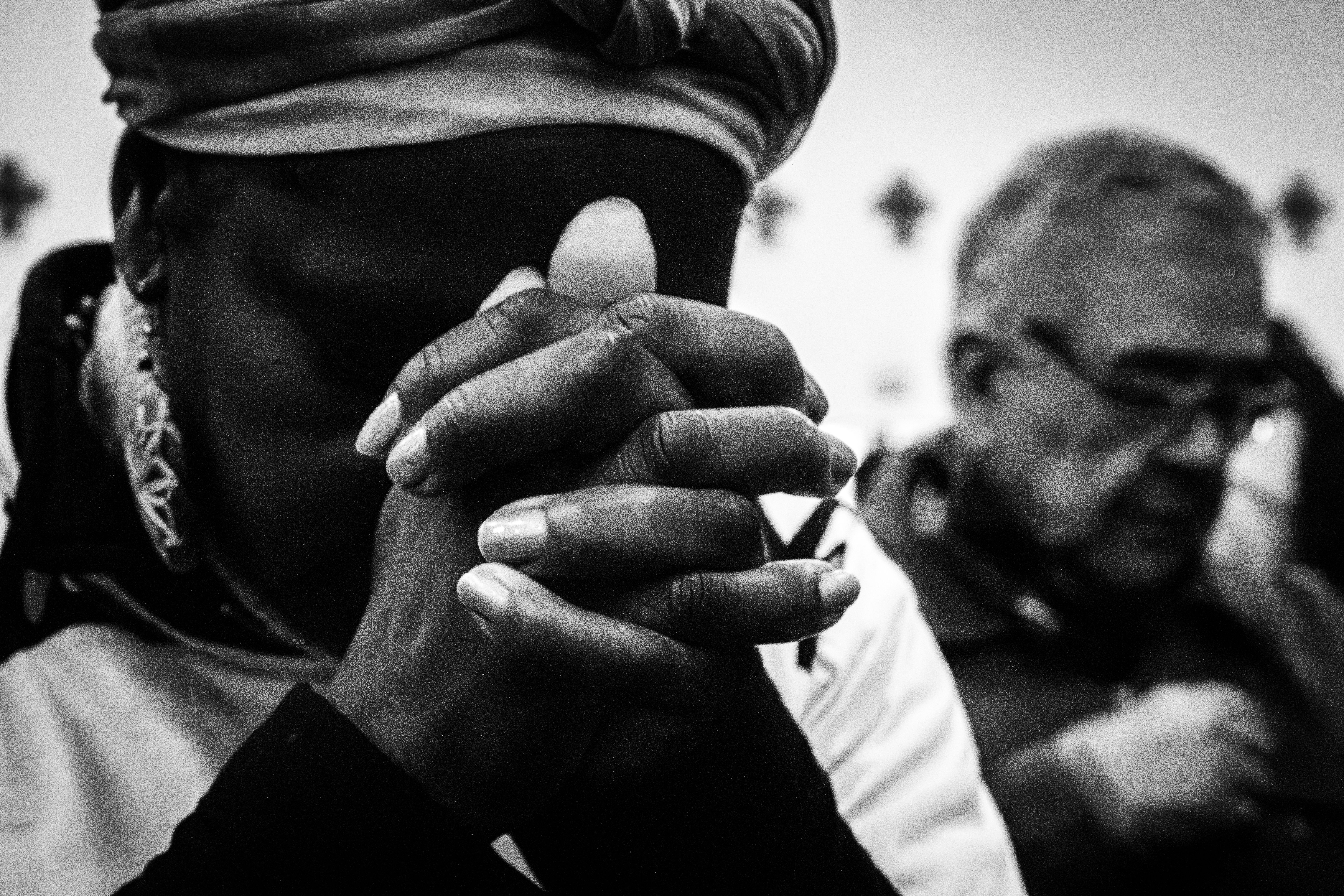
Image credits: People in prayer — photo by Carlos Alberto Sanches, Pexels free licence (thematic image only, not a photograph of Aretha Franklin). River at dusk — photo by Ehsan Haque, Pexels free licence (thematic image only). Microphone on a dark stage — photo by Michael DO, Pexels free licence (thematic image only). Close-up of microphones in a studio — photo by Clement Lepetit, Pexels free licence (thematic image only). Urban street scene — photo by Lesli Whitecotton, Pexels free licence (thematic image only). All images are thematic illustrations; none is a photograph of Aretha Franklin.