Johnny Cash / Behind the Songs
Ring of Fire: The Song That Came to Him in a Dream
June Carter wrote it about the terror of falling in love — then watched her future husband turn it into the biggest hit of his career.

The record in context
The most famous song Johnny Cash never wrote began as a confession he was never meant to hear. By the early 1960s June Carter — of the legendary Carter Family, touring regularly with Cash — was falling in love with him, and it terrified her. They were both married to other people: he to Vivian Liberto, the mother of his four daughters, and she to her second husband. Loving him meant stepping into his chaos — the amphetamines, the wrecked hotel rooms, the marriage visibly coming apart. She wrote the song with Merle Kilgore, a songwriter and distant Carter relative, and the title said exactly what she felt: love as a burning ring of fire, something you fall into and cannot climb out of. June’s sister Anita Carter recorded it first, in 1962, as “(Love’s) Ring of Fire.” The record went nowhere. The song sat there, smoldering, waiting for the one voice that could make it detonate.
To understand why Cash needed this song in 1963, look at where he stood. He was Columbia Records’ biggest country star and a man coming apart — the amphetamines he had started taking to survive the touring schedule now dictated his life, and his marriage to Vivian was fraying in public. June Carter had joined his touring show, bringing the Carter Family harmonies and something steadier: she was the person who would eventually, with her family, move into his house to help him get clean. In 1962 and 1963 they were circling each other, both married, both miserable, both pretending otherwise. “Ring of Fire” landed in the middle of that impossible situation like a flare. When Cash sang June’s words, everyone on that tour — the band, the crew — could hear exactly what was happening. The record didn’t just describe the fire. It announced it.
Cash cut his version on March 25, 1963, at the Columbia studio in Nashville with producer Don Law and the Tennessee Three. The session had originally been booked for early March but was pushed back after the plane crash on March 5, 1963, that killed Patsy Cline — the whole Nashville community was in mourning, and recording felt impossible. When Cash finally walked in, he brought with him the strangest arrangement idea of his career: mariachi-style horns, blaring over a country record, an idea he always insisted had come to him in a dream. Nobody in Nashville in 1963 was putting Mexican trumpets on a country single. Don Law let him do it anyway. The single was released on April 19, 1963, and also anchored the compilation Ring of Fire: The Best of Johnny Cash. Two minutes and thirty-six seconds long, it sounded like nothing else on country radio — which turned out to be exactly the point.
What happened next rewrote Cash’s career. “Ring of Fire” went to number one on the country chart and stayed there for seven weeks — his first country chart-topper since 1959 — and crossed over into the top twenty of the pop chart. It became one of his signature songs, the record people mean when they say “Johnny Cash” in a single breath. There is a footnote worth knowing: years later, his first wife Vivian Liberto claimed in her memoir that Cash had given June half the songwriting credit for monetary reasons rather than creative ones. The official credit has never changed — Carter and Kilgore — and the song’s power never needed the argument settled. Within five years of that recording, June and Johnny would be married, and “Ring of Fire” would stand as the public record of the most famous love story in country music: a warning she wrote to herself, sung by the very man she was warning herself about.
Listen closely
Start with the first two seconds, because the record announces its madness immediately. Before Cash sings a word, mariachi trumpets blast a fanfare — bright, brassy, vaguely like a bullfight — over a thumping “oompah” pulse. In the context of 1963 Nashville, this was absurd. Country records did not open with Mexican horn sections. But listen to what the horns do: they turn the song into a ritual, a procession, something closer to a mariachi wedding march than a honky-tonk single. Cash dreamed them, or said he did, and the dream was right — the trumpets make the fire in the title literal. You hear them and you see flames. No guitar intro in country history ever did that much work in four bars.
Then the lyric, which is June’s confession wearing Johnny’s voice. “Love is a burning thing, and it makes a fiery ring” — and then the plunge: “I fell into a burning ring of fire, I went down, down, down, and the flames went higher.” This is not a love song in any conventional sense. It is a woman describing the exact sensation of falling for someone she knows will burn her, written while she was living it. When Cash sings it, the perspective flips and doubles: he is both the fire and the man falling into it. Listen to “down, down, down” — each repetition drops lower, deeper, like a man describing his own descent in real time. June wrote a warning to herself. Johnny sang it like a man who had already ignored every warning he ever got.
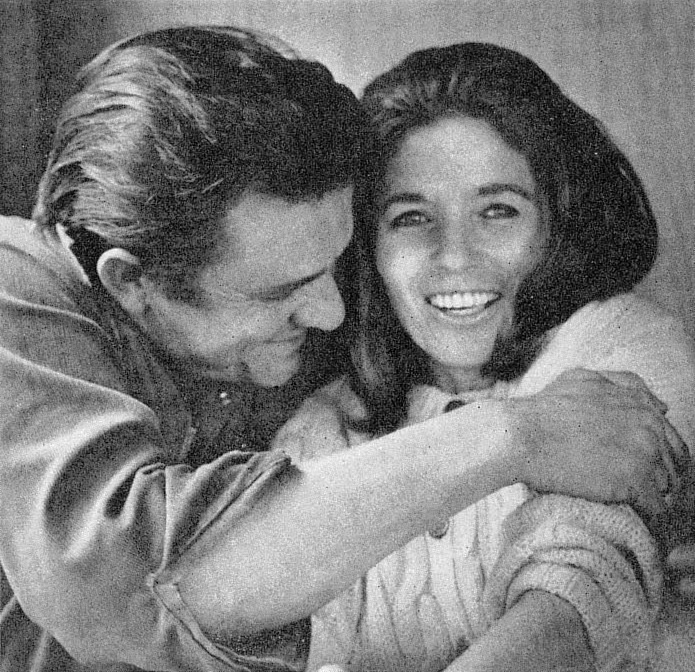
Now listen to the voice itself, because Cash does something remarkable with a song he didn’t write: he makes it sound autobiographical. The Tennessee Three are at their locomotive best behind him — Luther Perkins’ muted, chugging guitar, the upright bass pumping like a piston — and over it Cash’s baritone stays flat, certain, almost biblical. He doesn’t oversell a syllable. Where a lesser singer would have acted out the burning, Cash simply reports it, the way a man describes a fire he walked out of once and knows he’ll walk into again. That restraint is why the record works: the horns are ecstatic, the lyric is terrified, and the voice sits exactly between them, holding both truths at once. It is the sound of a man who understands the song better than its writers intended — because he was the reason it had to be written.
There is a smaller detail worth catching: the rhythm underneath the horns. The Tennessee Three play it almost as a march — Luther Perkins’ guitar chopping on the beat, Marshall Grant’s bass walking underneath — and the effect is closer to a procession than a dance. Country songs in 1963 swung or shuffled; this one advances, inevitable as a funeral cortege or a wedding march, which may be why it works as both. Don Law’s production keeps everything dry and forward, with no echo to hide in. And when the song ends, it ends the way it began — with the horns, a full circle, the ring closing. Two and a half minutes, no wasted motion. You can hear why disc jockeys couldn’t categorize it and played it anyway: it wasn’t quite country, wasn’t pop, wasn’t Mexican music. It was simply the sound of 1963 catching fire.
The song never left them. They sang it together for the rest of their lives, and it became the theme music of their marriage — the fire they fell into and somehow survived. At his final public concert, on July 5, 2003, at the Carter Family Fold in Virginia, weeks after June’s death, Cash played “Ring of Fire” and told the audience that June’s spirit was with him that night, giving him courage as she always had. He died two months later. Listen to the 1963 record with that ending in mind and the horns sound different — less like a gimmick, more like a prophecy. A dream gave Johnny Cash the arrangement. A frightened woman gave him the words. And the fire they were both singing about turned out to be the truest thing either of them ever recorded.
Release and recording reference ↗
Release context is sourced above. Listening observations are Past Tunes’ original interpretation, not quotations from the artist.
More from Johnny Cash
A freight-train rhythm from Sun Records that made a 23-year-old the voice of every inmate in America.
1956 / Behind the SongsI Walk the Line: The Vow He Hummed Into HistoryWritten backstage in under an hour as a pledge to his young wife — and the first number one of his career.
1967 / Behind the SongsJackson: The Duet That Made a Marriage SingJune and Johnny sparring on record in 1967 — two voices that couldn’t stay away from each other.
1969 / Behind the SongsA Boy Named Sue: The San Quentin ShowstopperShel Silverstein’s barroom poem, roared before 2,000 inmates, and a number-two pop smash.
1970 / Behind the SongsSunday Mornin’ Comin’ Down: The Song the Network Didn’t WantKris Kristofferson’s hungover hymn, sung on ABC television with the drug lyric intact.
1971 / Behind the SongsMan in Black: The Reason for the BlackIn 1971 he explained the wardrobe — and turned a stage costume into a moral statement.
1979 / Behind the SongsGhost Riders in the Sky: The Cowboy Song He Was Born to SingA 1948 western standard, reborn in 1979 by a voice like thunder on the prairie.
2002 / Behind the SongsHurt: The Farewell in the Ruined MansionA Nine Inch Nails song, a decaying house full of memories, and the most devastating video ever made.
1965 / Behind the SongsThe Long Black Veil: The Murder Ballad He Sang From Beyond the GraveAn innocent man chooses the gallows over the truth.