Johnny Cash / Behind the Songs
A Boy Named Sue: The Lyric Sheet He’d Never Seen Before
Shel Silverstein wrote it as a barroom joke. Cash read it cold in front of a thousand convicts — and their laughter turned it into the biggest pop hit of his life.
The record in context
The man who wrote “A Boy Named Sue” was famous for drawing cartoons and writing children’s books. Shel Silverstein — the bearded, growling, endlessly prolific author of The Giving Tree and Where the Sidewalk Ends — was also a Playboy cartoonist, a poet, and a songwriter with a taste for the rowdy and the profane. He had been part of Johnny Cash’s circle for years, one of the brilliant oddballs who drifted through Cash’s Hendersonville home, and at a gathering there he performed a new comic poem he had written: the tall tale of a boy whose absent father saddles him with a girl’s name, and the lifelong brawl that follows. It was June Carter Cash who saw the potential. She urged her husband to try the song at his upcoming prison concert — she understood, perhaps before he did, that a story about a fatherless boy forced to fight the whole world might land hard in front of men who knew exactly what that felt like. Cash agreed, though he had never performed it, barely rehearsed it, and would walk onstage with the lyrics on a sheet of paper in his hand.
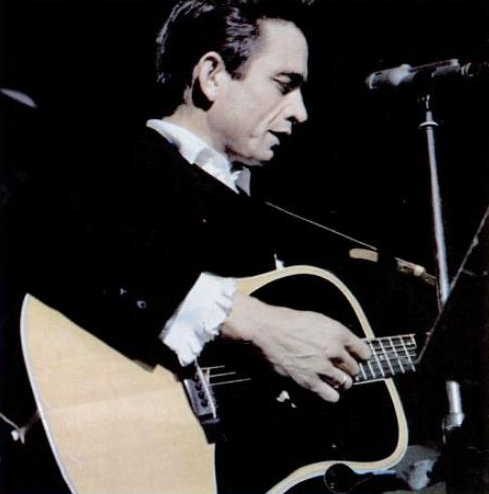
The concert was February 24, 1969, at San Quentin State Prison in California — two days before Cash’s thirty-seventh birthday, thirteen months after the career-reviving triumph of At Folsom Prison. Producer Bob Johnston was recording everything for a follow-up live album, and the set list was full of prison songs old and new. When Cash introduced the Silverstein number, he was frank with the audience: he had never sung it before, and he was going to read the words. What happened next is preserved on the tape and has been making people grin for more than fifty years. Cash stumbles, chuckles, nearly loses the thread; the band — the Tennessee Three plus the Statler Brothers and Carl Perkins in support — vamps and improvises behind him, trying to keep up with a singer who is discovering the jokes at the exact moment the audience is. The inmates howl. It is the loosest, happiest recording Cash ever made, and it happened because nothing about it was planned — a first take in front of a thousand convicts, and the only take that mattered.
Released as a single in July 1969, “A Boy Named Sue” did something no Johnny Cash record had ever done: it crossed over completely. It went to number one on the country chart, number two on the Billboard Hot 100 — the highest pop-chart placing of Cash’s entire career — number one on the Adult Contemporary chart, and number four in Britain. The parent album, At San Quentin, became one of the best-selling live albums in history. In 1970 the song won Cash the Grammy for Best Country Vocal Performance, Male. There was one complication: the lyric’s climactic insult — the father called a “son of a bitch” — which radio would not touch, so some single versions bleeped or softened the word, a censorship that arguably made the record funnier, since every listener knew exactly what was missing. A children’s author had written a prison concert’s comedy centerpiece, and the Man in Black had his biggest hit with a song he had to read off a page. Nothing about it should have worked. Everything about it did.
And it kept working. “A Boy Named Sue” stayed in Cash’s set list for the rest of his career — he sang it on television, in concert halls, and on the road for another three decades, always to the same eruption of recognition. Silverstein recorded his own version, and the song entered the language: “a boy named Sue” became shorthand for any trial-by-fire upbringing, quoted by columnists and comedians who had never bought a country record in their lives. The recording’s real legacy, though, is what it proved about Cash at the peak of his powers. The same year he released the grimmest prison songs in his catalogue, he also released a comedy record — and both were completely, recognizably him. The Folsom and San Quentin albums are usually filed under “outlaw” and “rebel,” but “A Boy Named Sue” is the track that reveals the fuller picture: a storyteller first, a moralist second, and an entertainer always. He could read a stranger’s joke off a sheet of paper, in front of a thousand convicts, and make it sound like the most natural thing in the world. That is not a trick. That is a gift.
Listen closely
Start with the sound of the paper. You cannot literally hear the lyric sheet, of course, but you can hear everything it causes: the micro-hesitations before the hard lines, the little catches where Cash is sight-reading a punchline, the grin that keeps breaking through his delivery. This is a master vocalist performing a song he does not know, and the vulnerability is the whole show. Listen to the famous moment near the end where Cash laughs mid-verse — a short, surprised bark of laughter, quickly swallowed — because the joke has landed on him too. Most live albums are documents of mastery. This one is a document of discovery, and the discovery is happening in real time: a singer, a band, and a thousand inmates all finding out together that the song is hilarious. It is impossible to fake, which is why no studio version could ever touch it.
Then listen to the band trying to keep up. There is no real arrangement here — the Tennessee Three fall into a brisk, vaudevillian lope and hold on, while Carl Perkins’s guitar fills dart around Cash’s vocal like a friend trying not to laugh during a toast. The tempo wobbles, the dynamics lurch, and it is perfect, because the song is a barroom story and the band is playing it like one. But the most important instrument on the record is not onstage at all: it is the audience. The inmates’ laughter is mixed right up front, a roaring call-and-response that turns every verse into a dialogue. When Cash delivers a setup, you hear a thousand men lean in; when the punchline lands, the room detonates. Listen to it as a duet — Cash and San Quentin, trading lines — and the record opens up completely. He is not performing for them. He is performing with them.

Now listen to the story itself, because Silverstein built it like a short story with a twist ending. A father walks out on his family, leaving his son with nothing but a girl’s name — Sue — and the boy grows up fighting everyone who mocks it, getting “meaner than a junkyard dog” in the process. Years later he finds his father in a bar, they brawl through the saloon, and the old man, bleeding, explains: the world is rough, and a boy named Sue had to get tough or die — the cruel name was a gift. It is sentimental and ridiculous at once, and that is Silverstein’s genius: the twist reframes everything, and the final line lands like a benediction. Notice, too, the famous profanity — the father’s parting shot — and how the single version’s censorship of it only sharpened the comedy. The bleep became part of the folklore. Everyone knew the word; the record just made you say it yourself.
Finally, ask why it worked so well in that room, because the answer is the key to Cash’s whole prison-concert legend. A thousand men sat in that audience who had been abandoned, renamed by the system, forced to be tough in places that reward toughness and punish everything else. When Cash sang about a boy fighting the world over a name he didn’t choose, the inmates were not laughing at a joke — they were recognizing a biography. That is why the laughter on the record sounds different from ordinary concert laughter: it is louder, rougher, more personal, the sound of men hearing their own story told back to them by a free man who bothered to come inside and tell it. Cash always said the prisoners were the best audience he ever had because they listened. On “A Boy Named Sue,” you can hear why: for three and a half minutes, the wall between the stage and the cellblock disappears, and everybody is in on the same joke. Then the song ends, the cheering fades, and the wall goes back up. That is what makes the laughter ache a little, underneath the joy.
Release and recording reference ↗
Release context is sourced above. Listening observations are Past Tunes’ original interpretation, not quotations from the artist.
More from Johnny Cash
A 1951 prison film, a Sun Studio train rhythm, and the Reno line that chilled a generation.
1956 / Behind the SongsI Walk the Line: The Vow He Hummed Into HistoryA wedding vow hummed between the chords — and his first number one.
1963 / Behind the SongsRing of Fire: The Song That Came to Him in a DreamThe mariachi-trumpet dream that became his signature song.
1965 / Behind the SongsThe Long Black Veil: The Murder Ballad He Sang From Beyond the GraveA murder ballad narrated from beyond the grave.
1967 / Behind the SongsJackson: The Duet That Turned a Marriage Into a LegendCash and June trade verses and barbs in country’s wittiest duet.
1970 / Behind the SongsSunday Morning Coming Down: The Song Kristofferson Flew In to DeliverKris Kristofferson’s hangover hymn became Cash’s number one and a CMA Song of the Year.
1971 / Behind the SongsMan in Black: The Song That Gave the Legend His NameThe song that explained the black — and turned it into a uniform.
1979 / Behind the Songs(Ghost) Riders in the Sky: The Yodel That Rode Out of 1948Stan Jones’s cowboy legend, yodeled by Cash into a late-career country hit.
2002 / Behind the SongsHurt: The Farewell He Sang in a Ruined MansionA Nine Inch Nails song becomes the most devastating farewell in American music.