Every long-running rock band has one song that the faithful treat as sacred text and the general public somehow never got issued as a single. For Styx, that song closes their fifth album. “Suite Madame Blue” begins in near darkness: a lone guitar figure, a keyboard breathing underneath, and Dennis DeYoung singing, softly and a little sadly, to a woman named Madame Blue — who is not a woman at all. Six and a half minutes later the track has swelled into a full-throated chant of one repeated word, “America,” delivered like both a cheer and an alarm bell.
DeYoung wrote the song in 1975, as the United States geared up to celebrate its two-hundredth birthday. Equinox, the album it closes, arrived on 1 December 1975, and while the record’s single “Lorelei” did the commercial work, “Suite Madame Blue” did something more durable: it became the band’s first great FM-radio epic, the track that told album-rock listeners this Chicago bar band had symphonic ambitions. It was never released as a single and never troubled the charts. It simply refused to go away — a staple of every Styx tour DeYoung fronted, a fixture of classic-rock programming, and, decades later, an unlikely sample source for a New Jersey rapper. This is the story of a birthday song for a country its writer wasn’t sure deserved the party.

Written for a Birthday Party Nobody Felt Like Throwing
Context is everything here. Styx recorded Equinox in 1975, at Paragon Recording Studios in Chicago, in a country that was limping. The Vietnam War had ended that April with televised helicopters on embassy roofs. President Nixon had resigned in disgrace the previous August. And into that national hangover rolled the Bicentennial — the 200th anniversary of American independence, due on 4 July 1976 — trailing an ever-louder caravan of commemorative merchandise.
DeYoung later explained the song’s origins in a Reddit question-and-answer session, and his irritation is still fresh in the telling. “It was the Bi-Centennial and as it was coming up you started seeing commercials for the Bi-Centennial mug and the Bi-Centennial panties and all of that,” he recalled. “The 200th anniversary of America was being totally taken over by commercialization in a rather unceremonious fashion. I had a moment of reflection.”
The reflection ran deeper than annoyance at souvenir tat. DeYoung had grown up, as he put it, in “the so called glory days of the United States of America, which was post World War II until 1970” — an era he flatly called the country’s golden age. What struck him, standing in 1975, was American fallibility: the suspicion that the best years might already be spent. That suspicion set the song’s tone. Madame Blue is the United States personified — the blue of the flag, the blue of melancholy — addressed as a former beloved who has changed, grown vain on power, and drifted far from what she was. The lyric keeps returning to the flag’s colours and to a single plea: that she look at herself honestly and make a new start.
DeYoung admitted one more influence, and it explains the song’s deliberate vagueness. He was, he said, “fearful of being literal,” and still under the spell of the art-rock bands he loved — Yes above all, whose lyrics he cheerfully confessed he had never understood. “Suite Madame Blue,” he concluded, sits “somewhere in-between”: a song whose meaning is unmistakable in outline and deliberately misty in detail. Even the title is a quiet joke — “suite,” the classical term for a multi-part composition, punning on “sweet.”
Six and a Half Minutes, Four Voices
On the album, the song doesn’t even start with itself. The penultimate track, “Prelude 12,” is a 1:21 instrumental for 12-string guitar written by guitarist John Curulewski, and it flows directly into “Suite Madame Blue” like a held breath. The Daily Vault‘s Benjamin Ray, reviewing Equinox, described the suite as “a multi-part moody number that starts with a five-chord arpeggio before the drums come thundering in,” building toward “an inspired middle eight with everyone singing ‘America’ at different times before the bombastic finish.”
That middle section is the song’s signature. The verses are hushed, almost apologetic; then the arrangement opens out and the word “America” is passed around the band in overlapping voices before locking into unison. It is a rare Styx recording that briefly demands four separate voice parts, and on the band’s Return to Paradise reunion tour in the 1990s the bridge became a small ceremony of its own, sung by DeYoung, Tommy Shaw, James “J.Y.” Young and the usually silent bassist Chuck Panozzo.
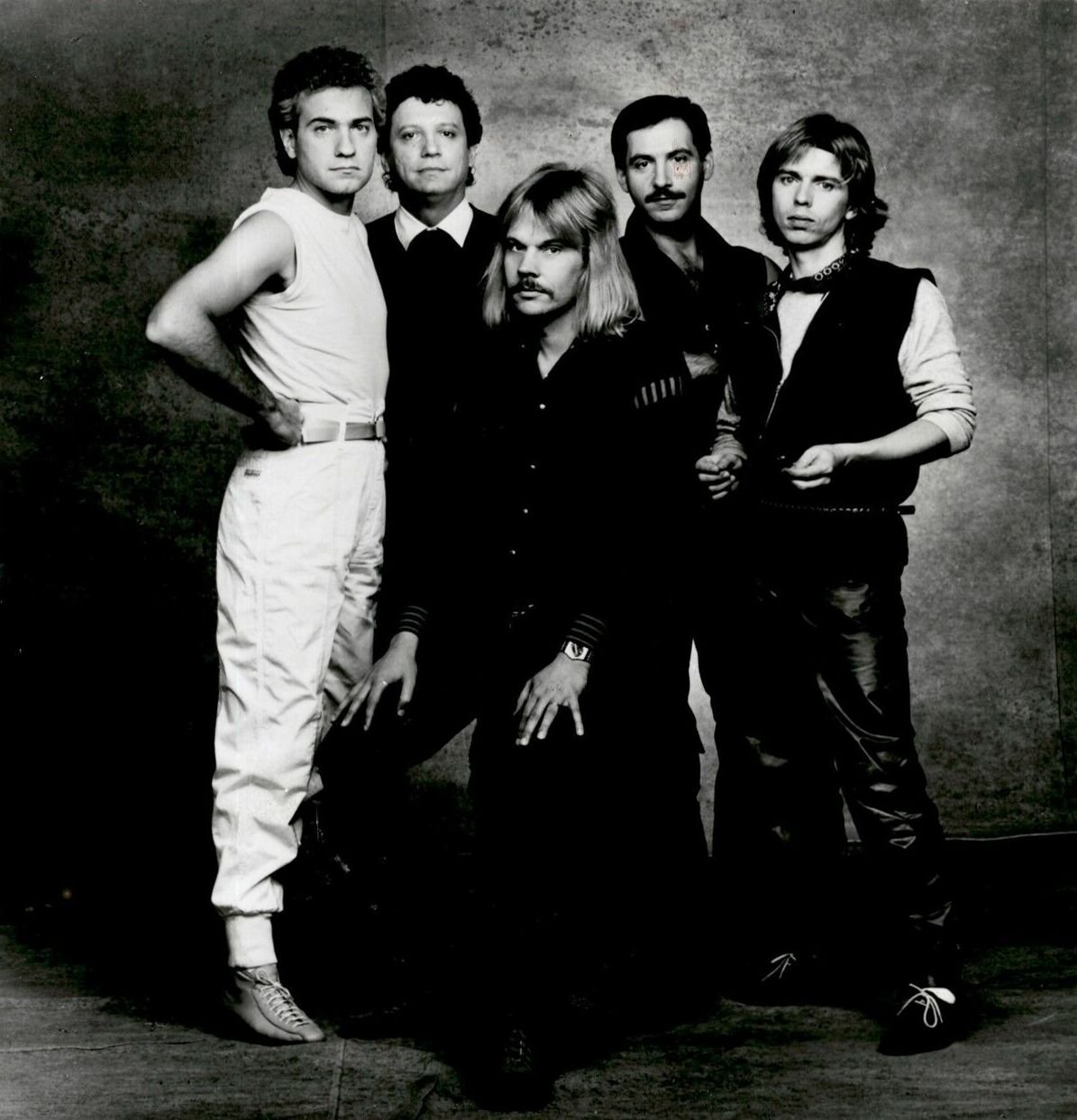
The band on the record is the original five: DeYoung on vocals and keyboards, Young and Curulewski on guitars, Chuck Panozzo on bass and his twin brother John on drums. Styx produced themselves, with Barry Mraz engineering. Ray’s verdict in The Daily Vault was not hedged: “Suite,” he wrote, is “perhaps the best song the group ever composed.”
Equinox: A New Label, a Last Stand for the Old Line-up
“Suite Madame Blue” cannot be separated from the strange, pivotal album around it. Styx had spent years as a respected Chicago club act on the small Wooden Nickel label when “Lady,” a ballad from their 1973 album Styx II, was revived by Chicago radio and climbed to No. 6 in America in the spring of 1975. The belated hit won them a deal with A&M Records, and Equinox — their fifth album, and their first for A&M — was the sound of a band seizing its second chance.
The album itself was a modest performer: it stalled at No. 58 on the Billboard 200, though it reached No. 14 in Canada. “Lorelei” became the band’s second US Top 40 hit at No. 27, and No. 6 in Canada. Equinox was eventually certified Gold in the United States in 1977 and Platinum in Canada. Respectable — but history was already moving. Days after the album’s release, as Styx prepared to embark on a nationwide tour in December 1975, Curulewski abruptly quit, wanting to spend time with his family. A frantic search produced a young Alabama guitarist named Tommy Shaw.
Which makes “Suite Madame Blue” doubly poignant. It is the closing statement of the original Styx — the last track on the last album the founding five made together, ending not with a celebration but with a warning addressed to their own country.
The Hit That Was Never a Single
A&M released two singles from Equinox: “Lorelei” and, later, “Light Up.” “Suite Madame Blue” was never one of them. At six and a half minutes, drenched in keyboards and ending in a chant, it was never built for AM radio — and it didn’t need to be. The relatively new Album Oriented Rock format on FM gave it a home, and the band’s official history credits the song with winning Styx “considerable recognition and airplay” at exactly the moment they were converting a fluke hit into a career.
Its canonisation was gradual but thorough. When A&M assembled Styx Greatest Hits in 1995 — a collection dominated by chart singles — “Suite Madame Blue” was on it, one of only four tracks included on the strength of heavy FM airplay rather than a chart peak. It also anchors the Equinox representation on the two-disc retrospective Come Sail Away – The Styx Anthology (2004). Songs that were never singles are not supposed to end up on greatest-hits albums. This one simply outlasted the distinction.
The Live Afterlife: Rosemont, Los Angeles, and a Rap Sample

On stage, the song became a ritual. It was a staple of every Styx tour of the DeYoung era, and when the classic line-up reunited in the 1990s, the live album Return to Paradise preserved a performance recorded in 1996 at the Allstate Arena in Rosemont, Illinois — a homecoming show, a short drive from the Chicago neighbourhoods where the band began. There is a particular charge in hearing that “America” chant sung by thousands of Illinois voices, twenty years after the Bicentennial it was written for.
After DeYoung and Styx parted ways in 1999, he kept the song in his own show — understandably, since it may be the most personal thing he ever wrote for the band — and it appears on his 2014 concert album Dennis DeYoung and the Music of Styx: Live in Los Angeles, sung by a man in his late sixties still arguing with the country of his youth.
The strangest afterlife, though, arrived via hip-hop. Joe Budden’s 2008 album Halfway House includes the track “On My Grind,” whose official sample credits list a sample of “Suite Madame Blue” performed by Styx. A Bicentennial lament by a Chicago prog band, repurposed as the bedrock of a New Jersey rapper’s hustle anthem: Madame Blue travels well.
Why “Suite Madame Blue” Still Matters
Most Bicentennial music has dated into kitsch — all fife, drum and flag-waving. “Suite Madame Blue” survives because DeYoung refused the easy assignment. Asked, in effect, to write a birthday card, he wrote a love letter with a warning folded inside it: you were glorious once, you have changed, and the way back begins with looking in the glass.
That doubleness is why the song keeps being rediscovered whenever America argues with itself — and why crowds still rise for a closing chant built from a single word. Nearly fifty years after Equinox, the toast still sounds less like nostalgia than like a question the country hasn’t finished answering.