The Faint Praise That Wasn’t: The Battles Behind The Doobie Brothers’ ‘Jesus Is Just Alright’
Few hit songs have ever been so thoroughly misunderstood by their own title. To modern ears, “Jesus Is Just Alright” sounds like the faintest praise ever committed to vinyl — a shrug set to music, as if the singer had reviewed the Son of God and awarded him a passing grade. That is not what the words meant in 1966, when a gospel singer named Arthur Reid Reynolds wrote them, and it is not what they meant when the Doobie Brothers turned the song into a Top 40 hit in 1973. In the slang of the decade that coined it, “just alright” meant something closer to “outta sight” — cool, right, exactly as it should be. But the misunderstanding turned out to be the least of the song’s fights. Before it became a classic-rock fixture, “Jesus Is Just Alright” had to survive being a flop for the Byrds, a hand-me-down arrangement passed between bands like a rumor, and the curious fate of becoming an anthem of the Jesus movement in the hands of a biker-friendly California rock band whose members cheerfully admitted they were not religious men.
And yet it won every one of those fights, and it is winning still. The Doobie Brothers have opened concerts with this song in the twenty-first century, half a century after they cut it for their second album, Toulouse Street. A Christian rap group carried it to a Dove Award and onto The Tonight Show. It has been sung by Patrick Simmons, by Cornelius Bumpus, by generations of bar bands, and by audiences who could not tell you who Arthur Reid Reynolds was if their encore depended on it. This is the story of a gospel song that crossed every border American music had — race, genre, faith, and fashion — armed with four words of slang that half its listeners have always taken the wrong way.
A Gospel Singer Writes a Slogan
The song begins in church — or at least in the professional gospel world that surrounded it. Arthur Reid Reynolds was a singer and choirmaster in the Los Angeles gospel scene, and in the middle 1960s his group, the Art Reynolds Singers, was making records that deliberately reached beyond the sanctuary, applying contemporary polish to sacred material. In 1965 the group went into the studio with producer Gary Paxton — a restless pop experimenter who had worked on novelty hits and understood both sides of the church/street divide — and recorded an album for Capitol Records. Tellin’ It Like It Is came out in 1966, and tucked inside it, all one minute and fifty-five seconds of it, was “Jesus Is Just Alright.”
The original is a sprint. Where the versions the world knows stretch the song past four minutes, Reynolds’ recording is over before it starts: a bright, urgent gospel performance that states its whole argument in the time it takes a rock band to tune up. The lyric is a testimony stripped to its chassis. The singer doesn’t care what you know, where you go, or what you may be; Jesus is just alright with him. That’s the song — a declaration of indifference to everybody else’s opinion, built to be shouted by a choir and answered by a congregation.
Reynolds was writing in a vernacular his first audience understood perfectly. In the Black vernacular of the 1960s, “alright” in this construction was praise, not adequacy — the same family of slang that made “outta sight” a superlative. Reynolds was not grading Jesus. He was endorsing him, in the language of the street corner rather than the pulpit, which was precisely the point of the Art Reynolds Singers: gospel that spoke the way its intended converts actually talked. The trouble — and the battle that would follow the song for the rest of its life — is that slang does not travel as reliably as melody. The words would cross over. The meaning would have to fight to keep up.
The World Reynolds Was Singing Into
Reynolds was not working in a vacuum, and the Art Reynolds Singers were not an anomaly. The mid-1960s were the great ferment of gospel’s long negotiation with the pop marketplace. Sam Cooke had walked out of the Soul Stirrers a decade earlier and proven that a gospel voice could rule the pop charts, at the cost of his standing in the church. The Staple Singers were moving steadily from pure gospel toward the message songs that would soon make them Stax stars. Within a couple of years of Tellin’ It Like It Is, Edwin Hawkins’ youth choir would record “Oh Happy Day” as a local fundraiser record and watch it become an international pop hit — proof, delivered at exactly the moment Reynolds was working, that an unapologetic gospel performance could cross over without diluting itself at all.
What distinguished Reynolds’ entry in that ferment was its deliberate plainness. “Oh Happy Day” crossed over on the strength of a massed choir and a piano figure anybody could hum; “Jesus Is Just Alright” was built like a jingle for the faith — ninety seconds of testimony, no decoration, the whole theology of the song contained in the refusal to care what anybody else thought. Where the crossover gospel of the era tended to dress the message in pop clothing, Reynolds did the opposite: he took the pop era’s own casual slang and showed that it had been church language all along, waiting to be claimed.
That plainness is why the song, alone among the tracks on Tellin’ It Like It Is, escaped its album. A jingle is designed to be carried away by whoever hears it. It asks nothing of the carrier — no range, no choir, no orchestra, not even agreement. A drummer in the studio could carry it for four years in his head. A folk-rock band could carry it on stage with three chords and harmonies. A boogie band could carry it into arenas. Reynolds, whether he knew it or not, had written the most portable gospel song of its decade: a testimony with no moving parts, small enough to fit in anybody’s set list.
The Faint-Praise Problem
Consider what happened to those four words as the song moved outward. Read cold, without the slang, “Jesus is just alright” parses as a devastating understatement — the kind of thing an unimpressed man says about a restaurant. For a sacred song, that reading is almost blasphemous in its mildness, and it trailed the record through every phase of its career. Church traditionalists could hear irreverence. Rock audiences could hear irony. Program directors could hear trouble. The song carried a permanent low-grade controversy in its title alone, generated entirely by a dialect gap.
But here is the thing the song’s history proves: the ambiguity was also armor. A straightforward hymn of praise, sung straight, would never have survived the journey this song took — out of a gospel album, into the set list of the Byrds at the height of the hippie era, onto a boogie-rock album by a band called the Doobie Brothers. The title’s slangy shrug let every audience hear what it needed. Believers heard testimony. Hippies heard a vibe. Rock fans heard a riff and a hook. The Jesus movement — the wave of young, countercultural converts who were remaking American Christianity in the early 1970s — heard a song in their own language, which is exactly what Reynolds had written it to be, five years before that movement had a name.
The misunderstanding, in other words, was the price of admission, and the song paid it gladly for sixty years. Reynolds’ little slogan turned out to be one of the most portable phrases in American music. It just had to survive its first carrier in the rock world nearly killing it with kindness — and indifference.
The Drummer Who Was in the Room
The song’s escape from the gospel world happened because of a coincidence so neat it sounds invented. Gene Parsons, who would become the drummer of the Byrds, had been present in the studio when the Art Reynolds Singers recorded their album — a working musician in the Los Angeles session scene, in the right room at the right moment in 1965, hearing a one-minute-and-fifty-five-second gospel track that lodged in his memory and stayed there.
Four years later, Parsons was a Byrd, and the Byrds were remaking themselves. The band that had invented folk-rock was now, under Roger McGuinn and drummer Parsons and the great guitarist Clarence White, pioneering country-rock. That 1969 lineup — McGuinn, White, Parsons, and bassist John York — was the most musically formidable and least commercially rewarded edition of the band, a group rebuilding an audience while standing, mostly unrecognized, at the foundation of an entire genre. Into that rebuilding project, Parsons carried a one-minute gospel song he had heard cut in a Los Angeles studio four years before he had any band to give it to. He brought “Jesus Is Just Alright” to the band, and the Byrds did what working bands do with a promising cover: they took it on the road first. For months before they recorded it, the song was part of their live show, and it quickly became an audience favorite — a shot of gospel adrenaline in a country-rock set.
Parsons even devised the arrangement’s signature: in concert, the Byrds’ version opened with a wordless vocal introduction, voices building in harmony before crashing into the chorus — a little piece of theater that turned a cover into an event. It is the first of the song’s many reinventions, and it belongs to a drummer. The Byrds were ready to record it for their eighth album, Ballad of Easy Rider. That is when the song met the music business, and the music business very nearly smothered it.
Two Minutes and Ten Seconds in Hollywood
The Byrds recorded “Jesus Is Just Alright” on June 17, 1969, at Columbia Studios in Hollywood, with Terry Melcher producing. Melcher — the producer of the band’s first hits, returned to the fold — made a decision that says everything about the era’s pop instincts: he cut Parsons’ extended wordless introduction. The concert arrangement had drama and build; the record, Melcher judged, needed to get to the chorus. The finished Byrds version runs two minutes and ten seconds, tight, bright, and — as the trade press agreed — extremely good. Cash Box praised the band for dropping its country trappings in favor of “blazing instrumental arrangements” and called the song “a marvel in the material department.” Record World called it an “out-of-sight driving rocker,” accidentally reviewing it in its own slang. Billboard praised Melcher’s first-rate production.
Ballad of Easy Rider appeared that October, and Columbia issued the song as a single on December 15, 1969, backed with Dylan’s “It’s All Over Now, Baby Blue” — an A-side about Jesus and a B-side by Bob Dylan, which tells you most of what you need to know about the Byrds’ world in 1969. The single entered the Billboard Hot 100 in February 1970 at its peak position, No. 97, and fell off after a single week. In Britain it did not chart at all. By every commercial measure the industry respected, “Jesus Is Just Alright” as a rock record was dead.
Except in the one place that mattered. The Byrds kept playing it — it remained a staple of their concerts from 1969 through 1971, long after the single’s failure, performed on television as late as 1972 on The Midnight Special, and preserved in live recordings from the Royal Albert Hall in 1971. The song had flopped as a product and triumphed as a performance, night after night, in front of audiences who had never bought the record. Among those audiences, in Northern California, was a young bar band that was paying very close attention.
The Doobies Take It Fair and Square
The Doobie Brothers of 1971–72 were not yet the hit machine of “Listen to the Music.” They were a San Jose band with a flop debut album behind them, a two-drummer boogie sound, a biker following, and a new producer, Ted Templeman, reshaping them for Warner Bros. They heard the Byrds’ version of “Jesus Is Just Alright” — by the band’s own history, that is where the song came to them — and they did exactly what the Byrds had done: they put it in the live set and let the audience decide. The audience decided the same way.
When the Doobies went in to cut their second album, Toulouse Street, at Warner Bros. Studios in Hollywood, the song went with them — and their arrangement, by open admission, was built heavily on the Byrds’ record. This is the hand-me-down at the heart of the story, and nobody involved has ever pretended otherwise: Reynolds wrote it, Parsons carried it to the Byrds, the Byrds arranged it, Melcher trimmed it, the market rejected it, and the Doobies inherited it from the stage. Rock and roll’s folk process, running in plain sight, on a major label, in 1972.
Toulouse Street was released on July 1, 1972, and it remade the band’s fortunes: “Listen to the Music” became their first big hit that autumn. “Jesus Is Just Alright” was on the album’s second side, road-tested, anointed by three years of other people’s concerts — and the Doobies had one more idea to add before they let it go. It was the idea that turned a cover into a signature.
Second Album, Last Chance
It is worth pausing on how much was riding on Toulouse Street, because the Doobie Brothers who carried “Jesus Is Just Alright” into the studio were not a success story protecting a brand. Their self-titled debut, released in April 1971, had yielded no hit singles at all; it is one of the great false starts in Warner Bros. history, a decent boogie album that the marketplace simply declined to notice. The band had already changed bassists before recording it — Dave Shogren departed, Tiran Porter arrived — and Michael Hossack had been added as a second drummer to thicken the live attack. By the standards of 1972, the Doobies were one more California band with one more album to prove they deserved a third.
Templeman’s rebuild worked by addition rather than subtraction. The boogie stayed — “Rockin’ Down the Highway” is nobody’s idea of a soft record — but around it the producer arranged space for Simmons’ fingerpicked folk, for Johnston’s choogling rockers to be sequenced like singles, and for covers and outside material to be treated as first-class citizens. On the finished album, “Jesus Is Just Alright” sits deep on the second side, after the blues shuffle “Don’t Start Me to Talkin’,” in the spot where a confident band puts the song it expects the audience already to know from the stage. The album around it climbed to No. 21 on the Billboard chart and was eventually certified platinum; more importantly, it established the band’s working method for the next decade, in which a song’s origin mattered far less than what the Doobie Brothers’ harmonies and twin drums could do to it.
That method is the real frame for everything that followed in this song’s life. The Doobies did not steal “Jesus Is Just Alright,” and they never disguised its source. They subjected it to the same process they applied to everything in those years — road-test it, harmonize it, stretch it, and let the audience vote — and the audience’s vote, this time, overruled the chart verdict the Byrds had received. The band that had nearly been dropped after one album was about to have its second hit with a song the industry had already thrown away once.
The Bridge Nobody Wrote — Until Tiran Porter
Play the Byrds’ version and the Doobies’ version back to back and the inheritance is obvious — until the middle of the Doobies’ record, where the tempo suddenly drops out from under the song. The guitars fall away, the groove goes half-time and heavy, and the voices stack up in close harmony on a new refrain: “Jesus is my friend.” Then the band slams back into the chorus at full speed. That slow bridge is not in Reynolds’ original. It is not in the Byrds’ version. The Doobie Brothers built it themselves, and it is the single most imitated element of their record — the moment every subsequent version, from DC Talk onward, has felt obliged to honor.
In 2007, bassist Tiran Porter publicly claimed the bridge as his. The idea of adding a slow section, Porter said, was his — including the “Jesus is my friend” line — with one catch: the part sat too high for his own voice, so guitarist Patrick Simmons, the band’s folk-singing counterweight to Tom Johnston’s rock roar, sang lead on the track instead. It is a perfect Doobie Brothers credit dispute: the band’s most famous addition to a gospel standard was composed by the bass player and sung by the other guitarist, while the band’s actual lead singer, Johnston, played guitar and sang backup.
The rest of the personnel explains the record’s muscle. The Doobies still carried two drummers — founding member John Hartman and Michael Hossack — giving the track its rolling, doubled momentum. Bill Payne of Little Feat, the era’s keyboardist for hire, played the organ that gives the record its church. Templeman himself added percussion. And Simmons’ lead vocal threads the needle the whole song requires: earnest without sanctimony, rocking without sneering. The album version runs four minutes and thirty-six seconds — nearly three times the length of Reynolds’ original — because the Doobies had learned, on stage, that this song was not a sprint. It was a structure you could build a room on.
Number 35 in the Middle of a Jesus Boom
Warner Bros. released the Doobies’ version as a single on November 15, 1972, backed — in one of the great value-for-money B-sides of the era — with “Rockin’ Down the Highway.” Both sides of the record are still classic-rock radio staples more than fifty years later. The A-side climbed through the winter and peaked at No. 35 on the Billboard Hot 100 in February 1973; in New Zealand it reached No. 8. It was not a smash. It was something better: a permanent record, the kind that never entirely leaves the air.
It was also, improbably, part of a wave. Between 1969 and 1973, American Top 40 radio — notionally a secular institution in a youth culture supposedly fleeing religion — hosted a procession of faith-haunted hits: Norman Greenbaum’s “Spirit in the Sky,” George Harrison’s “My Sweet Lord,” Ocean’s “Put Your Hand in the Hand,” Cat Stevens’ “Morning Has Broken,” Kris Kristofferson’s “Jesus Was a Capricorn” and “Why Me.” “Jesus Is Just Alright” rode that wave with a difference. Most of those records were written as pop by men thinking about God. This one was a genuine gospel song, written in a church idiom by a gospel professional, that had wandered into the charts by accident of arrangement.
And here the story takes its most human turn: none of the Doobie Brothers were, by the historical record, religiously inclined men. They were a hard-touring rock band named, legendarily, after slang for a marijuana cigarette. Yet their record of “Jesus Is Just Alright” was embraced — adopted, really — by the young Christians of the Jesus movement, the counterculture converts who were looking for faith that sounded like their own lives. A song written to speak slang to the street had done it again, one generation on: it spoke slang to the Jesus people, in a voice provided by men who did not share the faith but never mocked the song. That combination — total sincerity of performance, total absence of preaching — is why the record has never dated the way message records date.
The Congregation Answers Back
To hear the Doobies’ record the way its first surprise audience heard it, you have to picture the America of 1972–73, in which the strangest cultural fact was not the decline of religion but its mutation. In June 1971, Time magazine had put Jesus on its cover — in psychedelic portrait — for a cover story titled “The Jesus Revolution,” reporting on the wave of long-haired converts filling places like Calvary Chapel in Costa Mesa, California. The converts called themselves Jesus people; the culture called them Jesus freaks, a slur they promptly reclaimed as a name tag. They had their own newspapers, their own communes, their own music industry in embryo — and an acute hunger for songs that sounded like the world they had come from rather than the hymnals of their parents.
Rock radio kept handing them such songs by accident. “Spirit in the Sky” was a fuzz-guitar sermon by a man who never joined the movement. “My Sweet Lord” was a Hare Krishna chant wrapped around a gospel chorus. And “Jesus Is Just Alright” was the most accidental gift of all: an actual gospel composition, carrying an actual gospel singer’s arrangement DNA, delivered — this is the crucial part — by a band that asked nothing of the listener. The Doobies did not testify between songs. They did not pass a plate or preach a sermon. They played the song the way they played “Rockin’ Down the Highway,” as if it were simply one of the great American rock and roll records, which their treatment had made it.
That neutrality was the bridge the song had always needed. Reynolds had written slang to reach the street; the Jesus people were the street, organized. The record let a teenager in 1973 hold both identities at once — rock fan and believer, freak and faithful — in a single chorus, and it let the band’s secular audience sing along to a testimony without feeling recruited. Twenty years later, DC Talk would title their breakthrough album Jesus Freak and put “Jesus Is Just Alright” at the front of the one before it, picking up the same two identities and wearing them as a uniform. The line from a Capitol gospel session in 1965 to a Dove Award in 1994 runs straight through those early-70s congregations who heard a Doobie Brothers single and recognized it, correctly, as one of theirs.
The B-Side That Wouldn’t Sit Down
A word for the other side of the single, because the pairing is itself a piece of the story. “Rockin’ Down the Highway,” the Tom Johnston rocker tucked behind “Jesus Is Just Alright” in November 1972, went on to become one of the band’s most durable songs in its own right — a concert opener in its own era and a fixture of classic-rock playlists to this day. The historical record of the single notes, dryly, that the A-side “along with its B-side, continues to be a staple of playlists on classic rock radio stations,” which makes the 45 one of the more efficient pieces of vinyl Warner Bros. released in the 1970s: two permanent radio records for the price of one slot in the jukebox.
The pairing also freezes the band at its most balanced moment. The B-side is the founder’s music — Johnston’s highway boogie, all forward motion and guitar chug. The A-side is the collective’s music — a borrowed gospel song, sung by the folk guitarist, bridged by the bassist, churched by a borrowed organist, and carried by two drummers. Between the two sides you can hear the whole 1972 Doobie Brothers proposition: this band contains every kind of American music it has ever touched, and it refuses, on principle, to rank them. Within three years Johnston’s body would force the great reshuffle that made the band famous all over again. The single from Toulouse Street is what the first, united band sounded like when everything it touched turned to radio.
Fifty Years of Opening Nights
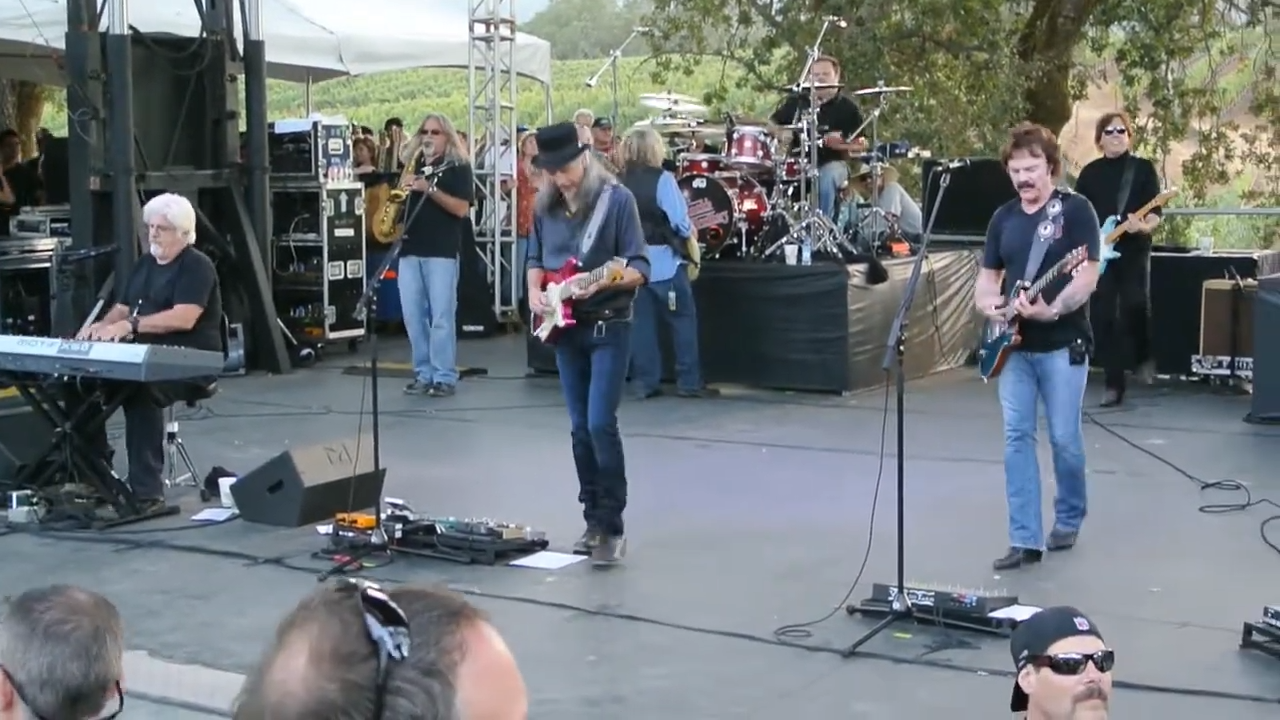
Some songs become encores; this one became a door-opener. The evidence is in the set lists across six decades. When the original band began its long goodbye, the song was there: the 1983 Farewell Tour live album includes it — sung on that record not by Simmons but by Cornelius Bumpus, the saxophonist-vocalist of the band’s final lineup, proof that by then the song belonged to whoever was standing at the microphone. It was recorded again for the 1996 reunion document Rockin’ Down the Highway: The Wildlife Concert, and again for Live at Wolf Trap in 2004, where it sits second in the running order, exactly where a band puts a song it trusts to start an engine.
The twenty-first-century set lists are more striking still. Reviewing the reunited Doobies at the Greek Theatre in Los Angeles in 2013, Vintage Rock noted the band “started in with” the Arthur Reid Reynolds tune; two years later, same venue, a reviewer recorded the moment plainly: “the Doobie Brothers hit the stage with the rousing ‘Jesus Is Just Alright’ and the party was on!” In July 2017, at Dodger Stadium, on the Classic West bill alongside the Eagles and Steely Dan — arguably the most prestigious classic-rock stage of the decade — the Doobie Brothers opened their fifteen-song set with it. Song one. Before “Rockin’ Down the Highway,” before “China Grove,” before “Listen to the Music.” In 2018 they performed the whole of Toulouse Street at the Beacon Theatre in New York, the album played front to back for the first time in the band’s history — and there it was in its original place, the 1972 arrangement intact, bridge and all.
Think about what that means. This is a cover of a cover of a gospel obscurity, whose first rock version peaked at No. 97, whose hit version peaked at No. 35 — and it opens stadium shows fifty years later, ahead of No. 1 singles. In the live economy of the Doobie Brothers, “Jesus Is Just Alright” is not nostalgia. It is infrastructure: the song a band with two complete golden eras reaches for when it needs the room won in the first four minutes.
Resurrection, Rap Division
Just when the song seemed settled into classic-rock permanence, it changed religions — formally, this time. In 1992 the Christian rock and hip-hop group DC Talk put “Jesus Is Just Alright” at the front of their album Free at Last, and released it as the lead single. TobyMac kept Reynolds’ chorus intact and wrote new verses of his own, rapped, with the sung chorus traded between Kevin Max and Michael Tait. He even revised the slogan for the new decade, slipping “Jesus is still alright” into the lyric — the songwriter explaining that the point was persistence: still alright, even for people who did not share the belief. The arrangement saluted its sources openly, building on the Byrds’ and Doobies’ recordings and sampling Madonna’s “Vogue” and Snap!’s “The Power” into the bargain — a gospel song from 1966, quoting the dance floor of 1990.
The establishment that had ignored Reynolds, and shrugged at the Byrds, now handed the song its trophies. Free at Last went platinum and won a Grammy; at the 24th GMA Dove Awards in 1994, “Jesus Is Just Alright” was named Best Rock Recorded Song. On November 12, 1993, DC Talk performed it on The Tonight Show with Jay Leno, among the first contemporary Christian acts ever given that stage. Michael Tait later said it was the song DC Talk performed most: played at every concert since 1992, the only song present on all four of their major headlining tours. The sepia-toned video — the trio singing around three crosses in a desert — ran in a Christian Television Association advertisement for over a decade.
It is the song’s neatest reversal. The cover version recorded by non-believers had kept the song alive for the church for twenty years; then the church’s own stars picked it up, kept the Doobies’ architecture — including, on the promo single, a mix proudly labeled “With Original Blues Bridge,” a direct nod to the slow section Porter built — and carried it to the one audience Reynolds had aimed at all along.
A Song with Many Owners
By then the song had long since become public property in the way only standards do. Exile cut it on their debut album in 1973, months after the Doobies’ hit. The Ventures did it. Alexis Korner, the godfather of British blues, did it. Shelagh McDonald did it. Stryper — Christian metal’s striped crusaders — put it on No More Hell to Pay in 2013, nearly half a century after Capitol released the original, which may be the only journey in pop from gospel to hair metal that passes through the Byrds. Robert Randolph, the pedal-steel virtuoso raised in the House of God church’s sacred-steel tradition, recorded it for Colorblind in 2006 with Eric Clapton as his guest — the song coming home to the church, escorted by a guitar god.
Each version is a small argument about ownership. The Byrds’ fans can claim the arrangement. The Doobies’ fans can claim the bridge and the hit. DC Talk’s fans can claim the Dove and the rap verses. Christians can claim the message; Reynolds’ estate can claim the copyright. The truth the record keeps demonstrating is that the song is a relay baton, not a trophy — dropped by the charts in 1970, carried by bar bands and stadium bands alike, and still moving.
The relay had begun almost immediately, in fact. In 1970, between the Byrds’ flop and the Doobies’ hit, the Wisconsin band Underground Sunshine — fresh off a Top 30 cover of the Beatles’ “Birthday” — took their own run at the song, an early sign that musicians, at least, had heard something in the Byrds’ record that the charts had missed. Nobody’s version that year made a dent. It didn’t matter. The song had already entered the working repertoire of American bands, passed hand to hand below the level of the hit parade, which is where standards are actually made. By the time the Doobies carried it onto Toulouse Street, “Jesus Is Just Alright” had been continuously performed, somewhere, by somebody, for six years — unbroken from the day Gene Parsons walked out of Gary Paxton’s studio with it in his head.
Why It Endures
“Jesus Is Just Alright” endures because it is, structurally, nearly indestructible. The chorus is a slogan that fits in a single breath. The verses make a promise anyone can sing without embarrassment: I don’t care what the world says; I know where I stand. And the Doobie Brothers’ contribution — that slow, harmonized bridge, the held breath before the plunge back into the chorus — gave every performer after them a built-in moment of drama, a place in the song where a room full of strangers goes quiet together before it erupts. Songs do not survive sixty years by accident. They survive because each generation finds a working part it needs, and this one is all working parts.
It endures, too, because its great misunderstanding turned out to be a prophecy. “Just alright” was slang for the highest praise; the decades have downgraded the slang and upgraded the song, until the title reads like the world’s verdict on the record itself — a No. 35 single, a borrowed arrangement, a gospel footnote — that somehow became immortal. Nothing about its résumé says essential. Everything about its life says otherwise.
And finally, it endures because it keeps its promise of welcome. Reynolds wrote it to tell outsiders that the language of faith could sound like their own speech. The Byrds sang it to hippies. The Doobies — unbelievers, by their own account — sang it without a wink and were believed. DC Talk rapped it to a generation that had never heard of the Art Reynolds Singers. Somewhere tonight, a band is opening a show with it, four words of 1960s slang detonating one more room. Jesus is just alright. He always was. The song’s whole history is the world slowly learning what the words meant.