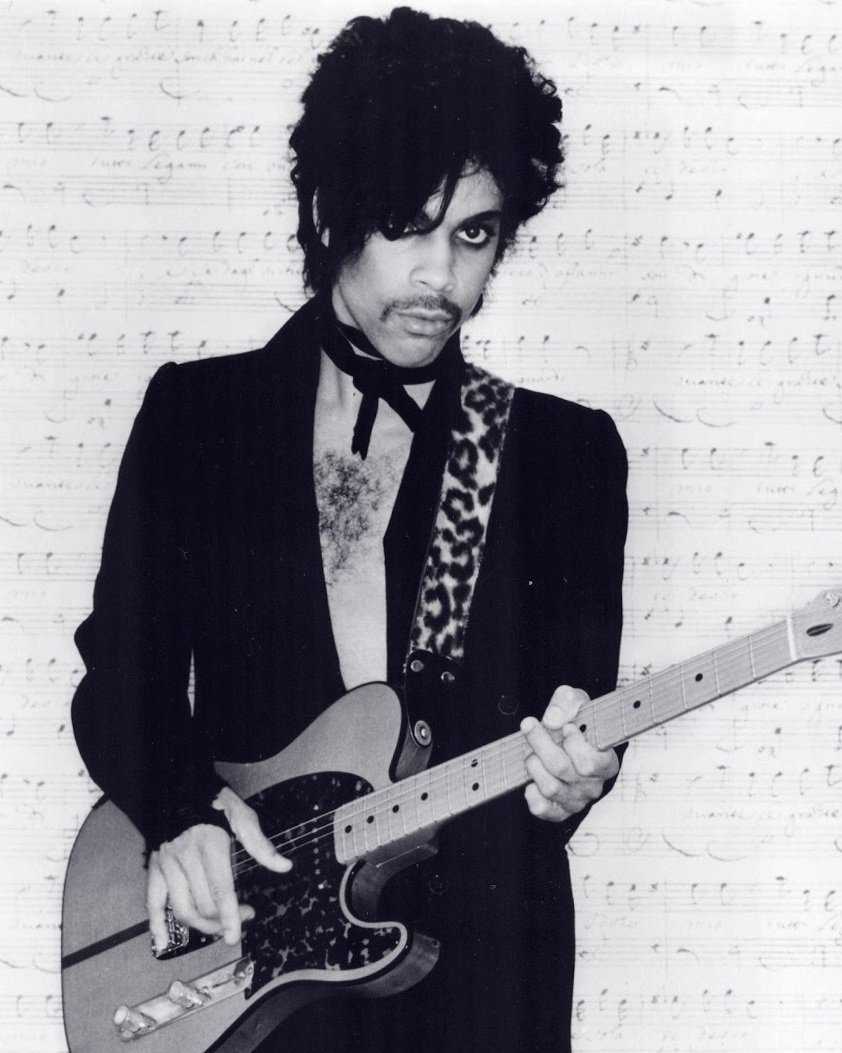
The Kind You Find in a Second-Hand Store: The Battles Behind Prince’s ‘Raspberry Beret’
In the spring of 1985, Prince was the biggest star in American pop, and everyone who had profited from that fact — his label, his managers, radio, retail, the press — expected the same thing from him: more of it. Purple Rain had spent twenty-four consecutive weeks on top of the Billboard 200. The film had made him a movie star. The tour was selling out arenas. The follow-up, the industry assumed, would be a second helping of purple thunder. What he gave them instead was a three-and-a-half-minute daydream about a girl in a raspberry-colored hat, bought second-hand, sung over finger cymbals and strings, on an album with a painted cover, no advance single and almost no promotion. “Raspberry Beret” was the lead single from that album, Around the World in a Day, and it reached number two in America, number one in Cash Box, and number two in New Zealand. It sounded like the easiest record Prince ever made. Almost nothing about it was easy.
The battles behind it were not the kind that produce headlines. They were battles of instinct and control: a song its creator had shelved three years earlier because, in its first life, it belonged to a different artist than the one he had become; a band asked to help him swerve away from the most successful sound in the world at the exact moment it was paying off; a record company instructed to keep quiet and let the album sink or swim whole; a music video shot twice and stitched together; a public-relations war over a charity record he had refused to sing on, fought out on the B-side of the single in Britain; and a chart race that the song lost to a James Bond theme. “Raspberry Beret” survived all of it, and then kept surviving — covered by a supergroup that barely wanted its own album released, sung by Prince on stage for thirty-one years, and played by him in public for the last time less than a month before he died. This is the story of how a song about a second-hand hat became the front line of the most consequential artistic stand of Prince’s career.
A Song from Another Lifetime
The first battle “Raspberry Beret” ever fought was against Prince’s own filing system. According to Prince Vault, drawing on Duane Tudahl’s session research, the song was originally tracked on April 27, 1982, at Studio 2 of Sunset Sound in Hollywood — and the company it kept that week tells you exactly where Prince’s head was at the time. The day before, he had recorded “How Come U Don’t Call Me Anymore”, and the day after he would cut “Something in the Water (Does Not Compute)”. This was the spring of the sessions that fed 1999, the double album of cold funk, drum machines and apocalyptic party music that would make him a star. “Raspberry Beret”, a warm, melodic, almost old-fashioned pop song about young love in the rain, did not belong to that world, and Prince knew it. The 1982 recording — Prince alone, on all vocals and instruments, as far as session researchers can tell — was simply shelved.
Shelving good material was not carelessness; it was method. Prince wrote and recorded at a rate that left finished hits sitting in his vault for years, waiting for the album, the band or the moment that suited them. But the shelving of “Raspberry Beret” created the song’s defining tension, because when he finally returned to it, he was no longer the artist who had written it. In 1982 he was a cult act with something to prove. By September 1984 he was coming off the biggest year any pop musician had enjoyed in a decade, fronting a band, the Revolution, that had become genuine collaborators, and chafing — already — against the sound that had conquered the world. The song he pulled out of the vault was a message from a younger, simpler Prince. The question that hung over its second recording was whether the new Prince could sing it without being swallowed by either version of himself: the hitmaker the public demanded, or the restless experimenter he insisted on being.
That tension is why the song matters more than its modest scale suggests. Dozens of artists, handed a three-year-old pop trifle in the middle of a commercial hurricane, would have left it in the vault or handed it to another singer. Prince did something harder. He rebuilt it, in public, as the calling card of an album designed to disappoint anyone who wanted Purple Rain repeated. The beret itself — the kind you find in a second-hand store — turned out to be the perfect emblem: something old, cheap and second-hand, worn with such confidence that it became the most recognizable look of the season.
The Empire It Had to Follow
To grasp what “Raspberry Beret” was up against, you have to measure the shadow it stood in. Purple Rain, released in June 1984 as the soundtrack to Prince’s film debut, was not merely a hit album; it was a total cultural occupation. It spent twenty-four consecutive weeks at number one on the Billboard 200 and 167 weeks on the chart in all. Its singles took turns ruling the summer: “When Doves Cry” and “Let’s Go Crazy” both reached number one, the title track peaked at number two, and “I Would Die 4 U” made the top ten. The film turned a Minneapolis club band into screen idols. The Purple Rain Tour played ninety-eight shows, opened every night with the album’s opening track, and sold some 1.7 million tickets before closing at the Orange Bowl in Miami in April 1985, where Prince told the crowd, “I have to go now. I don’t know when I’ll be back.” He collected Grammy Awards and an Academy Award along the way. By any commercial logic, the assignment for 1985 was obvious: make another one.
Prince had other plans, and he had begun executing them before the tour even ended. Recording for the next album reached back before Purple Rain itself, and sessions ran through 1984 at the Flying Cloud Drive Warehouse in Eden Prairie, Minnesota, at Sunset Sound, and in a mobile studio parked outside the St. Paul Civic Center. An early inspiration for the album’s sound, as Alan Light later wrote for Pitchfork, was a demo by David Coleman — the brother of Revolution keyboardist Lisa Coleman — which became the album’s title track and opened the door to music full of ouds, darbukas, cellos and finger cymbals. Where Purple Rain had been dense, electric and American, the new record would be dense, swirling and deliberately exotic: psychedelic pop and soul, drenched in strings, pitched somewhere between a fairground and a dream.
This was not a tantrum. It was strategy, and everyone around Prince understood the risk even if they could not stop it. He had fought for years to be taken seriously as an album artist rather than a singles act, and he had watched what happened to stars who repeated themselves on command: the second helping cooled, the audience drifted, the critics sharpened their knives. Better, in his calculus, to spend the capital of Purple Rain on freedom — to prove, at the peak of his leverage, that the follow-up could sound like anything he wanted. “Raspberry Beret”, the most straightforwardly lovable song in the vault, became the sugar that would help the experiment go down: the single chosen to lead an album that was, in every other respect, a refusal.
A Warehouse in Eden Prairie
The rebirth of “Raspberry Beret” began, per Prince Vault’s session logs, on September 7 or 12, 1984, at the Flying Cloud Drive Warehouse in Eden Prairie — the rehearsal-and-recording space that served as the Revolution’s home base. Prince laid down the basic tracks of the song essentially as a one-man band: lead vocals, twelve-string acoustic guitar, Yamaha DX7 and CP-80 electric piano, bass, Linn LM-1 drum machine and percussion, a blend of the organic and the electronic that was becoming his signature. Around him, though, the second recording of the song gathered the people the first one never had. Wendy Melvoin and Lisa Coleman, the Revolution’s guitarist and keyboardist, added their backing vocals, and a third voice joined them: Susannah Melvoin, Wendy’s twin sister, whose harmonies would become a defining texture of this era of Prince’s music.
Then, on September 13, 1984, the strings arrived. Novi Novog played violin; David Coleman, whose demo had set the album’s direction, played cello, alongside Suzie Katayama. Wendy and Lisa were credited with the string arrangement — a detail worth pausing on, because it captures how the Revolution actually functioned at its best. Prince was the unquestioned auteur, but the band’s members were not mannequins. Melvoin has recalled that the Revolution were “absolute musical equals in the sense that Prince respected us, and allowed us to contribute to the music without any interference”. On “Raspberry Beret” you can hear that trust in every bar: the song is a Prince solo performance at its core, but it blooms because other musicians were allowed to color its edges.
The finished arrangement expanded everything the 1982 demo had implied. Where the original had been a sketch, the album version was a miniature orchestra of pop: strings sighing over the verses, Middle Eastern finger cymbals ticking at the edges, the DX7’s bright synth sheen, and, in the extended version, a harmonica and a long funky introduction that reminded listeners the Revolution could still stomp when it chose to. Engineer Susan Rogers, who recorded much of the album, helped capture a sound that critics would file under neo-psychedelia and psychedelic pop — labels Prince himself resisted, but which described the record’s project accurately enough: the textures of 1967, rebuilt with the technology and rhythmic discipline of 1984.
What emerged from Eden Prairie that September was, on its surface, the least embattled record imaginable — three minutes and thirty-three seconds of sunshine. Underneath, it was a manifesto. Prince had taken a shelved song, dressed it in the Revolution’s full colors, and chosen it to lead the album on which he would test whether stardom could survive a left turn. The testing was about to begin.
Let the Project Be Taken in Its Entirety
The next battle was fought against the machinery of pop promotion itself, and Prince started it. When Around the World in a Day was released on April 22, 1985 — on his own Paisley Park imprint through Warner Bros. — it arrived, in compliance with his wishes, with minimal publicity. His thinking, as the label relayed it, was to “let the project be taken in its entirety before zeroing in on anything”: no advance single, no hype campaign, no framing. Singles were withheld until almost a month after the album was in the shops, an almost unheard-of act of restraint for a superstar release in the blockbuster 1980s. Radio, presented with a psychedelic song cycle where it had expected purple thunder, reacted warily; Billboard reported in May 1985 that radio was mixed on the album, and the trade press treated the whole enterprise as a puzzle: was this genius or self-sabotage?
The cover told the story before the needle dropped. Instead of Prince’s face, buyers got a fantastical painted landscape by Doug Henders, crowded with figures and colors, instantly drawing comparisons to the Beatles’ Sgt. Pepper’s Lonely Hearts Club Band. Prince swatted the comparison away when he finally discussed the album, and his explanation revealed the exhaustion underneath the strategy: “The cover art came about because I thought people were tired of looking at me. Who wants another picture of him? I would only want so many pictures of my woman, then I would want the real thing.” Of the album’s psychedelic tag he shrugged: “I don’t mind [the album being called psychedelic], because that was the only period in recent history that delivered songs and colors.”
The market, remarkably, held. Deprived of a single, dressed in a painting, following the biggest album of the decade, Around the World in a Day still climbed to number one on the Billboard 200 — Prince and the Revolution’s second consecutive chart-topping album — and was certified double platinum by the RIAA on July 2, 1985, eventually selling some 4.3 million copies worldwide. It was not a Purple Rain-sized phenomenon, and it was never meant to be. It was something rarer: proof that an audience would follow a pop star into strange territory on trust alone. The single chosen to prove it, when singles were finally allowed, was the beret.
Even the sequencing was a statement. On the album, “Raspberry Beret” sits fourth, after the title track’s Middle Eastern swirl, the utopian title-in-waiting “Paisley Park” and the six-minute piano reverie “Condition of the Heart” — a placement that said the hit was part of a landscape, not a lure. Fans who bought the album for the song had to travel through the experiment to reach it, and fans who came for the experiment found, glowing in its middle, the most purely pleasurable pop song Prince ever released. Both audiences were being trained. Neither was being asked.
Beaten by Bond
“Raspberry Beret” was released as a single in North America on May 15, 1985, and it immediately set about the most conventional battle a pop song can fight: the climb up the chart. It climbed superbly. In the United States it reached number two on the Billboard Hot 100 — and there it stopped, held from the summit by Duran Duran’s “A View to a Kill”, the theme from the James Bond film of the same name. There is no shame in the result: Bond themes were chart royalty, Duran Duran were at their commercial zenith, and a number-two single fronting a deliberately uncommercial album was a triumph of exactly the kind Prince had designed. But the near-miss has a poetic neatness. The song that was supposed to prove Prince could still write an effortless hit very nearly did top the chart, and was kept from perfection only by the most focus-grouped pop product imaginable — a movie theme by the era’s other great pop stylists. In Cash Box, the rival trade paper, the verdict was unambiguous: “Raspberry Beret” reached number one.
Everywhere else, the returns were those of a major hit. It topped Billboard’s Dance Singles Sales chart, reached number three on the Hot Black Singles chart and number four on Dance Club Songs, and even crossed to rock radio, peaking at number forty on Mainstream Rock. In New Zealand it reached number two, matching its American peak; in Canada it made the top ten; in Australia, number thirteen. The striking exception was Britain, where it stalled at number twenty-five — a flop by Prince’s standards, and a misleading one. In the UK and Europe, Warner’s had sequenced the campaign differently, leading with “Paisley Park” as the album’s first single there and issuing “Raspberry Beret” second, into a market that had already moved on. The song’s British afterlife would correct the record: in the streaming era it has been certified platinum by the BPI, and double platinum in New Zealand — the long tail of a song that British radio underplayed and British listeners never stopped loving.
The single also carried one of Prince’s secret weapons: its B-side. American buyers got “She’s Always in My Hair”, a taut rocker, all guitar and organ and a vocal that unravels into screaming by the end, which fans and critics have spent forty years ranking among the finest B-sides of his career — a song so strong that its presence quietly made the case, all by itself, that Prince’s throwaways outclassed most artists’ singles. The extended twelve-inch version of “Raspberry Beret”, the so-called New Mix, stretched the song to six minutes and thirty-four seconds, opening with that long funky introduction and finding room for the harmonica. Nothing about the package suggested an artist in retreat. It suggested an artist so confident that even his detours were deluxe.
Cash Box had greeted the single as “an immediately accessible track, melodic and teasingly sexual”, and Greg Tate, writing in Spin, heard “a typical Prince sex fantasy set to an arrangement reminiscent of the softer side of Abbey Road”. The Beatles comparison Prince kept refusing to make was, in the hands of his best critics, a compliment about craft. The battle with Bond was lost by one chart position. The battle for the song’s reputation was won on contact.
The B-Side That Went to War
If the American B-side was a fan favorite, the British one was a dispatch from a war. In the UK, Europe and Australia, “Raspberry Beret” arrived backed with “Hello” — a song Prince had recorded at Sunset Sound on May 24, 1985, in direct response to the worst press of his life. That March, the music world had gathered at A&M Studios in Los Angeles, on the night of January 28–29, 1985, immediately after the American Music Awards, to record “We Are the World”, USA for Africa’s all-star famine-relief single. Prince, the biggest star in America that night and the winner of three awards, declined to join the choir. He offered instead to write a song for the accompanying album — and did, contributing “4 the Tears in Your Eyes”, a track engineer Susan Rogers recalled him staying up all night to finish mixing in a mobile truck outside the New Orleans Superdome days later.
None of that nuance survived the night itself. Prince went out instead — to the Carlos ’n Charlie’s restaurant with singer Jill Jones, per Rogers’ account — where his bodyguards tangled with a paparazzo, and the gossip press had its story: the purple prince partied while his peers sang for starving children. Cartoonist Garry Trudeau mined the controversy in Doonesbury. Alan Leeds, Prince’s former touring manager, later summarized the pile-up in the liner notes to The Hits/The B-Sides: “Somehow his decision to pass on the ‘We Are the World’ session became convoluted by an encounter with an overzealous paparazzo and the gossip mongers had a field day.” Prince, who almost never answered criticism directly, answered it the only way he trusted: on record, in a B-side, within months.
“Hello” opens with his side of the story, set to cold funk: “I tried to tell them that I didn’t want to sing / But I’d gladly write a song instead.” It widens into an attack on celebrity culture itself — the camera that tried to get in his bed — and it name-checks the contribution the coverage had erased: “We’re against hungry children; our record stands tall.” Leeds called it “one of those rare cases where (Prince) used his studio forum for personal commentary, directly answering all those who second-guessed the effort and sincerity that had gone into ‘4 the Tears in Your Eyes’.” Released in America as the B-side of “Pop Life” on July 10, 1985, and in Europe behind “Raspberry Beret”, “Hello” ensured that the single which carried Prince’s sunniest pop song also carried, on its flip side, his angriest press release. The sunshine and the fight, pressed into the same seven inches of vinyl: that was who he was in 1985.
Two Videos, Mashed into One
The music video added another skirmish, this one inside Prince’s own perfectionism. Filmed on June 5, 1985, at S.I.R. in Los Angeles, the clip was directed primarily by Prince himself, and in its finished form it is a kaleidoscope: the Revolution performing amid a crowd of dancers, drifting animated elements drawn over the live footage, and Prince in the sky-blue suit covered in clouds that echoed the album cover — a star literally wearing the weather of his new psychedelic world. It uses the extended version of the song, funk intro and all. Producer Simon Fields later explained how the hybrid came to be: “For ‘Raspberry Beret’, we filmed a whole video, then Prince got a Japanese animator to do a completely different video and we mashed the two up.” The animation was created by Drew Takahashi, a co-founder of Colossal Pictures. Two complete conceptions of the video, neither sufficient alone, forced into one by the only man whose vote counted.
The set has passed into folklore because of one background dancer. Among the performers bouncing behind the band was a young punk musician named Pat Smear — later of the Germs’ legacy and the Foo Fighters — who could not, by his own cheerful admission, dance. As bandmate Dave Grohl tells it in the 2010 book I Want My MTV, the synchronized routines defeated Smear, the production sent him home, and then: “Prince whispers in the bodyguard’s ear. The bodyguard says, ‘You can stay. He likes your hair.’” It is the perfect Prince production note — arbitrary, aesthetic, absolute — and Smear stayed. The video also marked the screen debut of actress Jackie Swanson, who appears to hand Prince his guitar. Even the star’s appearance had been a negotiation with circumstance: Prince’s hair stylist Earl Jones later revealed that Prince had damaged his hair so badly before the shoot that “the hairstyle [in the video] was literally all I could do with it”.
Watched today, the video’s battle of styles reads as the album’s argument in miniature. A conventional performance clip — band, dancers, smiles — keeps being interrupted and overwritten by hand-drawn whimsy, as if the straightforward pop product were being doodled on by its own creator in real time. MTV put it in rotation, the song had its visual, and the mash-up stood: Prince would rather splice two visions together than release the safe one.
Breaking the Silence
For an artist who had built a mystique on refusing interviews, the autumn of 1985 brought the most public battle of all: Prince talked. On September 12, 1985, Rolling Stone published “Prince Talks: The Silence Is Broken”, Neal Karlen’s long interview — his first substantial print conversation in years — undertaken, with his management’s encouragement, as the pile-up of controversies (the bodyguard incident, the charity-single backlash, the puzzlement over the new album) demanded an answer. He used it to defend everything: the cover, the sound, the swerve. He denied the Beatles had inspired the record — “They were great for what they did, but I don’t know how that would hang today” — and pointed, characteristically, to Led Zeppelin as a model of albums that “make you feel differently on each song”. He also reported, with evident satisfaction, that funk godfather George Clinton was a fan of the album.
The critics, meanwhile, were fighting among themselves. Greg Tate’s Spin verdict on the album caught the bewilderment of the moment: “Perhaps it’s inevitable, given a career built as much on calculated mindfucking as mindblowing music, that Prince would choose to follow the best album of his career with the most bewildering, if not the worst.” Entertainment Weekly would grade it a C. Yet the reassessment, when it came, was emphatic. Alan Light, in a retrospective Pitchfork review that scored the album 8.8, called it “a brave and deeply personal project, exploring sounds and ideas that were almost shocking coming from a pop icon at his peak” — precisely the bravery that looked, in 1985, like commercial suicide. The Guardian’s Simon Price added the listener’s version of the same truth: the album “always sounds better than you think it will, when you revisit”.
“Raspberry Beret” was the bridge across which that reassessment marched. However listeners felt about oud solos and eight-minute closing tracks, nobody could argue with the beret; and because the song led the album in America, it became the door through which skeptical audiences kept re-entering the record, year after year, until the record’s reputation caught up with the song’s. Prince’s silence-breaking worked, in the end, because he had given the public one flawless pop object to hold onto while he explained the strange ones. The explanation took decades to be believed. The song never needed one.
The Excitable Boy Sings the Beret
Of all the covers “Raspberry Beret” has attracted, the strangest and most revealing arrived in 1990, when the song became a single for a band that had not meant to release an album at all. The Hindu Love Gods were a one-off congregation: Warren Zevon, rock’s laureate of beautiful losers, fronting three-quarters of R.E.M. — Bill Berry, Peter Buck and Mike Mills — who had backed him on his 1987 album Sentimental Hygiene. During late-night sessions in January and February 1987, at Record One in Sherman Oaks and A&M Studios in Los Angeles, the four cut a raw set of mostly blues covers for their own amusement: Robert Johnson, Muddy Waters, Willie Dixon, Woody Guthrie — and, sitting incongruously among the bluesmen, Prince. Their “Raspberry Beret” recast the daydream as bar-band stomp, Zevon’s dry bite replacing Prince’s coo, the strings and cymbals traded for guitar grit.
Then the battle started. According to Zevon and Mills, the album was published in 1990 — released on October 5 — by decision of Zevon’s manager, without consulting the musicians, creating a public rift between the singer and the R.E.M. contingent. The reluctant record nevertheless produced a genuine hit of its own kind: “Raspberry Beret” was issued as a single and reached number twenty-three on Billboard’s Modern Rock Tracks chart in December 1990, while the album reached number 168 on the Billboard 200. Zevon, undaunted, performed the song on Late Night with David Letterman. Think about what that means. A song Prince had shelved in 1982, then hidden inside his most willful album, turned out to be sturdy enough to survive translation into the idiom of two completely different artists — a psychedelic pop miniature robust enough to be played as a blues-rock bar song by men who were barely on speaking terms over its release.
The cover also proved something about the song’s construction that the original’s lushness concealed. Strip away Novog’s violin, the finger cymbals, the synth sheen and the Revolution’s harmonies, and the chassis still runs: that melody, that narrative, that chorus that lands like a wink. Songwriters call such songs indestructible. “Raspberry Beret” had now been a hit in two genres, for two artists with nothing in common but taste. It was becoming a standard — the fate Prince’s younger self, shelving it among the 1999 sessions, could not have pictured.
Thirty-One Years in the Setlist
The final measure of a Prince song is what he did with it on stage, and here “Raspberry Beret” outlasted nearly everything. Prince Vault’s records show its first live appearance on February 23, 1985, at the Forum in Inglewood, California — slipped into the Purple Rain Tour weeks before the album it belonged to was even released, a new daydream tested inside the purple machine. Once the album era began in earnest, the song stayed. On the 1986 Hit N Run shows it was performed in full; on the Lovesexy Tour of 1988 it survived in stripped-down form, Prince alone at the piano, often in medleys — the orchestral pop song reduced to voice and keys and losing none of its charm. Through the 1990s it recurred in medleys with “Take Me with U”; in 2002 it earned a place on One Nite Alone… Live!, his first live album. Tour after tour — Musicology, the London Earth Tour residency, Welcome 2 America, Hit and Run — the beret kept its place in the wardrobe.
And then there is the last entry in the ledger, the one that turns this whole story elegiac. The final time Prince performed “Raspberry Beret” in public was March 25, 2016, at the Sony Centre for the Performing Arts in Toronto — the second of two shows that night on his Piano & A Microphone tour, the stripped, reflective one-man production of his final months. Less than four weeks later, on April 21, 2016, he was dead at Paisley Park, aged fifty-seven. The song he had written at twenty-three, shelved, resurrected and fought for had been there at the end of the setlists, in the last chapter, sung by an older man alone at a piano — back, in a sense, to the one-man recording it had been at Sunset Sound in April 1982.
The public grief that followed carried the song back up the chart one more time. In the weeks after his death, “Raspberry Beret” re-entered the Billboard Hot 100 and reached number thirty-three on the chart dated May 14, 2016, and by April 30, 2016, it had sold 691,421 copies in the United States in the digital era alone. A song delayed three years at birth waited out its creator, and then, at the news of his death, went looking for the audience again — and found it, exactly where it had always been.
The One That Escaped the Vault
There is a final irony in the song’s history, and it concerns the version nobody has heard. The 1982 Sunset Sound recording of “Raspberry Beret” — the one-man demo Prince cut between two future 1999-era tracks — remains unreleased to this day, a citizen of the most famous archive in pop: the Paisley Park vault, the storeroom of thousands of tapes that became a legend in itself. Prince’s habit of recording far beyond any release schedule meant that for every song that escaped, dozens waited. “Raspberry Beret” is the great counterexample, the shelved song that got out, got rebuilt and got famous. Its original self never did. The hit the world knows is, strictly speaking, a cover version — Prince and the Revolution covering a record Prince alone had made three years earlier and decided, for reasons he never fully explained, not to release.
The released song, meanwhile, never stopped circulating. It anchored The Hits 2 in 1993, appeared on The Very Best of Prince in 2001, stretched out in its extended form on the Ultimate compilation in 2006, and took its place on 4Ever in 2016 — a permanent fixture of every attempt to summarize Prince in a track listing. Compilation producers are ruthless economists of attention, and their verdict across four decades is unanimous: no summary of Prince is complete without the beret. The song also escaped into other people’s repertoires in smaller ways — Zevon performed it on television, pub bands and wedding singers have made it a standard of the kind that needs no introduction — and it was sampled into the background of Prince’s own later work, turning up in the collage of his “Partyman” remix at the end of the decade, the Revolution era already being quoted by its own creator.
Consider, too, what the song did for the people who made it. The 1984 recording is the fullest flowering of the Revolution’s expanded family: Lisa’s brother on cello, Wendy’s twin on harmonies, strings arranged by the band’s two women. Within two years that family would be dissolved, the Revolution disbanded, the Melvoin-Coleman era over. “Raspberry Beret” preserves them at their most harmonious — literally, in the stacked backing vocals that carry the chorus — and it stands as the gentlest monument to a band that also made the most volcanic music of the decade. The battles around the song were real, but the record itself is the sound of a brief, unlikely peace: a shelved song, a united band, a star at his peak, all agreeing for three minutes about exactly what a pop song should feel like.
Why It Endures
“Raspberry Beret” endures, first, because it is perfectly made: a three-and-a-half-minute short story with a first line like a film still — a narrator working part-time in a five-and-dime, a girl who walks in through the out door wearing the kind of hat you find in a second-hand store — and a melody that critics have been decorating ever since. Paste ranked it eighth on its 2016 list of the fifty greatest Prince songs; American Songwriter placed it fourth in 2022. It is regularly spoken of in the same breath as his very finest singles, and it achieved that while standing, on its own album, as the representative of everything the album supposedly was not: simple, sunny, direct.
But the deeper reason it endures is the battle it commemorates. Every artist who reaches Purple Rain’s altitude faces the same fork: repeat the formula until the audience leaves, or spend the moment of maximum power on freedom and trust the audience to follow. Prince chose freedom, and he chose this song — slight, second-hand, three years old — as the flag planted on the new ground. The choice cost him a number-one single by a single place, a measure of radio goodwill and a season of hostile press. It bought him the rest of his career: the knowledge, proven in public, that he could put finger cymbals and cellos on a pop album at his commercial peak and take it to number one anyway. The beret was the proof of concept for everything that followed, from Parade to Sign o’ the Times to the symbol era and beyond.
That is why the song still feels like more than nostalgia. It is the sound of the biggest star in the world declining, politely and completely, to become his own tribute act — and doing it while whistling the catchiest tune of his life. The girl in the story wore a hat she had found in a second-hand store and made it unforgettable by how she wore it. Prince did the same with a song he had found in his own vault. The kind you find in a second-hand store, indeed. There was never another one like it.