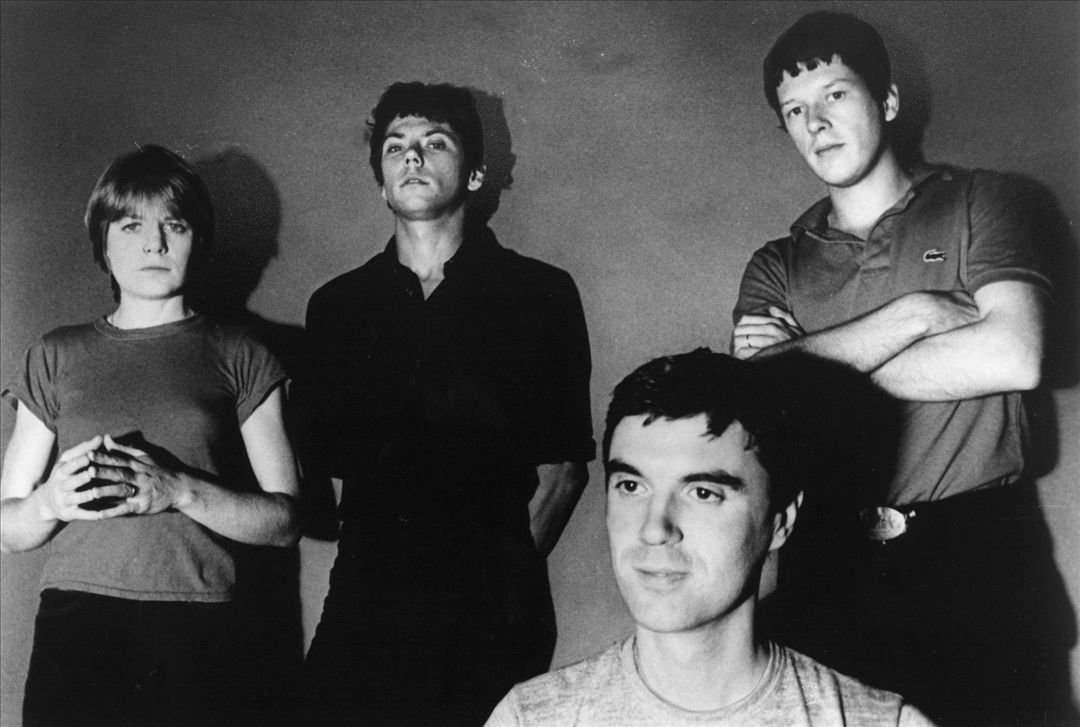
The Movie Flopped, the Lip-Sync Won: The Battles Behind Talking Heads’ ‘Wild Wild Life’
In the autumn of 1986, Talking Heads pulled off the strangest split decision of their career. On October 10, Warner Bros. released True Stories, the feature film David Byrne had written, directed and starred in — a gentle, baffling musical portrait of a fictional Texas town — and America declined to go. The film took in roughly $2.5 million at the box office and disappeared. Yet its lead single, released two months earlier, was by then climbing steadily toward number 25 on the Billboard Hot 100, its video — a frantic parade of ordinary people lip-syncing the song in a cabaret bar — was becoming one of the defining clips of the MTV era, and within a year it would win two MTV Video Music Awards. The movie had failed completely, and the song had escaped from it entirely. “Wild Wild Life” was the band’s third and last American top-40 hit, and it arrived attached to the project that more than any other announced what was really happening inside Talking Heads: the group was becoming a vehicle for one man’s ambitions, and everyone — the band, the label, the audience — was negotiating the new terms.
The battles behind “Wild Wild Life” are battles of ownership. Who owned the songs: the band whose name was on the sleeve, or the filmmaker who had written them alone for his own movie? Who owned the album: Byrne, who wanted the film’s cast to sing it, or Warner Bros., which overruled him and ordered a Talking Heads record instead? And who owned the hit that resulted — a song designed, uniquely in the band’s catalogue, to be performed by absolutely anybody? The answer to that last question turned out to be everybody, which is why the song is still alive. But the fight over the first two questions quietly consumed what was left of the band. This is the story of a joyous, disposable pop single with an unhappy family behind it — and of how the disposable thing outlasted nearly everything else.
The Director’s Chair
To see why True Stories happened at all, start with the band’s commercial position. Talking Heads had never been bigger. Speaking in Tongues had broken them in America; the self-financed Stop Making Sense had become a phenomenon; and Little Creatures (1985) — bright, tuneful, almost defiantly straightforward — had become the best-selling studio album of their career in the United States, eventually selling more than two million copies there. The anxious art-punk quartet from CBGB had become, improbably, a mainstream American pop band with a charismatic frontman whom Hollywood was beginning to regard as a personality in his own right.
Byrne’s ambitions had been leaking beyond the band for years: the Twyla Tharp ballet score, the Eno collaborations, the self-directed videos, the concert film he had essentially conceived for the stage. A feature film was the logical next annexation. He built True Stories from material he had collected out of tabloid newspapers — odd little items about ordinary people, which he expanded into a town: Virgil, Texas, preparing for a “Celebration of Specialness” to mark the state’s 150th anniversary. With playwright Beth Henley and actor Stephen Tobolowsky he shaped the clippings into a script of interlocking vignettes, less a plot than a pageant, in which the citizens of Virgil sing, scheme, shop, worship and look for love while a nameless narrator in a cowboy hat — Byrne himself — drives through town in a convertible, marvelling politely at all of it.
Warner Bros., which distributed the film and owned the band’s American label, Sire, agreed to finance the picture. It is important to register what an unusual arrangement this was: a major studio handing a feature film to a rock singer with no directing experience beyond music videos and a concert movie, on the strength of his sensibility alone. It is equally important to register whose project it was. The film was not a Talking Heads enterprise that Byrne happened to lead. It was a David Byrne film into which the band would be fitted — and the friction between those two descriptions runs through everything that followed, including the three minutes and thirty-nine seconds of “Wild Wild Life”.
Virgil, Texas
The cast Byrne assembled tells you the film he thought he was making: not a rock movie but an ensemble comedy of American eccentricity. John Goodman, then a working actor a couple of years away from Roseanne fame, plays Louis Fyne, a sweet-natured would-be country singer whose great project is finding a wife, and who advertises for one on television. Swoosie Kurtz is Miss Rollings, the laziest woman in the world, who has not left her bed in years and commands a small fortune from it. Spalding Gray plays Earl Culver, a civic booster delivering himself of an extraordinary monologue about the economics of progress; Annie McEnroe is his wife Kay, who lies compulsively and charmingly. Around them orbit a preacher, a Tejano singer who claims to hear the musical tone inside every person, a woman obsessed with conspiracy and cleanliness — played and sung by a community of townspeople in a town that is less a location than a state of mind.
Music was the town’s circulatory system. Byrne wrote a set of songs for the film’s characters to sing — not as decoration but as the mechanism by which these otherwise reserved people say what they feel. Goodman’s Louis performs the yearning “People Like Us”; Kurtz’s Miss Rollings croons from her bed; the gospel number “Puzzlin’ Evidence” erupts in a church; and at the town’s nightclub, the citizens step up one after another to lip-sync “Wild Wild Life”, each borrowing the song for a verse the way karaoke singers borrow a persona. In the film’s design, that sequence is the thesis: popular song as the voice ordinary people rent when their own words run out.
Byrne salted the fiction with reality wherever he could. Many of Virgil’s townspeople were not professional actors at all but local Texans — real talent-show performers, real paraders, real eccentrics recruited from the world the tabloids had described — and performers like Gray and Jo Harvey Allen extemporised around their scripted lines. The border between the film’s cast and its population was deliberately porous: Pops Staples, patriarch of the Staple Singers, appears as a voodoo practitioner; Tito Larriva, of the Plugz and the Cruzados, plays Ramon, the singer who hears tones in people. Virgil was built to feel like a place where a musical could plausibly break out, because the people in it were already halfway to performing. That porousness is the soil “Wild Wild Life” grew in: a song whose entire purpose was to be handed from stranger to stranger, tested in the film by an actual crowd of them.
Critics were divided about the result, though many were kind — Roger Ebert awarded it three and a half stars, and its retrospective approval rating sits respectably in the high seventies. Audiences, however, simply did not come. Released on October 10, 1986, True Stories earned about $2.5 million in American cinemas, a figure that constitutes a flop by any studio arithmetic, and settled into its long afterlife as a beloved curiosity rather than a hit. The film’s commercial failure matters to the song’s story because it transferred all of the project’s weight onto the record. Whatever True Stories was going to mean in public, the album and its singles would have to carry it.
One Name in the Songwriting Credits
Open the sleeve of Speaking in Tongues and the songs are credited to all four members of Talking Heads, with lyrics by Byrne. Open True Stories and the architecture has changed: the songs are David Byrne’s. “Wild Wild Life” is credited to David Byrne alone — songwriter, singular. It is the plainest possible documentary evidence of what the project was: a set of film songs written by a director for his characters, which his band then recorded. The other three Heads were, in the strictest contractual sense, his backing group. And True Stories stands alone in the catalogue for it: the albums either side of it — Little Creatures before, Naked after — restored the four-way songwriting credit, music shared among Byrne, Frantz, Harrison and Weymouth. Only here, on the film album, does the democracy formally lapse. A reader of nothing but the band’s sleeves could date the internal coup precisely: 1986, one album long.
The sessions reflected the paperwork. Where Speaking in Tongues had been built from communal jams across three studios and two seasons, True Stories was cut largely at Sigma Sound in New York with the band’s regular engineer of the era, Eric “E.T.” Thorngren, and the production credit was shared between Talking Heads and Andy Zax. Jerry Harrison later observed, in reflections on the period, that the True Stories sessions were different because the band was not really writing together in the rehearsal room anymore — the songs arrived formed, and the band’s job was to embody them. Everyone played beautifully; the record is tight, bright and professionally joyful. But the democracy that had produced “This Must Be the Place” out of a swapped-instrument jam — the four-way credit, the music-first method — had been replaced by a hierarchy, and everyone in the room could read the credits as clearly as the public could.
It would be too simple to call this theft. Byrne had genuinely written the songs, for a film he had genuinely directed; the other members had their own thriving outlets, and Frantz and Weymouth’s Tom Tom Club was a going concern. What changed was the meaning of the band’s name. “Talking Heads” had once described a method — four people making music none of them would have made alone. By 1986 it increasingly described a brand, under which one member’s work could be released with the others’ participation. “Wild Wild Life”, the most communal-sounding record they ever made — a song literally performed, in its famous video, by dozens of different people — was, behind the curtain, the least communal thing in their catalogue. The tension between those two facts is the song’s secret subject.
The Album Warner Bros. Ordered
The fiercest battle of the whole project was fought over a deceptively simple question: who should sing these songs on the album? Byrne’s intention was consistent with the film’s design. The songs belonged to the characters; the cast performances were the real soundtrack; and a cast album would preserve the eccentric, amateur-hearted spirit of Virgil — Goodman’s big earnest baritone, Kurtz’s lounger’s croon, the townspeople’s gospel. It was an artistically coherent position, and commercially it was hopeless, and Warner Bros. said so. The studio and label overruled him: Talking Heads would record their own versions of the film’s songs, so that the album could be sold as what the market wanted — the new Talking Heads record. The film’s incidental music was spun off into a separate low-key release, Sounds from True Stories, issued on LP and cassette and never reissued, and the cast performances were left in the film and on a handful of single B-sides.
Byrne complied, but he left a protest note in the one place he fully controlled: the album’s own liner notes. “This is not the soundtrack to the movie, True Stories”, he wrote, explaining that the record contained the band’s versions of the film’s songs, that in the film most of the songs are sung by the actors, and pointing listeners toward the separate score release. It is an astonishing document to find inside a major-label product — the artist using the packaging to disclaim the product, a small-print act of war filed in perpetuity. Read it again and the whole episode clarifies: the True Stories album that the world knows exists because a corporation won an argument with its own artist, and the artist made sure the record of that defeat would be printed on every copy.
What exactly was being withheld is worth spelling out, because the cast album-that-never-was had real riches in it. In the film, Annie McEnroe sings the dreamy “Dream Operator”; Pops Staples lends his trembling authority to “Papa Legba”; Tito Larriva performs “Radio Head” as Ramon; the preacher’s flock raises “Puzzlin’ Evidence”; and John Goodman gives “People Like Us” the full-throated yearning of a man singing his classified ad. These were not novelties but performances the film was built around — several of them by musicians of the first rank moonlighting as Texans. The 1986 settlement scattered them: the incidental score, featuring Byrne alongside Terry Allen and the Panhandle Mystery Band among others, was exiled to Sounds from True Stories, an LP-and-cassette-only release that was never reissued, and the cast’s songs survived officially only where a B-side had room. Warner Bros. had not merely chosen one album over another; it had chosen which version of Virgil the public would be allowed to own, and filed the other one away.
Only three performances escaped the split — the songs the film itself used exactly as the band recorded them: “Love for Sale”, “City of Dreams”, and “Wild Wild Life”. That accident of production had a long consequence. Because the album version and the film version of “Wild Wild Life” are the same recording, the song never suffered the identity crisis of its siblings; there was no rival “real” version haunting it. The single that radio played was the single the town of Virgil lip-synced. The corporation’s version and the artist’s version were, for these three minutes and thirty-nine seconds, the same thing — which may be one reason the song, alone among the album’s tracks, has never needed defending.
A Song Built for Strangers to Sing
Consider the song itself, because its construction is the plot. “Wild Wild Life” is a big, friendly, guitar-forward pop record — a strutting beat, a twang with a rockabilly sheen, a chorus that behaves like a chant, and Byrne whooping and yelping through verses that catalogue the enjoyably unhinged behaviour of modern life: sleeping on the floor, checking his behaviour, living the wild wild life of the title. Where the band’s earlier hits were built like puzzles, this one is built like a vehicle — Byrne’s own word for it, in his writing about the film’s lip-sync scene, was exactly that: the song becomes a vehicle that can say anything the performers want it to. He noted, with evident delight, the hall of mirrors involved: lip-synchers imitating characters in videos, who were themselves musicians imitating other characters.
That is why “Wild Wild Life” had to be the lead single, and why it worked as one. Released in August 1986, a month before the album, with the film version of Goodman’s “People Like Us” on the B-side — a B-side that quietly preserved a fragment of the cast album Warner had refused to release — it asked nothing of the listener but participation. Billboard’s reviewer heard “a bouncy singalong tune” over a minimal post-new-wave backing; Cash Box called it “quirky and typically fun”. Both were right, and both were describing an engineering achievement disguised as spontaneity: after a decade of making pop music that required explanation, Talking Heads had made a record whose entire meaning was that anyone could sing it. The strangest part is that this was not a sell-out but a concept — the democracy the band had stopped practising in the studio, staged as fiction in a Texas nightclub.
Listen to how it is actually put together and the craft shows. The record rides on Tina Weymouth’s bass — springy, melodic, the engine of the thing; her playing here has been singled out among the finest of her career — while Jerry Harrison’s guitar chops and struts over the top and the whole band piles into the chant of the title. It is arranged in layers of invitation: verses that behave like verses, a pre-chorus that winds the spring, and a title phrase engineered to be shouted by people who have heard the song exactly once. The twelve-inch single stretched it to an extended mix of five and a half minutes, on the correct theory that a song built as a party should be allowed to last as long as the party does. Nothing about it is naive, in the “This Must Be the Place” sense — it is the work of professionals at the height of their technique, aiming every technique they had at sounding like amateurs having the time of their lives. That aim, hit dead centre, is why the record has never dated the way its parent album has: technique ages, but an invitation does not.
The Slow Climb
The single’s chart life mirrored its nature: nothing explosive, everything cumulative. “Wild Wild Life” entered the Billboard Hot 100 in the first week of September 1986 at number 90 — the bottom of the chart, barely a foothold — and then climbed, week after week, the way a party song climbs, by being impossible to dislike in public. It reached its peak of number 25 in early December, twenty-one weeks after it began, and in doing so became the band’s third top-40 hit in America, after “Burning Down the House” and “Take Me to the River”, and also their last. On Billboard’s Mainstream Rock chart it reached number four. Abroad it did even better in places: number two in New Zealand, number nine in Ireland, number thirteen in Australia — though in Britain, where the band’s stock ran differently, it stalled at number 43.
The parent album, True Stories, released on September 15, 1986 — notably, a month ahead of the film it was supposedly the soundtrack to — peaked at number 17 on the Billboard 200, number seven in Britain, and number one in New Zealand, and was certified gold in both the United States and the United Kingdom. Respectable numbers, all of them; but for the first time in years the trajectory had bent downward, and number 17 made it the band’s lowest-charting American album since the end of the 1970s had established their ascent. The singles campaign ground on without another breakthrough: “Love for Sale” followed in November 1986, trailed by “Puzzlin’ Evidence”, “Hey Now” in some territories, and “Radio Head” in April 1987, each performing more modestly than the last — a long tail of releases from a project whose centre of commercial gravity was plainly its first single. The public had voted, in its aggregate way, for exactly one artefact of the Byrne film project, and it was the one where a roomful of nobodies sang the song.
There is a symmetry here that nobody involved can have enjoyed. “Wild Wild Life” succeeded by the very logic Warner Bros. had used to overrule Byrne: recognisable Talking Heads product, professionally delivered, would outsell an eccentric cast album. And it succeeded by Byrne’s logic too: a song built for strangers to sing was carried by strangers — radio listeners, MTV viewers, New Zealand — singing it. Both sides of the argument could claim the hit as vindication, which is usually a sign that the argument itself has become impossible to settle, and will simply be abandoned instead. Within two years, that is more or less what happened to the band.
The Lip-Sync
The video is an extended cut of the film’s nightclub sequence, padded with additional footage, and its premise is a single joke executed with total commitment. In a 1960s-styled cabaret bar, before a wall of video screens flickering with disjointed images, an endless procession of unannounced performers seizes the stage to lip-sync “Wild Wild Life” — townspeople, oddballs, and the band themselves in disguise. Jerry Harrison cycles through parodies: Billy Idol’s snarl, Kid Creole’s zoot-suited strut, Prince’s purple hauteur, even Ralph Macchio’s Karate Kid. Others in the parade channel Madonna and the general run of mid-eighties MTV royalty. Byrne himself pops up in character, including as a moustached lip-syncher; Frantz, Weymouth and Harrison appear as anonymous citizens of Virgil; and John Goodman, pre-fame and magnificent, takes his turn at the microphone like everyone else.
What elevates the clip beyond a novelty is that it inverts the normal economy of the music video. The star does not perform the song; the song performs the crowd. Identity in the video is a costume rail — anyone who steps to the front gets to be the lead singer for eight bars, and the pleasure on the participants’ faces is the entire special effect. In 1986 this was a lark. In retrospect it looks like prophecy: the clip anticipated the karaoke bars, the lip-sync television formats, and eventually the social-media era in which the default use of a pop song is for millions of ordinary people to mime it on camera. “Wild Wild Life” was not merely accompanied by the defining visual of its afterlife; the visual was its thesis, available to anyone with a mirror.
The industry ratified it. At the 1987 MTV Video Music Awards the clip was nominated three times and won twice — Best Group Video and Best Video from a Film — beating the ordinary run of performance clips with a video that is, essentially, the negation of performance. Harrison, looking back in the liner notes of the band’s best-of collection, called it his favourite Talking Heads video and the most fun to make, and wondered aloud what Prince had thought of his impersonation. Coming from the member of the band most often cast as its quiet professional, the affection matters: whatever the sessions had been, the day they all dressed up as other singers was the day the project felt like a band again.
The Quiet Casualty
And then there is what did not happen. Talking Heads did not tour behind True Stories. Indeed, they never toured again at all: the expanded nine-piece road band of the Speaking in Tongues era had played its last shows in 1984, and the machinery that once converted albums into communal experiences had been dismantled. The most successful American pop band of its kind spent its commercial peak as a studio-and-film enterprise — a fact that reads, now, less like a strategy than a symptom. A band that does not want to be in a bus together can still make records. It cannot do so forever.
The members’ recollections of the period share a rueful consistency. The collaboration had thinned; Byrne’s creative centre of gravity had moved to projects — film, theatre, solo records — where the chain of command was unambiguous, while Weymouth and Frantz had Tom Tom Club and Harrison had production work and solo ambitions. None of this was secret, and none of it was quite a quarrel either; it was a slow reallocation of loyalty that True Stories made visible in a single line of small print. When the songwriter credit on a Talking Heads album narrows from four names to one, the band has already told you its future. “Wild Wild Life”, the hit, was in that sense a message in a bottle from a group that was ceasing to be a group — and characteristically, the message was a party invitation.
It is only fair to record the dissenting critical view, because the song had one. Retrospective assessments of the album have often been unkind — Magnet, in a career re-evaluation, granted that the video was wonderful and the single a genuine hit, but heard the record itself as a well-planned pop product displaying little of the band’s wit or complexity; later rankings of the catalogue routinely place True Stories at or near the bottom. There is evidence for the prosecution: the song’s sunshine is generic in a way the band’s sunshine never had been, and its yelps and slogans sit closer to novelty than to the controlled derangement of the classics. But the prosecution keeps losing the case in the only court that finally matters, which is use. The song is still played, still mimed, still deployed wherever a filmmaker or a DJ needs four minutes of communal release. The well-planned single turned out to be planned well enough to survive its planners’ band.
After the Celebration
The band attempted one correction. For Naked (1988) they decamped to Paris with producer Steve Lillywhite and returned to improvisation — jamming first, songwriting second, in a deliberate echo of the Remain in Light method, as if the four of them could vote their way back to the old constitution. The four-way songwriting credit returned with the method, and the album yielded a durable fan favourite in “(Nothing But) Flowers”. But the constitution could not be restored by procedure: whatever had been reallocated could not be reallocated back, and after its release the band effectively ceased to function while never quite announcing that it had. Byrne made his solo album Rei Momo in 1989. The others waited. In December 1991 the end was made public in the bleakest possible fashion: Frantz has written that he learned Talking Heads was over by reading a newspaper interview in which Byrne said so. Sixteen years after CBGB, the most articulate band in rock ended by press clipping.
The aftershock produced one last battle, and it is the coda “Wild Wild Life” deserves. In 1996, Frantz, Weymouth and Harrison recorded an album as The Heads — pointedly, No Talking, Just Head — with a rotating cast of guest singers including Debbie Harry and Michael Hutchence, a format that amounted to the “Wild Wild Life” video rendered as a career move: the band as house ensemble, the lead vocal as an open mic. Byrne objected, and moved to stop the project, taking exception to musicians he regarded as trading on a name and a method he considered substantially his. The album was released anyway. Three years of arguments about who owned Talking Heads thus ended with the dispute made literal, in court filings and record-shop bins. The irony is heavy enough to bend light: the singer who had written a hit about how a song belongs to whoever is singing it spent the band’s afterlife contesting who was allowed to sing under its name. Both positions were honestly held. That is what a real battle looks like from inside.
There was one armistice. In 2002 Talking Heads were inducted into the Rock and Roll Hall of Fame, and the four members performed together on stage — briefly, graciously, and for the last time. Whatever lawsuits and newspaper announcements had intervened, the catalogue they had built together was formally declared permanent that night, with all four names attached to it. It remains the only full stop the story has: not a reunion, but a ratification.
The Thirty-Two-Year Wait
Meanwhile, the other artefact of the True Stories wars waited in the vault. The cast performances Byrne had wanted the world to hear in 1986 — Goodman, Kurtz, Gray and the townspeople singing their songs — survived the century only as fragments: stray tracks on the B-sides of twelve-inch singles, the occasional bonus cut, while the film itself drifted in and out of availability. The corporation’s 1986 decision had a half-life of decades. Fans who wanted to hear the movie’s actual soundtrack had to assemble it like smugglers.
Redress arrived in November 2018, thirty-two years after the film. The Criterion Collection issued True Stories on Blu-ray in a restored edition, and alongside it appeared True Stories, A Film by David Byrne: The Complete Soundtrack — twenty-three tracks presenting the music as recorded for the film, cast performances at last officially released, with the three Talking Heads performances used in the picture, “Wild Wild Life” among them, sitting inside the sequence they were made for. The critical rehabilitation of the film rolled along with it: the flop of 1986 is now a Criterion title, which is the film world’s equivalent of the Rock and Roll Hall of Fame. And the song that had spent three decades as a Talking Heads single could finally be heard in its other identity — as the sound of a fictional town celebrating itself, sung by everybody and nobody.
It is tempting to ask who won the argument of 1986. Warner Bros. got its Talking Heads album and its gold record and its top-40 single; the corporation was not wrong about the market. Byrne got his film restored, his cast album released, and his liner-note protest upgraded by history into a statement of principle; the artist was not wrong about the art. The listeners, meanwhile, got both, plus the delay — which suggests that the honest verdict on record-company interference is occasionally “not yet” rather than “no”. But if the question is which artefact carried the whole enterprise across thirty-two years of indifference, there is no contest. Without “Wild Wild Life” there is no Criterion edition, no complete soundtrack, no rehabilitation — because there would have been nothing the culture refused to forget. The hit the label manufactured and the set piece the director designed turned out to be the same three minutes and thirty-nine seconds, and they held the door open for everything else.
The album’s long underground influence surfaced in at least one place nobody predicted: the name of the next decade’s defining British band. Radiohead, casting about in 1991 for a replacement for their original name, On a Friday, took their new one from “Radio Head” — a True Stories track, one of the very songs that exists in two versions, the band’s and Tito Larriva’s, because of the 1986 settlement. The supposedly disposable film album had seeded the future twice over: once in a hit single built for amateurs, and once in a throwaway title that ended up on the sleeves of OK Computer and Kid A. Catalogues dismissed in their own decade have a way of collecting these debts quietly and presenting them later, with interest.
Why It Endures
“Wild Wild Life” endures, first of all, because it is built to be used. Its pleasures are transferable: the chant, the strut, the grin in the vocal, the sense that the song is a room anyone can walk into. It asks for no context — not the film, not the band’s history, not even the words, most of which are cheerful nonsense about the carnival of modern life. Playing it at a party in any decade since 1986 produces the same small event: people who were sitting down stand up, and somebody mimes the chorus. The song designed as a vehicle is still being driven, by new strangers every night, exactly as its author said it would be.
Its employment record since proves the point across generations and media. The Jamaican duo the Wailing Souls covered it for the 1993 film Cool Runnings; it turned up in trailers for Brother Bear and Over the Hedge; and in 2006 it opened Sony’s animated Open Season, riding over the credits of a children’s film whose audience had not been born when Virgil, Texas, was invented, and earning its place on that film’s soundtrack album. A generation of kids met Talking Heads through a cartoon bear, singing along to a song their parents knew from MTV — the lip-sync relay passing the baton exactly as designed. Perhaps the neatest footnote of all: Talking Heads themselves never performed the song live. It entered the concert repertoire only a quarter-century later, when Byrne added it to the setlist of his Love This Giant tour with St. Vincent — the song’s author finally stepping up to the microphone like one more citizen of Virgil, to sing the number he had written for everybody else.
But there is a second, sadder reason, and it gives the record its peculiar sweetness. “Wild Wild Life” is the sound of a great band at the precise moment it stopped being a band and became a brand — and the sound, miraculously, is joy. Nothing in its grooves betrays the narrowed credits, the overruled director, the unreplaced producer’s chair or the tour that never happened. The friction that produced it was real, and the friction is nowhere in it; what is in it is four musicians and a town full of imaginary Texans all briefly agreeing that singing somebody else’s song, as loudly as possible, is one of the best things people do. Talking Heads made cleverer records, deeper records, more revolutionary records. They never made a more generous one. The movie flopped, the band dissolved, the cast album waited thirty-two years — and the lip-sync, as predicted, won.