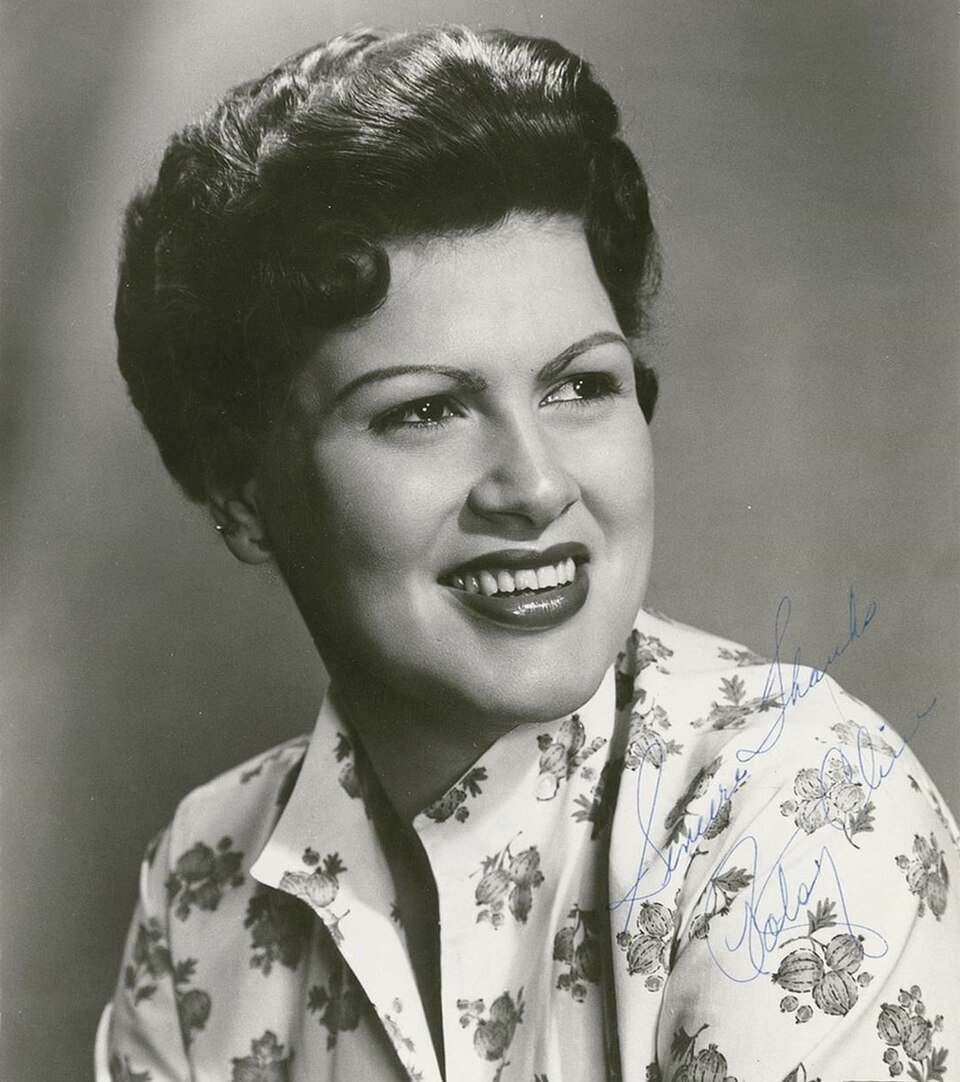
The Song Nobody Wanted: The Battles Behind Patsy Cline’s ‘I Fall to Pieces’
On January 30, 1961, Decca Records released a single that almost nobody in the music business had wanted. Brenda Lee had turned the song down for being too country. Roy Drusky had turned it down for not being a man’s song. The singer who finally recorded it thought it was too pop, fought her producer over its sound, and nearly froze out the backing singers hired for the session. Radio, when the record finally arrived, ignored it almost completely. Yet by the first week of August 1961, “I Fall to Pieces” stood at No. 1 on the Billboard country chart and No. 12 on the pop chart — and the woman who sang it was recovering, on crutches, from a near-fatal car crash that had nearly killed her while the record climbed.
Few records have had to win so many fights before, during, and after their making. “I Fall to Pieces” survived a songwriting partnership’s growing pains, a string of rejections, a hostile recording session, a promotional campaign waged disc jockey by disc jockey, and one of the slowest chart climbs Billboard had ever seen. It then outlived its singer, who was dead less than two years later, and went on to be re-dressed, electronically duetted, covered by generations of singers, and ranked among the greatest country songs ever made. This is the story of those battles — and of how a song about falling apart became the record that held a legend together.
Written in an Hour
The song began, as so many Nashville standards did, with a title looking for a home. Hank Cochran, a young songwriter from Mississippi who had knocked around California’s honky-tonk circuit, was working as a song plugger for Pamper Music when a phrase came to him one night while he was turning over ideas: “I Fall to Pieces.” It was a title with the ache already built into it — all it needed was a song underneath. The next day, Cochran took it to the house of Harlan Howard, the prolific professional writer with whom he had begun collaborating after the two met in California.
Howard later told the story with the economy of a man who had written hundreds of songs. “In the summer of 1960, here in Nashville, a friend of mine named Hank Cochran stopped by my house on his way to work as a song-plugger for Pamper Music, and asked me to help him write a new song he was working on,” Howard recalled. “He then sang me the first two lines of the song, and I liked it. So in the next hour, we wrote it.” But Howard, a craftsman who would one day define his trade as “three chords and the truth,” was not quite satisfied. “After Hank left for work, I sang what he had and timed it with my watch, and it seemed like it wasn’t long enough,” he said. “So I wrote another section the same length as the first half and took it to Hank at his office, and he liked it, and that was about it.”
The result was a lyric of unusual emotional cruelty, all the worse for being so plain: a woman keeps running into the man who has discarded her, and each sighting — each time someone speaks his name — undoes her all over again. “You want me to act like we’ve never kissed,” she tells him. “You want me to forget, pretend we’ve never met.” It was a song about the impossibility of performing indifference, written in an hour by two working songwriters who understood heartbreak as a trade.
It was also, structurally, a small marvel of honesty. There is no revenge in it, no new lover waiting in the wings, no promise of recovery. The singer does not even claim she will stop trying to get over him — only that every attempt collapses on contact with reality, when he walks by. Howard built the song to be sung by someone standing still and taking it, which may be why it resisted every singer who wanted to perform it, and yielded only to one prepared to inhabit it. “The toughest songs in the world to write are love songs,” Howard once said. “‘I love you, and I will forever, and blah blah blah.’ I’d rather get into a song about a relationship that’s a little bit shaky or even tragic. That, in my mind, represents country music and the drama of the man/woman thing.”
Cochran took the finished song to Decca. The demonstration recording was cut at Pamper Music in Goodlettsville, Tennessee, and sung by Howard’s wife, Jan Howard — herself a formidable country singer who would place no fewer than thirty singles on the country chart in her own career. With Jan’s demo in hand, the song went looking for a voice. It would not be an easy search.
There is a rich irony in what followed. Cochran plugged songs for a living — it was literally his job to place material with artists and producers — and both writers were already respected craftsmen on the rise. Yet their most durable creation would spend months being passed from singer to singer like an unwanted parcel. “I Fall to Pieces” was the first of a string of songs that Cochran and Howard, together and separately, would write for Cline, but in the summer and fall of 1960 it was simply a beautifully built heartache song that nobody seemed to want to own.
Too Country, Not Manly Enough
Producer Owen Bradley, the architect of Decca’s Nashville operation and one of the founding fathers of the polished “Nashville Sound,” believed in the song before he had even properly heard it. “I always look carefully for a song idea,” he told Billboard in an interview published on August 5, 1961, the very week the record climbed to the country summit. “When I heard about ‘I Fall to Pieces’… I bought the lyrics right over the phone, without even hearing the tune. These are the kind of song thoughts for the everyday little guy, for the working people. They capture a little human experience that people can identify with.”
But belief in the song was not the same as finding someone to sing it. Bradley first offered it to Brenda Lee, another of his Decca productions and the label’s brightest young star — still in her teens, and sliding so easily between country and pop that she seemed the obvious candidate for crossover material. Lee turned it down: the song, she felt, was too country for her pop style. Bradley next approached Roy Drusky, a rising baritone whose smooth, sorrowful delivery seemed made for heartache material. Drusky refused on opposite grounds — in his judgment, it was not a man’s song. Between them, Lee and Drusky had located the song’s defining problem and its defining strength: it belonged fully to neither market, which meant it might, with the right singer, conquer both.
The argument between Bradley and Drusky was overheard. Standing in the hallway was Patsy Cline, newly signed to Decca and hungry for material she could believe in. She asked Bradley if she could record the song instead, and he accepted her offer. It is one of the great accidents of casting in American music: the definitive recording of “I Fall to Pieces” happened because its singer happened to be within earshot of its rejection.
The Singer Who’d Had One Hit
To understand why Cline seized on a song two other singers had refused, you have to understand how precarious her career was in 1960. She had been recording for six years, and the ledger was bleak. She had signed with 4 Star Records on September 30, 1954, on a contract that gave the label the vast majority of the revenue and left her with less than three percent in royalties. The label’s boss, Bill McCall, handpicked her material, much of it mediocre, and she spent years groping for a sound across gospel, rockabilly, traditional country, and pop.
There had been exactly one breakthrough. In January 1957, she appeared on Arthur Godfrey’s Talent Scouts and — over her own initial objection, since she had wanted to sing a different song — performed “Walkin’ After Midnight.” She won the contest, Decca rush-released the single, and it became a major hit on both the country and pop charts. Then, for three more years, nothing. Single after single failed, and Cline, who had relocated to Nashville in 1958, was in danger of being remembered as a one-hit wonder with a magnificent voice. Historians Robert Oermann and Mary Bufwack, in Finding Her Voice: Women in Country Music, called the material 4 Star gave her “mediocre” and wrote that she seemed to have “groped for her own sound on the label.” Unterberger judged that on most of her early singles she sounds “stiff and ill-at-ease” compared with her best work. She was also, by 1960, a mother of two young children — her son Randy was born in 1961, the year of this record — trying to sustain a household on a career that had produced one hit in six years.
In 1960 the pieces finally moved. Under manager Randy Hughes, she became a member of the Grand Ole Opry, and when the 4 Star contract at last expired, she signed with Decca. Crucially, the new deal gave her something she had never had: freedom. As AllMusic’s Richie Unterberger has noted, “I Fall to Pieces” was cut at the very first session where Cline was at liberty to record what she wanted. And there, waiting for her, was Owen Bradley — who had actually produced her very first recording session back in 1955, when 4 Star leased its masters through Decca.
Bradley had a vision for Cline, and it was not the vision she had for herself. Cline saw herself as a honky-tonk singer, a belter in the tradition of the music she had grown up on. Bradley wanted to move her toward lush, pop-leaning torch ballads — smooth arrangements, background voices, material that could cross over. As he later told Loretta Lynn in an interview for Lynn’s 1977 album I Remember Patsy, Cline’s instinct was that if she couldn’t yodel or growl on a record, she wanted no part of it. The song she had just volunteered to record sat precisely on the fault line between those two visions.
War in the Quonset Hut
The session took place on November 16, 1960, at Bradley Studios — the famous Quonset Hut on Music Row, a surplus military hut behind a house on 16th Avenue South that had become the birthplace of the Nashville Sound. Bradley assembled the A-Team, the elite pool of session musicians who played on seemingly every Nashville hit of the era. The personnel, as preserved in the liner notes of Cline’s album Showcase, reads like a hall of fame roll call: Hank Garland on electric guitar, Randy Hughes — Cline’s own manager — on acoustic guitar, Harold Bradley, the producer’s brother, on six-string electric bass, Bob Moore doubling on acoustic bass, Doug Kirkham on drums, Ben Keith on steel guitar, and the blind piano virtuoso Hargus “Pig” Robbins at the keyboard. Keith, then a young steel player, would a decade later become Neil Young’s longtime right hand.
Before a note was recorded, there was a confrontation. The background singers Bradley had booked were the Jordanaires, the celebrated vocal quartet who spent much of their time backing Elvis Presley — which was, from Cline’s side of the glass, precisely the problem. They were the most famous pop-backing voices in Nashville, and she heard them as a threat twice over: they might drown out her sound, and they would mark her record as pop. According to Jordanaires member Gordon Stoker, she was not very friendly — indeed, not very pleasant — when they first met her that day. She also remained deeply suspicious of the song itself, believing its production lacked the country instrumentation she wanted and leaned too far toward pop.
Then the musicians themselves got stuck. Everyone in the room had agreed on one thing: they did not want the arrangement to ride the standard 4/4 shuffle, the default rhythm of a thousand country records. Harlan Howard, present at the session, remembered the struggle vividly. “On the night of the session, we absolutely did NOT want to do the standard 4:4 shuffle that had by then been done to death,” Howard recalled. “We were trying all kinds of other (basic rhythm) combinations, but they all just laid there and bled all over the floor. So, it had to be the shuffle then, like it or not.”
What happened next passed into Nashville legend. “But the amazing thing was, once Patsy got into the groove, she just caressed those lyrics and that melody so tenderly that it was just like satin,” Howard said. “We knew we had magic in the can when, on the fourth take, every grown man in that studio was bawling like a baby and Bradley said ‘That’s the one’.”
The playback settled everything. Listening to herself, Cline finally heard what Bradley had heard all along: the restraint was the power. Biographer Ellis Nassour recounts that she concluded Bradley had been right about the torch songs, that she liked the track, and that she felt she had finally found her own identity as a singer. The Jordanaires, far from remaining enemies, became fast friends and part of her inner circle, backing her for the rest of her career. The finished record ran just two minutes and forty-seven seconds. Nobody in the Quonset Hut that night doubted its quality. The battle now was to get anyone else to listen.
Listen to what that reluctant session produced, and you can hear every argument resolved into design. The shuffle the musicians had tried to avoid became the record’s heartbeat, a gentle rocking motion under Robbins’s piano and the doubled basses of Moore and Harold Bradley. Ben Keith’s steel guitar sighs rather than weeps. The Jordanaires — the very voices Cline feared would swamp her — do not compete with her at all; they cushion her, humming the song’s sorrow back at her like a room full of witnesses. Above all of it, her voice stays level, almost conversational, cracking only where the lyric cracks. Bradley had not diluted country music. He had built a frame quiet enough for the most expressive voice in Nashville to be heard at full emotional volume.
The Record Radio Wouldn’t Play
“I Fall to Pieces,” backed with “Lovin’ in Vain,” was released as a single on January 30, 1961. The response was silence. Upon its release, the record was virtually ignored by radio stations, both pop and country — a record caught in precisely the borderland its makers had argued about. Country programmers heard the smooth Bradley production and the Jordanaires’ crooning and hesitated; pop programmers heard a country singer’s name and a shuffle beat and passed. The song that had been rejected as too country by one star and embraced as a torch ballad by its producer now risked pleasing no constituency at all.
The rescue was mounted by the song’s publisher. Hal Smith, the promotion man at Pamper Music, believed in Cochran and Howard’s song when almost nobody else would act on that belief, and he hired a road man named Pat Nelson to take the single directly to disc jockeys, station by station. Nelson’s task was harder than it sounds: he was carrying a record by a singer whose name, to most programmers, meant one four-year-old hit followed by a string of flops, on a label whose Nashville Sound many country purists distrusted, in a song two name artists had already refused. Nelson’s strategy was a two-front war, and he pitched the same record as two different things. To country DJs, he explained that “I Fall to Pieces” was a departure from anything Cline had released before — a new, modern sound. To pop DJs, he argued that Cline was about to become one of the great torch singers, in the lineage of Patti Page and Rosemary Clooney.
The breach came in Columbus, Ohio, where a pop radio station began playing the single — a country record, breaking first on pop radio, after having been turned down by Brenda Lee for excessive country-ness. From there, distributors across the country began fanning the record, and within four months the momentum was building on both the country and pop charts at once. It was a template the industry would use for decades: when a record falls between formats, you don’t fix the record — you sell it twice.
The stakes of that border war are easy to forget now. In 1961, rock and roll had supposedly killed old-fashioned country music, pop stations treated country singers as hillbilly novelties, and the Nashville Sound itself — Bradley’s smooth, string-and-voices answer to rock — was a survival strategy for an entire industry. A Decca single by a twenty-eight-year-old singer with one hit in six years was nobody’s idea of a safe bet. That is why the Columbus breakthrough mattered so much: it proved the record could play in the format that was supposed to be closed to it, and it gave every hesitant country programmer permission to follow.
The Slowest Climb Ever Seen
The song debuted on the Billboard country chart on April 3, 1961, and then began what Ellis Nassour’s biography calls the slowest ascent ever seen. Week after week it inched upward, a record with no promotional blitz behind it, carried by requests, jukeboxes, and the slow contagion of a performance listeners could not shake. On August 7, 1961 — more than six months after its release, nearly nine months after it had been recorded, and some eighteen weeks after it had first crept onto the country chart — “I Fall to Pieces” reached No. 1 on the Billboard country chart, Cline’s first chart-topper. It crossed over to No. 12 on the Billboard Hot 100, reached No. 6 on the Adult Contemporary chart, and even climbed to No. 13 in Australia. True to its nature, it was also one of the slowest chart descenders of its era, refusing to leave.
The achievement was bigger than one singer’s comeback. Cline had proven that a solo female artist could have major hits on both the country and the pop charts simultaneously — a demonstration that landed in an industry that had treated women singers as novelties and sideline attractions. By the end of 1961, she was being acclaimed in the trade press as one of the nation’s leading recording artists, in the company of pop stars such as Jimmy Darren and Bobby Vee.
Cline knew exactly whom she owed. In gratitude, she bought a bracelet for Harlan Howard and a money clip for Hank Cochran, each engraved with the same message: “Thanks for the Hit – Patsy.” For the rest of their lives, both men said, it was the only token of appreciation — other than a great recording — that either of them had ever received from an artist. Howard’s affection for the record never faded. “After several rejections, Patsy recorded it,” he said decades later, “and I still love the record as much as I did way back then.” She could not have known, as she handed the gifts out, that she would have less than two years to enjoy what the song had won her. She also could not promote the record at the moment of its triumph. By the time it reached the top, Patsy Cline was fighting a battle of an entirely different kind.
In November 1961, Decca gathered the hit onto her second studio album, Showcase, sealing the transformation: the honky-tonk singer who had groped for a sound through six years of flops now had a defined identity, an album built around it, and a producer whose once-resisted instincts had been vindicated in public. The torch-ballad style she had fought in the studio was now simply, permanently, the Patsy Cline sound.
June 14, 1961
That summer, Cline’s mother, sister, and younger brother Sam Hensley Jr. came to Nashville to visit the new home she had bought. On June 14, 1961, Cline and Sam went out shopping for fabric, so their mother could make clothes during the visit. Driving home along Old Hickory Boulevard in Nashville, they were met by a car in the oncoming lane that pulled out to pass another vehicle — and struck them head-on.
The impact threw Cline into the windshield. It was the second serious car accident of her lifetime, and by far the worse. Fellow singer Dottie West, among the first to reach the scene, picked pieces of glass from Cline’s hair and rode with her in the ambulance. Even in shock and agony, Cline insisted that the driver of the other car be treated before her. She later said that she saw the woman die before her eyes; as she afterward put it to friends, it was “like maybe I watched her die for a reason.” The driver and her young son were both killed, two of the three people in the other car. Cline’s own injuries were catastrophic: a jagged cut torn across her forehead that barely missed her eyes, a broken wrist, cracked ribs, and a dislocated hip.
She was taken to Madison Hospital, where doctors did not expect her to survive the surgery she needed. She did survive it — she later told her husband, Charlie Dick, that she had felt a presence at her side in the hospital, recounting, “Jesus was here, Charlie… He took my hand and told me, ‘No, not now. I have other things for you to do.’” Her friend Billy Walker recalled that she rededicated her life to Christ during that hospital stay, as thousands of cards and flowers from fans poured in. She would spend a month in the hospital. And outside its walls, her record kept climbing.
A Song on the Radio, a Singer in a Bed
There is a particular cruelty in hearing your own breakthrough on the radio while lying bandaged in a hospital bed, forbidden to work. For weeks, “I Fall to Pieces” rose up the charts while its singer could do nothing to help it — no television appearances, no tour dates, no Opry performances. Promotional tours are how records were sold in 1961; Cline’s convalescence was, commercially speaking, the worst-timed absence imaginable. The record climbed anyway, on its own merits, without her.
Then the song gave something back. One Saturday night that July, a young Kentucky singer named Loretta Lynn — a newcomer who had moved her family across the country to Tennessee with little more than a seventeen-dollar guitar and a single, “I’m a Honky Tonk Girl,” to her name — stood up on the Midnite Jamboree, the live WSM radio broadcast from Ernest Tubb’s record shop that followed the Grand Ole Opry, and sang “I Fall to Pieces,” dedicating the performance to the hospitalized star. Cline, listening in her hospital room, was so moved that she sent her husband Charlie down to bring Lynn straight to her bedside. “Did I know meeting Patsy that day would change my life? No. How could I?” Lynn wrote in her 2020 memoir Me & Patsy Kickin’ Up Dust. “But I knew I’d found a real friend: a great singer, a proud momma, a woman who wasn’t afraid to stand up for herself.”
The bedside meeting began one of the most famous friendships in country music history, with Cline mentoring Lynn in everything from hair and makeup to standing her ground in a male-dominated industry — even, Lynn recalled, confronting a group of Opry women who had plotted to block the newcomer’s appearances, and ending the scheme by showing up with Lynn at her side. “She came into my life and changed everything,” Lynn wrote. “That’s what real friendships do. We made each other better.” It had all begun with the song — a recording about a woman undone by hearing a name, answered by a stranger singing it back to her as an act of love.
Cline was released from the hospital on July 17, 1961, to recover at home on crutches. Her forehead was visibly scarred, and for the rest of her career she would wear wigs and makeup to cover the scar and headbands to ease the headaches the injury left behind. About six weeks after the crash, still on crutches, she returned to the stage of the Grand Ole Opry. A live recording from Tulsa’s Cimarron Ballroom that summer, released on record decades later, preserves her telling the crowd, “This is the first time I’ve worked since I got outta the hospital.” Weeks later she was back in Bradley’s studio, still healing and still reliant on crutches, recording her follow-up single — but that is another song’s story. In the first week of August, battered, scarred, and standing with difficulty, she watched “I Fall to Pieces” complete its climb to No. 1.
Twenty-One Months Later
Twenty-one months after the crash on Old Hickory Boulevard, Cline’s story ended the way the crash had nearly ended it. Her peak years were brilliant and brutally short. The hits continued — and then, on March 5, 1963, flying home to Nashville after a concert in Kansas City, the small private plane carrying her went down near Camden, Tennessee. Cline was killed, at thirty years old, along with singers Cowboy Copas and Hawkshaw Hawkins and her manager Randy Hughes, who was piloting the plane — the same Randy Hughes whose acoustic guitar can be heard on the “I Fall to Pieces” session, twenty-seven months earlier. The voice on the record was twenty-eight when she made it. She never grew older than the song.
But the battles over the record were not finished; they simply changed form. In 1980, Cline’s isolated vocal was lifted from the original three-track master tapes, transferred to digital multitrack, and built into an entirely new arrangement — new instrumentation, new female background vocalists in place of the Jordanaires she had once resisted and then embraced — for the compilation Always. The re-dressed “I Fall to Pieces” charted all over again, reaching No. 61 on the Billboard country chart, a ghost record from a singer seventeen years dead. Two years later came something stranger still: an electronically assembled duet with Jim Reeves, who had himself died in a plane crash in 1964. Cline and Reeves never recorded together in life; engineers married their master tapes in death, and the duet reached No. 54 on the country chart in the United States and No. 41 in Canada. The song had become so valuable that the industry was now manufacturing new versions of it out of tape, technology, and memory.
Everyone Falls to Pieces
Other singers, at least, could do it honestly. The covers began almost immediately and never really stopped. Boots Randolph cut an instrumental version for his 1963 album Boots Randolph’s Yakety Sax! In 1964, Dottie West — the friend who had picked the glass from Cline’s hair at the crash scene — recorded it for her album The Country Girl Singing Sensation, an act of remembrance as much as repertoire. Diana Trask took it back onto the country chart in 1969 with a version from her album From the Heart, reaching No. 37 in the United States, No. 29 in Canada, and even bubbling under the Hot 100. Linda Ronstadt recorded it on her 1970 album Silk Purse, carrying it into the country-rock era. Loretta Lynn, whose friendship with Cline had begun with the song, included it on her 1977 tribute album I Remember Patsy — produced, closing the circle, by Owen Bradley.
The movies kept it in circulation, too. Sissy Spacek sang it on the soundtrack of the 1980 Loretta Lynn biopic Coal Miner’s Daughter, an album the RIAA certified Gold. In 1985, the Cline biopic Sweet Dreams reintroduced the original recordings to a new generation, with Jessica Lange lip-syncing to Cline’s own voice. In 1994, Aaron Neville and Trisha Yearwood recorded it as a duet for Rhythm, Country and Blues, a concept album pairing country stars with R&B singers; Yearwood, who had modelled her singing on Cline’s more openly than any star of her generation, helped take the song to No. 72 on the country chart and to the 1995 Grammy Award for Best Country Collaboration with Vocals. LeAnn Rimes built her 1999 album LeAnn Rimes almost entirely from Cline’s repertoire, this song included. Actor Sam Rockwell performed it for the Trolls World Tour soundtrack in 2020 — the same year Loretta Lynn, at eighty-eight, recorded it once more, closing a loop that had opened at a hospital bedside fifty-nine years before. And in 2024, Beyoncé wove a portion of the song into the introduction of “Sweet Honey Buckiin’” on her country album Cowboy Carter, a nod from the biggest star in American music to the record’s permanent place in the tradition.
Why It Endures
The institutional verdicts match the popular ones. Rolling Stone ranked “I Fall to Pieces” at No. 238 on its 2004 list of the 500 Greatest Songs of All Time. CMT placed it at No. 7 on its countdown of the 100 Greatest Songs in Country Music. The RIAA included it at No. 107 on its Songs of the Century list. Rolling Stone later named it No. 40 on its list of the 40 Saddest Country Songs of All Time, and in 2024 placed it at No. 72 on its 200 Greatest Country Songs of All Time. Pitchfork selected it among the 200 Best Songs of the 1960s. A 1991 British re-release even returned Cline’s original to the UK Singles Chart. It is, by any measure, a standard — and it remains the opening argument of her catalog, the track that fronts the greatest-hits album that had sold more than ten million copies by 2005, over four decades after she died.
Why this song, of all the torch ballads of its era? Partly it is the writing: Cochran and Howard built a lyric with no wasted motion, in which the title phrase returns like a symptom. Partly it is Bradley’s production, which won its argument — the smooth surface and those once-feared Jordanaires harmonies are exactly what let the record cross over, and exactly what lets it still sound modern. But mostly it is the performance that four takes produced in the Quonset Hut: Cline does not wail or plead; she caresses the lyric, as Howard said, like satin, letting the devastation arrive quietly. The woman who wanted to yodel or growl found her immortality in restraint.
And partly, it must be said, the song endures because of everything that happened around it. A song about a woman who falls apart every time she encounters the past was sung by a woman who was quite literally put back together — stitched across the forehead, hip reset, career resumed on crutches — and who then sang it, and everything after it, with the authority of someone who had survived the lyric. In 1973, a decade after her death, Cline became the first female performer inducted into the Country Music Hall of Fame, and this record is the foundation stone of that honor: the moment the groping, growling honky-tonk singer of the 4 Star years became, in three syllables of its title phrase, the voice against which every country singer since has been measured. The record was rejected, resisted, ignored, and orphaned, and it outlasted every one of those verdicts. “I fall to pieces,” it says. The miracle of the record is that it never did.