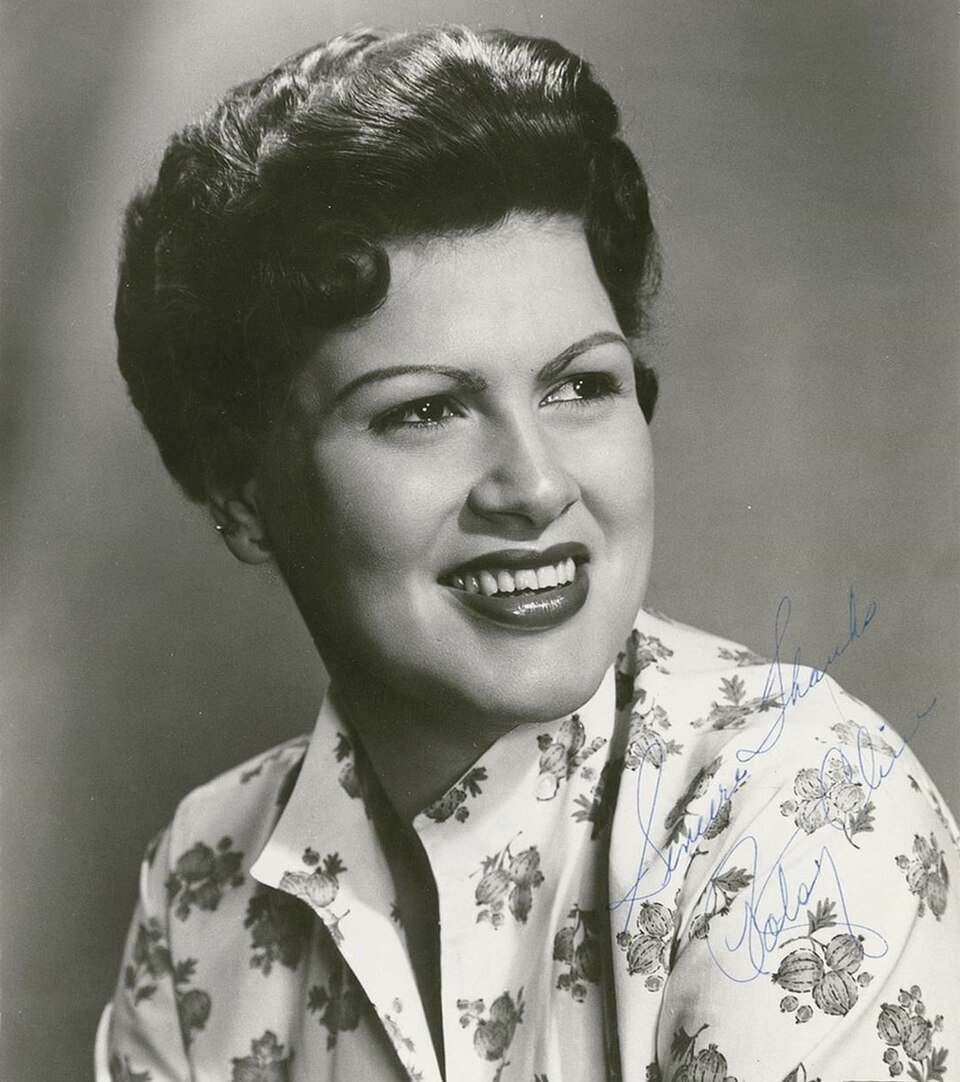
The Song She Didn’t Want: The Battles Behind Patsy Cline’s ‘Walkin’ After Midnight’
Patsy Cline fought “Walkin’ After Midnight” at almost every step of its journey to her, and the song resisted her right back. It had been written for another singer and rejected by that singer’s label. Its writer had to pawn his furniture just to get it heard. When it finally reached Cline, down a telephone line, she disliked it on sight — too pop, not country enough, nothing like the record she wanted to make. She cut it only as one half of a bargain, and when the biggest opportunity of her life arrived, a slot on national television, she tried to sing something else there too. Twice she lost the argument. Twice the song won, and the second time it won so completely that it turned a struggling Virginia club singer into a national star in a single night.
What makes the story worth telling at length is that “Walkin’ After Midnight” did not simply rescue Cline. It also trapped her. The hit proved that her voice could cross from country into pop, yet the contract she was locked into made sure she could not follow where it pointed, and she would wait four long years for another hit to arrive. The record she never wanted became the record that defined her, the one she cut twice, the one other singers have been covering for nearly seventy years, and the one that now sits in the Grammy Hall of Fame. This is the story of the battles behind it — against a publisher who owned her repertoire, a songwriter who would not take no for an answer, a television producer who overruled her on live network TV, and, hardest of all, against Cline’s own instincts, which for once in her life were wrong.
A Song Nobody Wanted
“Walkin’ After Midnight” began life in 1954 as a piece of professional songwriting craft, written by Alan Block and Don Hecht and aimed squarely at the traditional pop market. It was, by design, an elegant little song: a lonely narrator walks the streets after midnight, searching the moonlit dark for a lost love, in a lyric built on the classic AABA form. Block and Hecht wrote it in the key of B-flat, and they wrote it for Kay Starr, one of the biggest pop vocalists of the era, a singer whose records could turn a new copyright into a standard overnight.
Starr’s label rejected it. That single refusal is the first hinge of the story, because a song turned down in 1954 by a major pop singer usually died in a drawer. This one survived because its co-writer refused to let it die. Hecht signed a songwriting contract with 4 Star Records, the Pasadena-based label and publishing company run by Bill McCall, and his assignment was to look over the label’s roster and find an artist he could write for. Going through the 4 Star acts, he heard the early recordings of a young country singer from Virginia whose singles had all failed. What struck him was not her country pedigree but the opposite quality: he decided her voice was best suited to pop music.
Hecht believed in the match so strongly that he put his own money behind it at a moment when he had almost none. As he later told the story, he pawned his furniture to pay for a demonstration session, hiring pop singer Lynn Howard to sing “Walkin’ After Midnight” so that Cline could hear what the song might become. The demo was played to Cline’s producer, and then — in one of the great unlikely auditions in country music history — the producer played it down a telephone line to Patsy Cline herself.
The song’s road to release did not even wait for Cline. Lynn Howard’s recording, credited to Lynn Howard with the Accents, was commercially released in August 1956, making it the first version of “Walkin’ After Midnight” the public could buy. It went nowhere. The song had now been rejected by a label, released by a demo singer to indifference, and shelved in the 4 Star catalogue. What it needed was not another release. It needed a singer who would fight it — and mean it.
The Singer Who Said No
To understand why Cline pushed back, it helps to understand the cage she was already in. Born Virginia Patterson Hensley in Winchester, Virginia, on September 8, 1932, she had been chasing this life since she was a girl, and the chase had not been gentle. At fifteen she wrote to the Grand Ole Opry asking for an audition, and talked her way backstage to gospel star Wally Fowler at a hometown concert; the Opry bit, and the family — mother, two siblings and a friend — drove eight hours to Nashville, slept in a park because they could not afford a room, and watched her audition for Opry star Moon Mullican. The audition went well. The promised call never came. Back home she worked the soda counter at Gaunt’s Drug Store and sang anyway: at local station WINC, where disc jockey Joltin’ Jim McCoy let her on air after she asked outright — “Well, if you’ve got nerve enough to stand before that mic[rophone] and sing over the air live, I’ve got nerve enough to let you,” he reportedly said — and in the band of local bandleader Bill Peer, who took her stage first name from her middle name, Patterson.
By the early 1950s she was a regular presence on Washington, D.C.’s Town and Country television broadcasts, promoted by Connie B. Gay, and the critics who saw her there understood what Nashville had missed. The Washington Star praised a singer who stood out from every other woman in country music: “She creates the moods through movement of her hands and body and by the lilt of her voice, reaching way down deep in her soul to bring forth the melody. Most female country music vocalists stand motionless, sing with monotonous high-pitched nasal twang. Patsy’s come up with a throaty style loaded with motion and E-motion.” She had even appeared nationally, on ABC’s Ozark Jubilee, in 1956. But television exposure in the sticks was not a recording career, and a recording career was the one thing she could not seem to buy. On September 30, 1954, she signed with 4 Star Records, alongside Peer and her husband Gerald Cline. It was, on paper, her break. In practice it was one of the most lopsided deals of the era: the contract gave the overwhelming majority of the revenue to 4 Star, left Cline with less than three percent in royalties, and gave Bill McCall final approval over everything she recorded. Her masters were leased on to Decca Records, but the material came from McCall’s catalogue, picked by McCall and Decca’s Paul Cohen.
Her first session took place in Nashville on January 5, 1955, produced by Owen Bradley, and her first single, “A Church, a Courtroom, Then Goodbye”, failed — as did the four singles she released across 1955 and 1956. The 4 Star material wandered between gospel, rockabilly, traditional country and pop, and critics have generally been unkind about it: the songs were mediocre, the choices were McCall’s, and Cline sounded like a major voice groping for material worthy of it. She knew exactly what she wanted to sound like. She wanted to be a country singer, full stop — and then the telephone rang with Don Hecht’s demo.
Her first reaction to “Walkin’ After Midnight” was flatly negative. She heard a pop song, not a country song — by later accounts she dismissed it as nothing but a little old pop song — and she did not believe it could be a hit for her. Remarkably, the two men who might have forced the issue agreed with her: Hecht himself and Bill McCall both conceded her doubts. But Hecht had pawned his furniture for this song, and the matter did not end there. What followed was a negotiation, one of the earliest and most revealing of Cline’s career, because she did not simply refuse. She bargained.
The compromise was this: Cline would record “Walkin’ After Midnight” if she could also record “A Poor Man’s Roses (Or a Rich Man’s Gold)”, written by Bob Hilliard and Milton DeLugg — a song she genuinely loved and believed in as her hit. By Hecht’s account, she even sweetened the wager with a promise: if she turned out to be wrong about “Walkin’ After Midnight”, she would never argue about her material again. It is a wonderful pledge, and posterity can be grateful she had no power to keep it, because arguing about material would become one of the defining features of her working life with Owen Bradley. But on this occasion the deal was struck, and on November 8, 1956, she walked into Bradley’s Nashville studio to cut both songs — the one she wanted, and the one that would change her life.
Two Songs, One Session
The session of November 8, 1956, took place at the Bradley Film and Recording Studio in Nashville, the converted house and studio complex Owen Bradley was building into one of the most important rooms in country music. Alongside the two sides of the bargain, Cline also cut “The Heart You Break May Be Your Own” and “Pick Me Up on Your Way Down” that day. Paul Cohen, Decca’s country chief, held the producer’s credit, with Bradley assisting — and sitting in at the piano himself.
The band was a roll call of the Nashville A-Team, the pool of session musicians who played on most of the RCA Victor and Decca sessions of the era, and it is worth pausing on who was in the room, because several of them would still be beside Cline when she became a star. Harold Bradley played acoustic guitar, Grady Martin handled the electric guitar, and Bob Moore played acoustic bass — all three would play on her celebrated Decca records of the early 1960s. Farris Coursey kept time on drums, Tommy Jackson added fiddle, and the steel guitar belonged to Don Helms, who had come out of Hank Williams’s band, the Drifting Cowboys, bringing with him the crying, conversational steel sound of country music’s founding generation.
The record they made runs two minutes and thirty-two seconds, and its construction repays attention. Cline recorded the song in C major, a step up from the B-flat in which Block and Hecht had written it for Kay Starr, and the lyric follows the traditional AABA form, followed by a short instrumental solo and a repeat of the B and A sections. Critics have struggled ever since to file it under a single genre: it is generally described as a country pop song drawing stylistic elements from jazz, traditional pop and the blues. Alanna Nash, in Will the Circle Be Unbroken? Country Music in America, called it “bluesy”, and Richie Unterberger of AllMusic praised its bouncy beat and its sound, unlike either rockabilly or the country music of its moment.
Unterberger’s judgment of the vocal has become the standard one. “While Cline’s vocal is a little restrained in comparison with the approach she used on her better-known sides in the early 1960s,” he wrote, “it’s well-suited for the almost bemused aura of loneliness of the lyric. More than any of the other songs she recorded for the 4 Star label in the 1950s, it anticipates the successful country-pop fusion of her crossover hits for Decca in the early 1960s.” That is the sound of the session in a sentence: a country singer, a pop song, a jazz-tinged lilt in the arrangement, and Don Helms’s steel guitar holding the whole thing inside country music while Cline’s voice quietly steps across the border. Nobody in the room that day — not Cohen, not Bradley, not Cline — can have known they had just made the record that would define the rest of her short life. Indeed, when the session ended, the song was not even scheduled to be a single. It took television to change that.
The Night the Applause Meter Froze
The call to appear on Arthur Godfrey’s Talent Scouts had come in 1956, months after Cline had auditioned for the CBS programme, and it came wrapped in small deceptions and large arguments. The show’s format required each contestant to be introduced by a “talent scout”, and the rules forbade the scout from being a family member. Cline used her mother, Hilda Hensley, anyway. When Arthur Godfrey asked Hensley whether she had known Cline her entire life, her mother lied cheerfully to the nation: “Yes, just about!” Mother and daughter flew into New York’s LaGuardia Airport on January 18, 1957, and Cline was set to make her debut on January 21.
Then came the second great battle over the song — nearly a repeat of the first. Cline arrived intending to perform “A Poor Man’s Roses (Or a Rich Man’s Gold)”, the song she had won in the compromise, the song she believed in. The show’s producer, Janette Davis, preferred the other one. Davis had heard the recording of “Walkin’ After Midnight” and insisted that was the song for television. Cline initially refused to perform it, then ultimately agreed — and the humiliations were not finished. Davis also suggested that Cline abandon the cowgirl outfit her mother had made for her and wear a cocktail dress instead. The girl singer from Winchester, who had built her stage act in fringed Western wear, would face America dressed by a New York television producer, singing the song she had twice tried to refuse, in the programme’s 8:30 p.m. slot.
What happened next passed immediately into country music legend. Cline performed “Walkin’ After Midnight” with the controlled, sultry confidence that had been wowing Washington audiences on the Town and Country broadcasts, and the studio audience’s response overwhelmed the show’s applause meter — the device that measured the crowd’s reaction to determine the winner — so completely that the excessive applause froze the meter itself. Cline won first place on the night, and it was not close. A twenty-four-year-old club singer with a string of failed singles, a royalty rate under three percent, a mother smuggled in as her scout, and a borrowed dress had just beaten the entire field on one of the most watched programmes in America, singing a song she had never wanted.
The aftermath ran for months. Godfrey’s organisation kept her working over the following several months, and she appeared on the Grand Ole Opry in February and on the television programme Western Ranch Party in March. The money from her run of engagements totalled some $10,000 — a fortune beside her 4 Star royalty rate — and Cline gave all of it to her mother, who used it to pay off the mortgage on the family house in Winchester. But the most consequential consequence was sitting in a record company office. “Walkin’ After Midnight” had not been a single when she sang it on television. Now the public wanted the record, and Decca had to give it to them.
Rush Release
Decca rush-released “Walkin’ After Midnight” as a single on February 11, 1957, barely three weeks after the broadcast, with “A Poor Man’s Roses (Or a Rich Man’s Gold)” on the B-side — catalogue number 9-30221, the compromise preserved in vinyl, both halves of the bargain on one seven-inch disc. The record climbed through the spring and peaked at number two on Billboard’s country chart, the Hot Country and Western Sides, and number twelve on Billboard’s pop chart. It even reached number 33 in Australia. For a country singer on a leased-master deal with a tiny Pasadena label, it was an extraordinary breakthrough — one of the records that established, before the term existed, that a woman singing country could cross over to the pop audience without sanding down who she was.
The score-settling between the two sides of the single is one of the story’s quiet delights. “A Poor Man’s Roses (Or a Rich Man’s Gold)”, the song Cline had championed, was no failure: released as the B-side, it charted in its own right, reaching number 14 on the Billboard country chart, and Patti Page quickly covered it for the pop market. Cline’s instincts about that song were perfectly sound. They were simply aimed at the wrong side of the record. The A-side she had resisted went on to sell over one million copies, and it remains, in the familiar phrase, her first major hit.
The timing mattered as much as the talent. In 1957 the American pop chart was being remade nightly by rock and roll, and traffic between the country chart and the pop chart usually ran in one direction: pop and R&B acts plundering country songs, or rockabilly boys blurring the line from the country side. What “Walkin’ After Midnight” did was rarer. A grown woman, singing grown-up heartbreak in a voice trained in Virginia church choirs and honky-tonks, with a steel guitar crying behind her, reached number twelve on the pop chart without impersonating anyone else. That is why Cline is now routinely described as one of the first country artists to cross over into pop successfully — and why this record, rather than the bigger ballads that came later, is so often treated as the starting gun. The later hits proved she could sustain the crossing. This one proved the crossing was possible.
Success pulled an album behind it. On August 5, 1957, Decca issued her debut studio album, simply titled Patsy Cline — though, in a final irony of the compromise, the album did not include the B-side she had fought for. The machinery of a career was now moving: national television, a million-selling single, an album on the shelves. And yet, almost immediately, the machinery stalled, because the woman at the centre of it did not control her own repertoire. The next chapter of the “Walkin’ After Midnight” story is the four years in which it stood alone — her only hit — while the contract that had delivered it slowly strangled everything that might have followed.
One Hit, Then Silence
Cline’s follow-up singles to “Walkin’ After Midnight” all failed. None of them yielded any success at all, and the failure was only partly hers. The material available to her remained whatever Bill McCall’s 4 Star catalogue offered and whatever McCall approved; the same system that had accidentally handed her a standard now handed her mediocrity, record after record. She was dissatisfied, and her frustration survives in Owen Bradley’s recollection of her coming to him during those years and pleading, “Hoss, can’t you do something? I feel like a prisoner.” It is one of the saddest quotations in her biography, and one of the most exact. The hit had shown her the size of her talent. The contract showed her the limits of her freedom.
Her professional life frayed in step with her records. Around the same time she was fired from her regular slot on the Town and Country Jamboree; according to promoter Connie B. Gay, she ran late for shows and showed up with liquor on her breath. Her personal life was moving just as fast. In September 1957 she married Charlie Dick, the man she had met at a local performance the year before; he was soon sent to Fort Bragg, North Carolina, on a military assignment, and she gave birth to their first daughter, Julie. In 1958, hoping to restart her career where the music actually was, Cline moved her family to Nashville.
The rescue, when it came, came in stages. Under new manager Randy Hughes, she began working steadier jobs and singing more regularly on the Grand Ole Opry, and in January 1960 she asked the Opry’s general manager, Ott Devine, about membership. His reply has been quoted ever since: “Patsy, if that’s all you want, you’re on the Opry.” That same January she made the final recording sessions set down in her 4 Star contract, and later in 1960 her last singles for the label, “Lovesick Blues” and “Crazy Dreams”, were released. Then, at last, the cage opened. Free of McCall, she signed directly with Decca in late 1960, to work exclusively under Owen Bradley — and, in a detail that says everything about what the 4 Star years had taught her, she insisted on receiving an advance before she began. Bradley gave her $1,000. Within months she had cut “I Fall to Pieces”, and the second, greater career began. But that is another song’s story. The point here is the gap: from February 1957 to 1961, “Walkin’ After Midnight” stood in complete isolation, the lone proof of what Patsy Cline could do — a standard in search of a catalogue.
Cutting It Again
There is a coda to the recording itself, and it says much about how the industry understood the song by the time Cline was a star. For her second studio album, Patsy Cline Showcase, released by Decca in late 1961, Cline re-recorded “Walkin’ After Midnight” — along with, fittingly, a fresh version of “A Poor Man’s Roses (Or a Rich Man’s Gold)”, so that the two halves of the old bargain were reunited on the new album just as they had been on the single. This time there was no bargain to strike and no producer to overrule: Bradley produced, and the remake was built to the new specifications of the Nashville Sound that he and Cline had pioneered together in the intervening years.
The differences are audible in every bar. The 1961 version gives the song a more explicitly “pop” arrangement: backing vocals from the Jordanaires, a pronounced “clip-clop” percussion effect keeping the walking rhythm, and a modulation up to the key of C-sharp for the final verse. The personnel were the mature A-Team — Floyd Cramer at the organ, Hargus “Pig” Robbins at the piano, Buddy Harman on drums, Walter Haynes on steel guitar, Harold Bradley now on six-string electric bass, Randy Hughes on acoustic guitar, Grady Martin on electric guitar and Bob Moore on acoustic bass. As AllMusic’s review of the song notes, the remake dispensed with the prominent steel guitar of the original and added countrypolitan backing vocals and piano in its place. The after-midnight walk, harmless in 1956, had acquired a rhythm section that clip-clopped like footsteps.
The context of the remake deepens it. Nineteen sixty-one was the year Cline’s career finally ignited and very nearly ended: “I Fall to Pieces” was climbing to number one on the country chart when, on June 14, she was thrown through the windshield of a car in a head-on collision, suffering a broken wrist, a dislocated hip and a forehead wound that nearly took her eyes, and spending a month in hospital not expected, at first, to live. She returned to the Opry six weeks later, finished the year with “Crazy”, and Showcase gathered both of those giant hits alongside the re-recorded “Walkin’ After Midnight” and “A Poor Man’s Roses (Or a Rich Man’s Gold)”. Heard in that company, the remake plays as something more than catalogue housekeeping. It is a star, at the summit and freshly reminded of her own fragility, deliberately revisiting the two sides of the single that had started everything — and re-cutting them now entirely on her own terms, in the sound she and Bradley had built, with no Bill McCall anywhere near the repertoire.
Purists should be clear about one thing: the 1961 remake is not the hit. It is the 1956 recording — Cohen’s production, Don Helms’s steel, Cline’s younger and more restrained voice — that sold the million, froze the applause meter and entered the Hall of Fame. The remake has nevertheless had a long afterlife of its own on country oldies playlists, and the song kept finding new frames. Live recordings of Cline performing it have surfaced on Live at the Opry, drawn from 1957, and Live at the Cimarron Ballroom, from 1961. And decades later, for the soundtrack of Sweet Dreams, the 1985 film of her life, her vocals from the 1961 recording were lifted and overdubbed with a jazzier arrangement — the song rearranged one more time, around a voice that could no longer object, compromise, or bargain. She had made her peace with it long before, of course. Singers rarely argue with the song that made them, and Cline sang “Walkin’ After Midnight” for the rest of her career, in a repertoire that soon included country number ones. But its position never changed. It was first.
Everybody Walks It
The truest measure of what happened in that November 1956 session is how thoroughly the song escaped its origins. Before Cline ever sang it, Lynn Howard’s version had already come and gone without trace; after Cline, the walkers multiplied across genres and generations. AllMusic’s survey of the song lists versions by the Cowboy Junkies, Loretta Lynn, Fairground Attraction, Katy Moffatt and Bryan Adams — a roll call that runs from country’s inner circle out through alternative country, British folk-pop and arena rock, each of them drawn to the same moonlit, lovesick stroll.
Two covers, forty years apart, frame the song’s reach especially well. In 1996, Madeleine Peyroux — a young American singer whose phrasing drew constant comparisons to Billie Holiday — chose “Walkin’ After Midnight” to open her debut album, Dreamland, released by Atlantic Records on October 1, 1996. She stretched it to nearly five minutes, slowing the stroll into a late-night jazz reverie, and placed it ahead of Edith Piaf’s “La Vie en rose” on the same record — company that would have been unthinkable for a 4 Star copyright in 1954, and entirely natural by 1996. The same album even closed the circle by including “Lovesick Blues”, one of the final singles of Cline’s own 4 Star years, as though Peyroux had set out to honour not just the hit but the whole difficult apprenticeship behind it. In 2016, Cyndi Lauper recorded the song in Nashville for Detour, her album of classic country covers released by Sire Records that May and produced by Tony Brown. Lauper cut it alongside a second Cline standard, “I Fall to Pieces”, on a record whose guest list ran from Emmylou Harris to Willie Nelson — a pop star of the MTV generation paying formal tribute, in Music City itself, to the country-pop border crossing Cline had made sixty years earlier.
Between those poles, the song became a kind of rite of passage. Torch singers take it up to prove they can carry longing without melodrama; country singers take it up to prove their lineage; jazz singers take it up because its changes and its melody sit so comfortably after midnight. It asks for restraint — the very quality Unterberger singled out in Cline’s original — and it exposes anyone who oversings it. Few standards police their interpreters so politely, or so effectively.
What the covers reveal, taken together, is the song’s unusual double nature. It is sturdy enough to survive being slowed to a jazz meditation, dressed in countrypolitan strings, or stripped back to bar-band basics, because its emotional architecture never moves: someone who cannot sleep, cannot stay in, and cannot stop hoping walks out into the night to look for the person who left. That is why the failed demo, the rejected manuscript and the reluctant hit version all read, in retrospect, like a single story about misjudgement — everybody underestimated the song except the song itself.
The Honors
The institutions took their time, but they arrived. In January 2020, the Recording Academy announced its annual inductions into the Grammy Hall of Fame — twenty-six recordings, each at least twenty-five years old, chosen for lasting qualitative or historical significance, joining a roll of more than eleven hundred honoured recordings. Among them, alongside Elton John’s “Tiny Dancer”, the Eurythmics’ “Sweet Dreams (Are Made of This)” and Nancy Sinatra’s “These Boots Are Made for Walkin’”, was Patsy Cline’s “Walkin’ After Midnight”, the 1957 release — sixty-three years after Decca had rush-pressed it to satisfy a television audience. The song has also been added to the Rock and Roll Hall of Fame’s expanded list of “The Songs That Shaped Rock and Roll”, the museum’s permanent-exhibit canon of the recordings that made the music, and it is a fixture of authoritative lists of the greatest country songs ever recorded. Even the academy has had its say: musicologist Jocelyn R. Neal’s scholarly study of the record, in the University of Illinois Press collection Sweet Dreams: The World of Patsy Cline, is titled “Nothing But a Little Ole Pop Song” — borrowing Cline’s own dismissal of the song as the heading under which to explain its genius. For a song that a major label rejected, a demo singer couldn’t sell, and its most famous singer didn’t want, the honours have a satisfying symmetry: every gatekeeper who said no has been overruled by history.
It is worth being precise about what is being honoured. The Hall of Fame induction belongs to the 1957 single — the November 1956 session, Cohen and Bradley in the control room, Don Helms on steel. And it belongs, unavoidably, to the performance that forced the single into existence: a singer in a borrowed cocktail dress, on a stage in New York, landing the song so completely that the applause broke the machine built to measure it. The recording and the broadcast are the same event, really — the moment a great singer stopped resisting a great song and the friction between them caught fire.
Why It Endures
Why does “Walkin’ After Midnight” endure, of all the country singles of 1957? Part of the answer is the voice, of course — that booming contralto Cline said she woke up with after a childhood throat infection and rheumatic fever, when “the fever affected my throat and when I recovered, I had this booming voice like Kate Smith’s”. On this record the voice is young, restrained, almost bemused by its own loneliness, and that restraint is precisely what makes it ache: she sounds like a woman who has talked herself into the walk and is pretending, to the moonlight, that it might work. Four years later she would sing with the full, wounded grandeur of the Decca ballads. Here you can hear the singer she was before anyone would let her be that.
But the deeper answer is in the battles themselves, because the song’s history is a perfect inversion of how hits are supposed to happen. A songwriter believed in it enough to pawn his furniture. A label man and a songwriter both agreed with the singer that she was right to doubt it — and it was a hit anyway. A producer in Nashville heard a pop song and built it a country frame sturdy enough to cross over. A television producer overruled the artist on live television, dressed her in the wrong clothes, handed her the song she had twice refused, and was proved gloriously right in front of millions. Even the compromise at the story’s heart broke even: the song Cline demanded as her price charted respectably and earned a Patti Page cover, while the song she accepted as her burden sold a million and outlived everyone who argued about it. At every single decision point, somebody was wrong about “Walkin’ After Midnight” — and the song survived all of them.
There is one last turn. Cline reportedly promised, when she struck the bargain in 1956, that if she was wrong about the song she would never argue about her material again. She was wrong, and she argued constantly — with Bradley, with labels, with everyone — and country music is richer for every one of those arguments. But on the central question of her career, the first one, the verdict of January 21, 1957 stands unamended. She went out walkin’ after midnight, out in the moonlight, with a song she never wanted — and she has never really come back in. Neither have we.