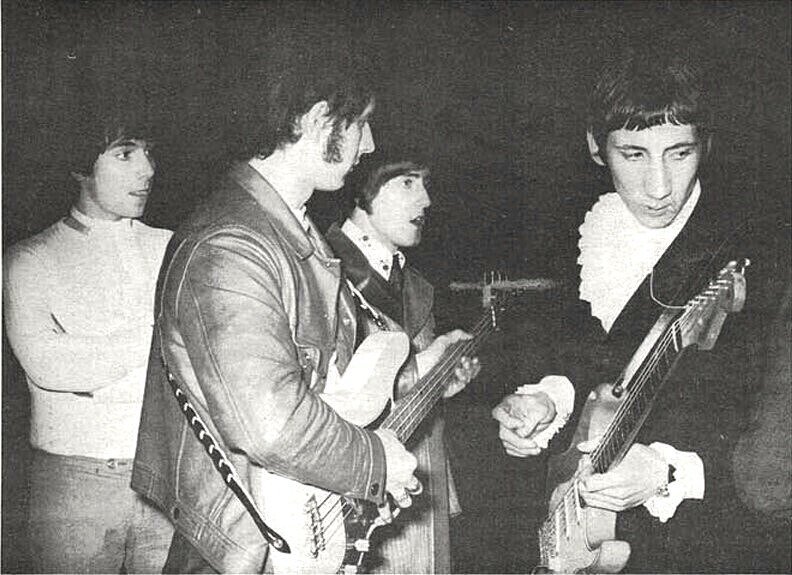

It begins with a stutter. Not a polished opening line, not a guitar riff, but a voice tripping over its own words — “people try to put us d-d-down” — and then a band crashing in behind it like a door being kicked off its hinges. When The Who released “My Generation” in the autumn of 1965, nothing on British radio sounded like it: a bass that jumped out of the mix to take a solo, drums that seemed to be falling down a flight of stairs and landing on their feet, a guitar that ended the whole thing in a hail of feedback, and a singer who could not, or would not, get his words out cleanly. It reached number two in Britain, the highest any Who single would ever climb there, and it became something no chart position could measure: the first pop record to say, out loud and in the first person, that the young did not want to be understood by the old — they wanted to be left alone. The story of “My Generation” is the story of how a twenty-year-old guitarist, on a train, angry at rich neighbours and inspired by an American bluesman, wrote three minutes that gave post-war youth its voice — and of how the record’s famous stutter, its bass solo and its feedback ending were all accidents, arguments and improvisations that somehow became a manifesto.
To understand why the record mattered, you have to understand where Britain stood in 1965. The country was twenty years out of the Second World War, and the generation that had fought it still ran everything: the government, the BBC, the record companies, the rules about hair, clothes, noise and respect. Their children, born at the very end of the war and just after it, were now teenagers and young adults with money in their pockets, records on their turntables and no memory of rationing or bombing — and they were starting to notice that the world their parents had built did not seem to have a place in it for them. In London, the sharpest expression of that generation was the mod: young, working-class, obsessed with clothes, scooters, American soul records and all-night dancing. The Who, a band of west London lads who had started out playing rhythm and blues in pubs and clubs, had become the mods’ band almost by accident, and their manager Kit Lambert understood, before almost anyone else in the business, that the band’s audience did not want to be entertained by their elders. They wanted a band that was theirs. “My Generation” was the record that made that feeling audible, and it did so in the bluntest language pop had yet allowed itself.
The song itself began, by Pete Townshend’s account, on a train journey in the spring of 1965, with the blues in his head. Townshend, the band’s guitarist and principal songwriter, has said that without the American pianist and singer Mose Allison — specifically Allison’s “Young Man Blues” — he would never have written “My Generation” at all. The other inspiration he has described was much closer to home and faintly comic: his car, a black 1935 Packard hearse, had been towed away from its parking spot in a wealthy London neighbourhood, reportedly on the orders of the Queen Mother, who was said to have been offended by the sight of it on her daily drive. Townshend, a young man living, almost by accident, among people far richer than himself, felt pushed around in shops and on streets by people who assumed money bought deference. Over the years he has given the song different explanations — the generational divide between those who lived through the war and those born at its end, the search for a place in society, simple revenge on the rich — and the honest thing to say is that all of them are probably true at once. The song he wrote on that train was, at first, much slower and bluesier than the record that followed, and it was Lambert’s idea to speed it up, to sharpen it, to make it sound like the band on stage rather than a bluesman in a club.
The recording captures that sharpening in sound, and it took place on a single day: 13 October 1965, at IBC Studios in London, with the American producer Shel Talmy at the desk. Talmy had already produced the band’s first two singles, and he understood what The Who were: not a polite beat group but a noise machine with melodies. Townshend’s guitars were tuned down a whole step, giving the record its dark, sludgy weight. Roger Daltrey, the singer, delivered the vocal that made the record famous — and it was, by his own later account, partly real. Daltrey has a stutter, one he has since learned to control, and in the studio Lambert told him to lean into it, to sound like a mod kid on speed, or “pilled,” as Daltrey put it. Townshend has also cited John Lee Hooker’s “Stuttering Blues” as an influence on the idea. Either way, the stutter was not in Townshend’s original vision of the song; it was a studio suggestion that became the record’s signature, the sound of a young man who literally could not get his words past the older generation. Then there was the bass solo. John Entwistle, the band’s bassist, played a Danelectro bass fitted with unusually thin, wire-wound strings that rang like a piano — strings so rare that he bought three of the instruments just to keep himself supplied. When the last string broke before the re-recording, he cut the solo on a Fender Jazz bass with tape-wound strings instead, and the result was the first bass solo ever to be a featured moment on a hit rock record: a melodic, almost classical break in the middle of a three-minute riot. Around it, Keith Moon’s drums crashed and tumbled, and the track ended not with a neat fade but with a burst of guitar feedback, as if the band had simply blown the song apart rather than finish it.
The single’s chart story is a study in two countries hearing the same record differently. In Britain, where it was released on 29 October 1965 on Brunswick with a James Brown cover, “Shout and Shimmy,” on the B-side, it was an immediate sensation. It climbed to number two on the UK chart, kept off the top by the Seekers, and it remains, jointly with 1966’s “I’m a Boy,” the highest-charting single The Who ever had in their home country. In America, where Decca released it on 20 November 1965 with Townshend’s “Out in the Street” on the reverse, it barely registered at first: it entered the Billboard Hot 100 on 15 January 1966 at number 98, inched up to number 75, and peaked at number 74 on 12 February 1966, spending just five weeks on the chart in total. The contrast is the whole story of The Who in the 1960s in miniature: in Britain they were the voice of a generation; in America they were still a curiosity, a loud band from London whose moment there would not come until the end of the decade, with Tommy and Woodstock and the long, loud road that followed. The album the single titled, My Generation, released in Britain in December 1965 and in America in April 1966 under the title The Who Sings My Generation, reached number five in Britain and, as the band’s own site puts it plainly, flopped in the United States.
The song’s afterlife began almost immediately, and it began with a ban. The BBC, worried that the stuttering vocal might offend listeners who stammered, initially refused the record airplay — a decision that now reads as a perfect illustration of the song’s own point, the older generation policing the younger generation’s voice for its own good. When the record became a hit anyway, the BBC relented, and the ban became part of the legend: the song the establishment tried to silence became the song everyone under twenty-five knew by heart. On stage, “My Generation” grew. Where the studio version runs a little over three minutes, the live versions stretched and stretched, becoming a vehicle for improvisation, instrument-smashing and, on the 1970 album Live at Leeds, a fourteen-minute-plus explosion that is widely considered one of the greatest live recordings ever made. It stayed in the band’s set for decades, usually as a closing number, the song that ended the night the way it had begun the band’s career: with a stutter, a bass solo and a noise.
There is a final pleasure in the story, and it belongs to the line everyone remembers. “I hope I die before I get old” was, in 1965, a young man’s provocation, a dare thrown at a world that seemed to value age over youth, caution over life. Sixty years later, the men who sang it are old men, still touring, still playing the song, and the line has changed its meaning without changing a word. Townshend has said the song was “very much about trying to find a place in society,” and that he was, at twenty, “very, very lost.” The song’s endurance comes from that honesty: it was not a pose struck by a marketing man but a feeling described by someone who was living it, and feelings like that do not date. The honours that followed tell the same story in institutional language. Rolling Stone placed “My Generation” at number eleven on its 500 Greatest Songs of All Time list in 2004 and 2010 (it was re-ranked at number 232 in the 2021 revision); VH1 put it at number thirteen on its list of the greatest rock songs; the Rock and Roll Hall of Fame included it among its 500 Songs that Shaped Rock and Roll; and it was inducted into the Grammy Hall of Fame for its historical, artistic and significant value. The American version of the album was added to the National Recording Registry in 2008, the first — and, as of 2025, the only — Who recording to be so honoured.
That is why “My Generation” still works, sixty years later, for listeners who have never been a mod, never ridden a scooter and never been told to fade away by anyone. It is not The Who’s most sophisticated song, and it is not their most successful in America. It is the one that tells the truth about what it feels like to be young in a world run by people who do not understand you: the words stick, the frustration builds, the music gets louder, and in the end you do not resolve the argument — you drown it in feedback. The charts gave it number two in Britain and number seventy-four in America. The BBC tried to ban it and then gave in. And the stutter, which began as a studio trick and a real speech impediment, became the most honest sound in 1960s pop: a young man trying to speak, tripping over the words, and being heard anyway — by everyone his own age, all at once.
Watch the video below and listen for the moment Daltrey’s stutter gives way to Entwistle’s bass solo. It is the sound of a generation finding its voice — halting, defiant and louder than anything that came before it.