A Riot of Our Own: The Battles Behind The Clash’s ‘White Riot’
It lasts less than two minutes, and it begins with a count-in — “one, two, three, four” — shouted like a man starting a fight in a stairwell. “White Riot” was the first single The Clash ever released, issued on 18 March 1977, and nearly everything about it was a provocation: the title, which could be misread at a glance and was; the delivery, two minutes of buzzing guitars and a singer barking as if the studio were on fire; and the circumstances of its making, by a band that had existed in public for barely eight months, had played around thirty gigs, and had just signed the most notorious record deal in British punk — a deal so large, and so compromised, that the editor of punk’s most influential fanzine declared the movement dead the day it was signed. The record was supposed to be a debut. Instead it became an argument: about race, about class, about who owned punk, and about whether a song could demand a riot and mean something closer to solidarity.
The battles behind “White Riot” started before the band did. The song was born in the wreckage of the Notting Hill Carnival of August 1976, where singer Joe Strummer and bassist Paul Simonon had stood in a crowd that turned, within an hour, into a running battle with the Metropolitan Police. Strummer came away insisting that black Britain had shown a courage that white Britain — comfortable, equipped, “too chicken to even try it,” as the song put it — had forgotten. The record he built from that afternoon was immediately misunderstood by some as its opposite, a racist chant, and the misunderstanding dogged it for years, through censorious radio, through a Top 40 peak of just No. 38, through the strange honour of closing the Rock Against Racism carnival in 1978 with a guest vocalist from Sham 69. This is the story of how a 118-second record became the founding document of the only band that mattered — and how it nearly tore their credibility apart before they had any.
The Carnival That Turned
Bank Holiday Monday, 30 August 1976, was the closing day of the Notting Hill Carnival, then a decade old and drawing something like 150,000 people into the streets of west London. The carnival had been born as an act of healing — first staged indoors in 1959 in response to the racist violence that had scarred the area the previous year — and by 1976 it was the largest Caribbean street festival in Europe. But the relationship between the carnival and the police had been deteriorating for years. Black youths in London lived under the shadow of the “sus” laws, which allowed officers to arrest people on suspicion of intending to commit a crime, and which fell overwhelmingly on young black men. In the weeks before the 1976 carnival, community leaders warned the police that the atmosphere was dangerous. The police responded by flooding the event: roughly 1,600 officers were deployed, eight times the number of the year before.
What happened next is recorded in the blandest official language and remembered in something hotter. In the late afternoon, near the north end of Portobello Road, police moved on a small group of alleged pickpockets; onlookers came to the group’s defence; more officers arrived with truncheons drawn; and the carnival tipped into hours of running skirmishes. Bricks and bottles came down on police lines; officers, in the famous images of the day, defended themselves with dustbin lids because British policing had not yet issued them riot shields. Figures vary between accounts, but around 250 people were hospitalised, among them roughly 120 police officers, and about sixty arrests were made. When it was over, the Police Federation pressed — successfully, in time — for the introduction of riot shields, and the press settled into a narrative of black lawlessness that took the carnival years to shake off.
Strummer and Simonon were in the middle of it. Neither man was a tourist that day. The Clash’s inner geography was west London — Ladbroke Grove, the squats and rehearsal rooms under the Westway flyover — and the carnival was their neighbourhood’s festival as much as anyone’s. Accounts of the day agree that the two were caught up in the fighting rather than watching it, and whatever precisely they did, the effect on Strummer was decisive and specific. He did not come away talking about disorder. He came away talking about envy. The black kids of Notting Hill, he argued, had been prepared to stand up to poverty and to heavy-handed policing; the white kids of the same estates, facing the same dead-end economy, had been bought off with consumer goods and sedation. Years of grievance had produced, in one community, resistance; in the other, apathy. A song began to form around that contrast — not a lament, but a demand that white youth find “a riot of my own.”
It is important to understand what a loaded artefact a riot was in the Britain of 1976. The country was in one of its periodic fits of self-disgust: inflation rampant, the government fresh from an IMF bailout, the far right of the National Front marching and recruiting, and the tabloids oscillating between moral panic about muggings and open hostility to the black presence in British cities. To write a song calling a riot admirable was to handle live ammunition. To put the word “white” in front of it was to guarantee that half the audience would hear the ammunition before they heard the argument. Strummer knew the risk. He took it anyway, and the taking of it — the wilful, artful ambiguity of the title set against the unambiguous solidarity of the lyric — became the engine of everything that followed.
A Band Barely Standing
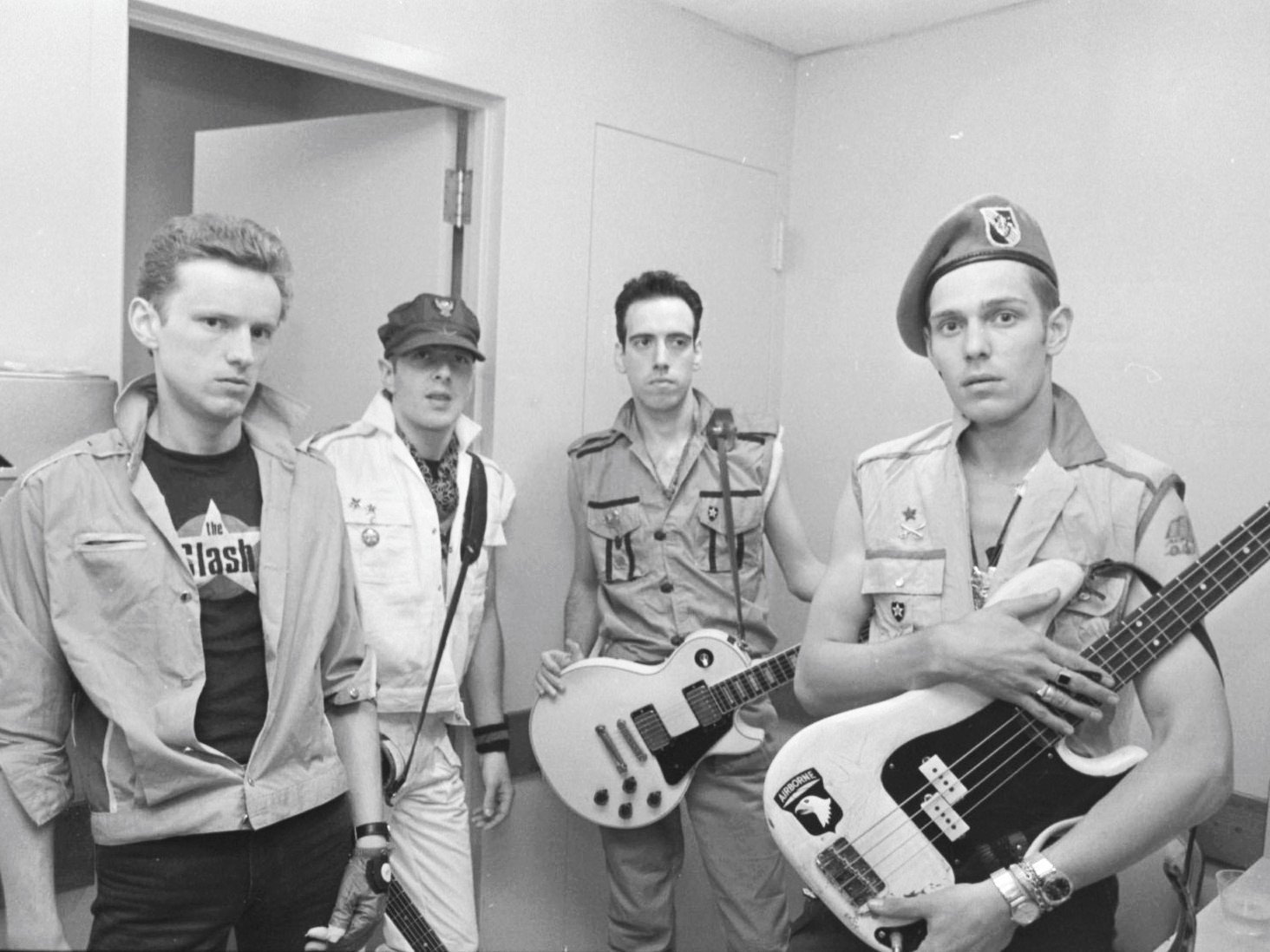
The Clash who carried that song into the world were, by any professional standard, not ready. The band had formed only that spring and summer. Strummer, born John Mellor, the son of a Foreign Office diplomat, had been fronting a pub-rock band called the 101ers when he saw the Sex Pistols in the spring of 1976 and understood, in his own later telling, that what he was doing belonged to yesterday. Within weeks he had been recruited — by manager Bernard Rhodes, acting as punk’s self-appointed Svengali — into a new group being assembled around guitarist Mick Jones and bassist Paul Simonon, two west Londoners whose previous band, London SS, had generated far more legend than music. Simonon gave the band its name, lifted from the word that kept appearing in newspaper reports of disorder: clash. He also gave it its look — paint-splattered clothes, slogans stencilled like agitprop posters — and, as the carnival episode suggests, he was not playing at any of it.
The early Clash were a proposition about energy compensating for craft. Simonon was learning the bass as he went, having failed to make it as a guitarist; drummers came and went so quickly that Terry Chimes, who played on the debut album, was billed on the sleeve as “Tory Crimes” and was never quite a member at all. The band’s public unveiling came on 4 July 1976, opening for the Sex Pistols at the Black Swan in Sheffield, and through that summer and autumn they built a following in the only currency punk recognised: short, violent, ecstatic live sets, mostly as a support act, mostly in rooms that smelled of spilled lager. By the turn of the year they had played perhaps thirty gigs, almost none as headliners.
“White Riot” entered the repertoire early and announced itself immediately. The band gave it its first public performance on 20 September 1976 at the 100 Club Punk Festival, the two-night showcase on Oxford Street that functioned as British punk’s coming-out party, and the song’s effect was out of proportion to its length. Where the Pistols traded in sneering negation, “White Riot” was a demand with a beat you could chant: two chords’ worth of Ramones-speed guitar, Jones counting the band in, and Strummer spitting the lyric like a man reading a charge sheet. Caroline Coon, writing in Melody Maker that November, described the song as “played with the force of an acetylene torch.” It was, already, the song that defined what The Clash were for — the point at which punk’s noise acquired a politics you could quote.
But a live reputation in London clubs was not a career, and the business of 1976 knew it. Punk had become, almost overnight, a media phenomenon and a label obsession. The Pistols had signed to EMI and then detonated the Bill Grundy television interview in December, turning themselves into a national scandal and punk into a word every A&R department in London was terrified of missing. Polydor’s Chris Parry had courted The Clash and had demos and a contract ready. What happened in January 1977 would become the band’s original sin in the eyes of the faithful — and the first of the battles that “White Riot” had to survive.
The Day Punk Died, On Paper
On 25 January 1977, The Clash signed to CBS Records for £100,000. For a band with thirty gigs behind them, it was an astonishing sum, and it detonated on contact with punk’s founding mythology. Punk had defined itself against the corporate music business — against the majors, the advances, the limousines — and here was its second most important band taking the biggest cheque on offer from the biggest company in the world. Mark Perry, whose fanzine Sniffin’ Glue had more or less invented punk journalism, produced the era’s most quoted obituary: “Punk died the day The Clash signed to CBS.”
The band’s defenders could point out, correctly, that outrage was cheap and rehearsal rooms were not. But the harder truth was in the small print. The CBS deal was structured, as one band associate later put it, as a classic example of the kind of contract no group should ever sign: the £100,000 was an advance against which practically everything would be charged back — tours, recordings, remixes, artwork, expenses. The Clash had accepted not so much a fortune as a very large debt, repayable through a machine they did not control, and they would spend years working their way out from under it. Strummer, to his credit, did not pretend otherwise. “Signing that contract did bother me a lot,” he admitted that March. “I’ve been turning it over in my mind.” Punk’s argument with itself — purity versus reach, the fanzine versus the major label — was now The Clash’s argument, and every record they made for CBS would be judged against it.
There is a coda to the Perry story that redeems it, and it involves the song at the centre of this article. When Perry actually heard “White Riot,” he recanted completely and in print: “They’re the most important group in the world at the moment. I believe in them completely. All I said about them is crap.” It was an extraordinary reversal, and it established the pattern of the band’s early career: the suspicion was always about the deal, never about the music, and the music — beginning with this single — kept winning the argument that the contract kept losing. CBS, for its part, moved fast. The day after the signing, by Record Collector’s account, the band were put into CBS’s smallest studio on Whitfield Street to record their debut single. The label wanted product. The band wanted a manifesto. On “White Riot,” unusually, they were the same thing.
The speed of it is worth dwelling on. Three weeks of studio time, spread across weekends in February 1977, produced not just the single but the bulk of the debut album — sessions remembered for costing in the region of £4,000 all in, a rounding error against the advance. Producer Micky Foote, the band’s live sound man, was hired precisely because he understood that the point of The Clash on record was the point of The Clash in a club: impact. There was no attempt to polish Simonon’s still-developing bass playing or to tidy the rough edges of a band whose singer attacked songs like a man trying to get through a locked door. What CBS got for its money was the rawest major-label debut of the punk era. What it did with it is another story.
Two Versions of a Riot
One of the record’s oddities — the kind of detail that only emerges from the chaos of a band recording faster than its own history — is that “White Riot” exists in two distinct versions, and the more famous one is not the single. When The Clash went into CBS Studio 3 on Whitfield Street in February 1977, the single was among the first things they cut: a fresh recording that opened with the wail of a police siren, ran about 1:55, and was duly released on 18 March with the non-album track “1977” — a companion piece declaring Elvis Presley, the Beatles and the Rolling Stones finished — on the B-side.
But when it came to the album, the band made a stranger choice. They preferred the earlier, rawer demo of “White Riot” cut in 1976 at Beaconsfield Studios in Buckinghamshire, in sessions overseen by film-maker Julien Temple, and it is that demo version — Mick Jones counting “one, two, three, four” over the top of the intro, running 1:58 — that opens the UK edition of The Clash and that most listeners know. The single version, siren and all, later surfaced on the American edition of the album in 1979, when CBS in the United States finally issued a modified version of a record it had originally refused to release at all, deeming its sound unfit for American radio. By then the UK original had become the best-selling import album in America — a statistic that says as much about CBS’s judgement as it does about the band’s.
The debut album itself, released on 8 April 1977, shot to No. 12 in Britain, a result that reportedly took the label by surprise: the raw, barely produced sound it had feared was precisely what the public wanted. And “White Riot” stood at the head of it as track one, side one — the first thing The Clash ever said to the record-buying public at album length. In the economy of a debut, that placement is a thesis statement. The album had funnier songs, catchier songs, songs with more obvious futures. It had nothing else that compressed the band’s entire world-view — the politics, the neighbourhood, the velocity, the nerve — into two minutes and a count-in. That the version enshrined there was a demo, cut before the CBS deal, before the controversy, almost before the band, only sharpens the point. The most durable recording of “White Riot” is the sound of The Clash before anyone was watching.
Listening now, what startles is not the primitivism — plenty of punk records are primitive — but the discipline inside it. The song is built like a chant at a demonstration: a repeated slogan, verses that function as placards, no solo, no bridge, no wasted motion, Strummer’s rhythm guitar sawing against Jones’s lead lines while Chimes keeps the whole thing at the tempo of a run. It took its cue, openly, from the Ramones’ first album, which the band had absorbed the previous summer: songs as short bursts, choruses as hooks, silence between tracks kept to a gasp. But the Ramones sang about sniffing glue and boredom. “White Riot” took that machinery and pointed it at the British state. The form was imported; the fury was local.
Hate and War, Airbrushed Out
If the record had a second text, it was its picture sleeve, and even that had to survive a small act of censorship. The cover photograph was taken by Caroline Coon — journalist, artist, and one of the punk scene’s central connectors — on 5 November 1976 at the band’s rehearsal studio in Camden Town. It showed Strummer, Jones and Simonon backed against a wall with their hands raised, in the posture of young men being searched by the police: a direct visual reference to the stop-and-search encounters that were a routine humiliation for working-class and black youth alike, and the very grievance that had detonated at Notting Hill ten weeks earlier. The sleeve did not illustrate the song. It testified to the same thing.
The original photograph carried a slogan. On the back of Strummer’s boiler suit were the words “Hate and War” — half of the band’s early pair of slogans, the other being “Love and Peace,” punk’s bleak little joke about the sixties’ leftovers. For the released single, the words were airbrushed away and replaced with “1977.” The retouching is a small thing, but it captures the permanent tension around “White Riot”: a record whose makers kept choosing the most confrontational available formulation, and whose handlers kept reaching, instinctively, for the airbrush. The title, of course, survived the handlers. Whether it should have been the lyric or the sleeve that worried them more is a question the next few months would answer.
What the sleeve got right, and what no amount of airbrushing could soften, was the identification it made between the band and the policed. Three white musicians posing as suspects was a statement of alignment, not of equivalence — the visual form of the song’s argument that the machinery of control bore down on the same streets for everyone who lived on them, even if it did not bear down on everyone equally. It is a nuance the band’s critics then, and since, have not always granted them. But it was there from the first sleeve, in the first photograph, before the first review: The Clash were not observing the battle. They were posing inside it.
What the Song Actually Says
Strip away the title, and “White Riot” is one of the most explicit lyrics in the whole punk catalogue — which makes the decades of misreading a case study in how titles can drown texts. The argument runs in two verses. Black people, Strummer sings, have plenty of problems but do not mind throwing a brick; white people go to school, where they are taught “how to be thick,” and come out obedient. Everybody is doing just what they are told to; nobody wants to go to jail; all the power is in the hands of people rich enough to buy it, while “we” walk the street “too chicken to even try it.” Then the hinge, delivered as a pair of questions: are you taking over, or are you taking orders? Are you going backwards, or are you going forwards?
In December 1976, before the single was even released, the NME put the misreading to Strummer directly: were the lyrics racist? His reply was furious. “They’re not racist! They’re not racist at all!” He spelled out the song’s thesis in terms that leave little room for honest confusion: inner-city black youth were fighting back against poverty and heavy-handed policing, and “White Riot” was a call for white youth to fight back in the same way — to have, in the song’s words, a riot of their own. He returned to the point in the statement that has become the song’s canonical gloss: “The only thing we’re saying about the blacks is that they’ve got their problems and they’re prepared to deal with them. But white men, they just ain’t prepared to deal with them — everything’s too cosy. They’ve got stereos, drugs, hi-fis, cars. The poor blacks and the poor whites are in the same boat.”
That last sentence is the song’s centre of gravity, and it is pure class politics: the riot being demanded is not racial but shared, a common rising of the people at the bottom against the people at the top, with black Britain cast — pointedly, for 1977 — as the example to follow rather than the threat to fear. In the Britain of the National Front, where the far right was explicitly organising around black immigration and winning council seats on it, a white band releasing a record that held up black resistance as a model was not a neutral act. It was a deliberate intervention on the other side. Billboard, looking back, called “White Riot” the most controversial song The Clash ever recorded. The controversy, though, was never really about what the song said. It was about what its title could be made to say by people who never reached the verses.
The band would spend years paying a tax on that ambiguity. The phrase “white riot” could be torn from context and waved by racists as an anthem of grievance; far-right appropriation was attempted, and Strummer had periodically to restate the obvious. But there is a defence of the title beyond stubbornness. Punk ran on compression and provocation; “White Riot” was built to be shouted before it was understood, and its shock was aimed at its own side — at white apathy — rather than at anyone else. Songs with footnotes do not start movements. The Clash chose the slogan and accepted the misunderstanding as the cost of the megaphone. Whether that trade was worth it has been argued ever since, which is, in a sense, the song still working.
One Man on the Radio
Released on 18 March 1977, “White Riot” walked into a broadcasting landscape that had decided punk was filth. The Grundy scandal of the previous December had sealed the doors of television and most of radio; the BBC’s pop gatekeepers wanted nothing to do with a record called “White Riot” by a band the tabloids had filed under public menace. Strummer’s verdict on the blackout became one of the era’s great bitter jokes: “The only person who played ‘White Riot’ on the radio was John Peel — and he’s gone on holiday.” Peel, Radio 1’s great patron of the new, was indeed virtually alone in championing the single, and his support mattered disproportionately: in a media freeze-out, one influential DJ was a lifeline.
The music press, though, made up for the broadcasters. The NME’s review of the single was the kind of notice publicists dream about and critics almost never write: “‘White Riot’ isn’t a poxy Single of the Week, it’s the first meaningful event all year… The Clash aren’t just a band, and this is more than just a single.” Coon’s “acetylene torch” line in Melody Maker belongs to the same moment of recognition — the sense, among the writers who had watched the band in clubs, that the record had captured the live thing without diluting it. In the marketplace, the single climbed to No. 38 on the UK chart: a modest number that undersells its effect, since its real circulation was through the album, the live show, and word of mouth. It was less a hit than a rumour with a catalogue number.
Set the No. 38 in context and it looks different. Punk singles in the spring of 1977 were not chart product; they were samizdat with better distribution. The Pistols’ “Anarchy in the U.K.” had stalled in the thirties too, and their label troubles were already legendary. What “White Riot” did, commercially, was prove to CBS that its £100,000 punt had an audience that bought records despite radio, despite the tabloids, despite everything the industry understood about how hits were made. The album’s No. 12 a month later confirmed it. The lesson the label drew — that this band could sell provocation — would shape the rest of their relationship, for better and for worse. The lesson the band drew was simpler: the radio did not matter as much as it claimed to.
There is one more reception worth recording, because it came from inside the house. Mark Perry’s public recantation — “All I said about them is crap” — on hearing the single did something structural for early punk: it signalled that the movement’s own purity police could be answered by the work itself. The Clash would never fully escape the sell-out charge; no band that signed that deal in that year could. But “White Riot” established the terms on which they would fight it for the rest of their career — not by denying the compromise, but by making records so obviously undiluted that the compromise looked, each time, a little smaller beside them.
Victoria Park
On 30 April 1978, a little over a year after the single’s release, The Clash played the Rock Against Racism Carnival in Victoria Park in east London — a march and open-air festival that drew tens of thousands in explicit opposition to the National Front and to the rising racial violence of the period. Rock Against Racism had been formed in 1976 in disgust at a strain of establishment racism that had found voice even inside rock music itself, and the Victoria Park carnival was its defining public moment: a multiracial bill, a multiracial crowd, and an argument, made with music, about which Britain was going to win.
The Clash closed their set with “White Riot.” For the final performance, they were joined on vocals by Jimmy Pursey of Sham 69 — a choice freighted with meaning, since Sham’s following included a noisy skinhead contingent that RAR viewed with deep suspicion, and Pursey’s presence on that stage, on that song, was a deliberate piece of bridge-building: an attempt to claim the skinhead working class for the anti-racist side of the street. Footage of the performance survives in the film Rude Boy, and it remains the single most legible image of what “White Riot” was always supposed to mean: a white band and a borrowed frontman, at an anti-fascist carnival, performing a song written out of admiration for black resistance, to a crowd that understood it instantly.
The Victoria Park performance effectively closed the argument about the song’s intent for anyone acting in good faith. It also completed a peculiar circle. A song inspired by a carnival that ended in a riot was now being sung at a carnival organised so that the riot would not be necessary — or rather, so that its energies could be turned outward, at the ballot box and in the street, against the people who profited from division. Strummer had wanted a riot of his own. What he got, in Victoria Park, was something rarer and harder: a demonstration of what the riot was for.
RAR’s broader campaign is now credited, alongside the Anti-Nazi League, with helping to break the National Front’s momentum in the late seventies — a reminder that “White Riot” was not merely adjacent to politics but effective inside it, in the modest, real way that songs can be: as recruitment, as morale, as a flag. Few debut singles have ever been asked to carry so much. Fewer still have carried it in public, on a stage built for the purpose, fourteen months after release.
The Song They Outgrew
Success changed the song’s status inside the band. As The Clash developed — as Jones’s songwriting opened out into reggae, dub, funk and eventually the world-music sprawl of their later albums — “White Riot” came to seem, to some of its makers, like a first draft they had long since revised. Mick Jones at times refused to play it, regarding it, as he later admitted, as crude and musically inept: the work of a band that could barely operate its instruments, preserved in amber at the moment of maximum belief. The refusal is understandable and, in a way, the highest compliment the song could be paid — it was so completely of its moment that the men who made it could not re-enter the moment without embarrassment.
Strummer felt differently. After The Clash ended, he revived “White Riot” with his later band the Mescaleros, restoring it to his sets two decades on: the older man, long past the barricades, still willing to stand behind the two minutes he had written at twenty-four. Between Jones’s embarrassment and Strummer’s loyalty lies the song’s whole afterlife — the tension between the record as artefact and the record as creed. Critical opinion, meanwhile, kept quietly upgrading it. In March 2005, Q magazine placed “White Riot” at No. 34 in its list of the 100 Greatest Guitar Tracks, a ranking that would have astonished the men who recorded it in a weekend: the crudest record in their catalogue, reclassified as a guitar classic.
There is a sense in which Jones’s critique and Q’s praise are the same judgement wearing different expressions. The record’s power is inseparable from its limitations — from the audible fact that the band is playing at the very edge of its ability, that the song could collapse if anyone relaxed, that the count-in at the top is not a device but a necessity. Later Clash records are better in every measurable way. None of them sounds like it might fall apart or catch fire. “White Riot” sounds like both, simultaneously, for 118 seconds, and that is not a flaw in the recording. That is the recording.
Covers, Answers, Echoes
A song that compressed becomes a song that gets quoted back, and “White Riot” has been answered almost since the day it appeared. Sham 69 covered it — Pursey’s band claiming, in the studio, the song he had already claimed on the Victoria Park stage. Cock Sparrer, standard-bearers of the Oi! movement that grew in punk’s harder suburbs, made it a live staple and put it on their best-of collections: the song circulating downward and outward into the working-class terrace culture it described. Most pointedly, the Mekons — Leeds art-punks who began as the Clash generation’s internal critics — titled their very first single “Never Been in a Riot,” a direct reply record, half parody and half rebuke, questioning the authenticity of middle-class riot envy from inside the same movement. “White Riot” had become, within a year, a position other bands defined themselves against.
The echo kept sounding as the decades turned. Rage Against the Machine, the Clash’s most obvious American heirs in the fusion of rap, rock and insurrectionary politics, performed it at their free concert in London’s Finsbury Park in 2010 and at the Download Festival that summer — the song coming home, as it were, in the repertoire of a band that existed because it did. Rise Against played it at the Reading and Leeds Festivals in 2011, after singer Tim McIlrath addressed the crowd about the London riots that had torn through the city weeks before: the song, thirty-four years old, deployed in real time as a commentary on the same streets, the same anger, the same questions about who riots and why. Audioslave, the Transplants, Anti-Flag, Camper Van Beethoven, Dropkick Murphys and the Angelic Upstarts all recorded or performed it — a spectrum running from stadium rock to Celtic punk that testifies to the song’s strange portability. It is a two-minute slogan, and slogans travel.
What none of the covers can reproduce is the context that made the original dangerous. A “White Riot” in 2011 is a quotation; in 1977 it was a wager — that a band could shout the two most combustible words in the British headlines and be heard, eventually, correctly. The covers prove the chorus works anywhere. The original proves something the covers cannot: that the men shouting it were standing, when they wrote it, in the middle of the thing itself.
Why It Endures
“White Riot” endures, first of all, because it is the sound of a beginning that knows it is one. Debut singles are supposed to introduce a band; this one introduced an argument that British music spent a decade having — about whether pop could be a form of political organisation, whether a major label could be used as a weapon rather than a sedative, whether white working-class anger could be aimed at the people who profited from it instead of the people who shared its streets. The Clash did not resolve those arguments. Nobody could. But they stated them, once, perfectly, at the start, in under two minutes — and then spent the rest of their career as the band that had stated them, measured against their own first principles by every audience they ever faced.
It endures, too, because the battle it describes never adjourned. The grievances inside the lyric — policing that falls hardest on the poor, power held by people rich enough to buy it, obedience taught as education — did not retire in 1977, and the song’s central question, are you taking over or are you taking orders, has been re-asked by every generation that has found the record since. Each rediscovery re-litigates the title and re-learns the verses. Perhaps that is the point of the ambiguity Strummer refused to surrender: the song cannot be passively consumed. It has to be argued with, and the argument always leads back to the text, and the text always turns out to be about solidarity rather than hate. A record that forces its listeners to do that work will never be finished being heard.
And it endures in the simplest way of all: as a noise. Strip the politics, the carnival, the contract, the airbrushed sleeve, and there remains a count-in, a guitar attack like a slammed door, and a chorus built to be shouted by people who were never asked. “White Riot” was The Clash’s first record and their first battle — against the police narrative of Notting Hill, against punk’s purity police, against their own record deal, against the radio that would not play it and the front that tried to steal it. They won enough of those battles to build a career on, and lost enough to stay honest. The whole of it is in the two minutes. It still sounds like a beginning. It still sounds like a riot of their own.