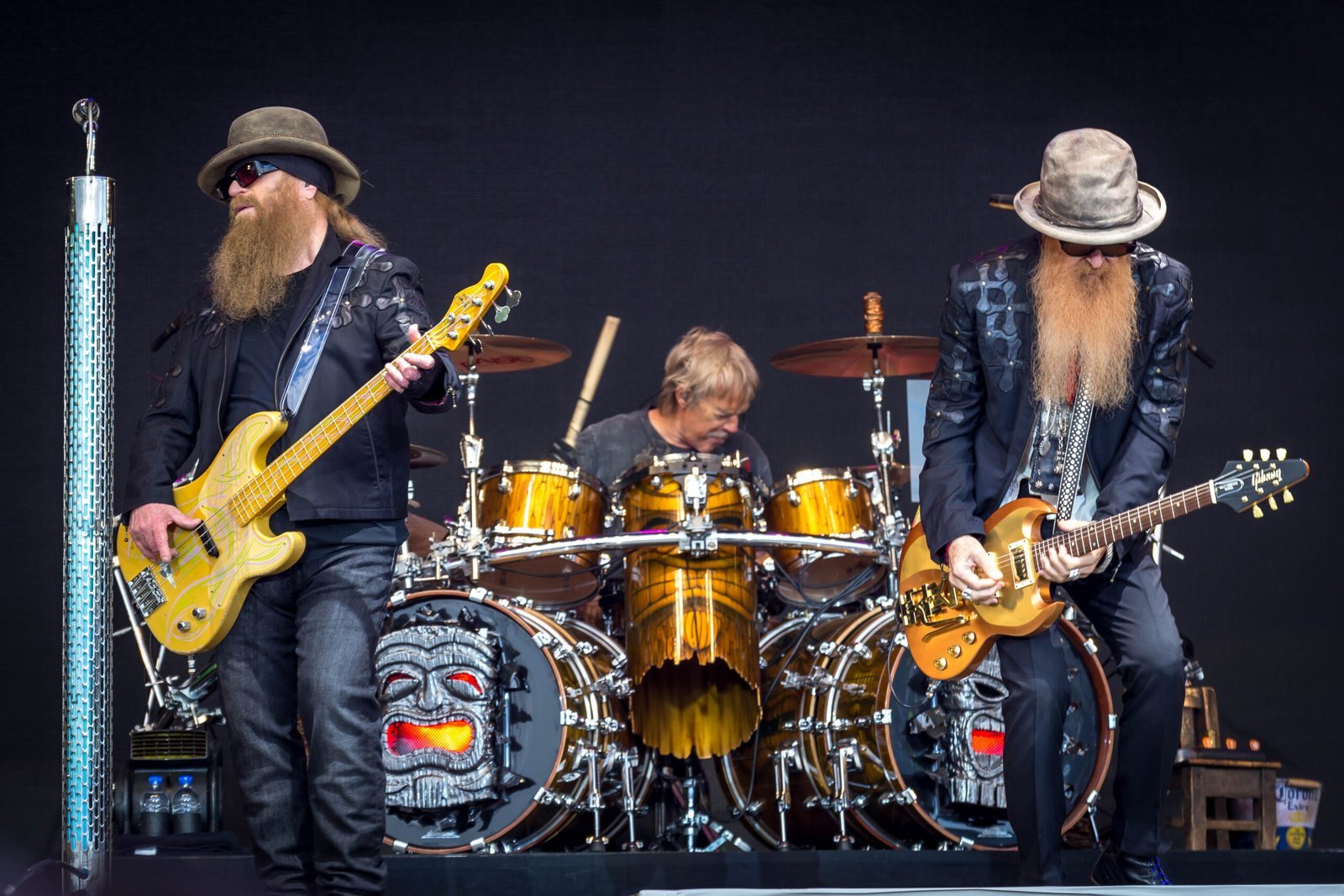

It begins with a sound nobody expected from ZZ Top: not a riff, not a growl, but a soft wash of synthesizers, patient and almost dreamy, over a slow, steady pulse. Then Billy Gibbons’ voice comes in, hushed and low, singing not about a fast car or a sharp-dressed man but about a rough boy who wants to be understood. When ZZ Top released “Rough Boy” in the spring of 1986, it was the strangest single the band had ever put out — a power ballad from the beardiest, bluesiest band in Texas, dressed in the sleekest electronic clothes of the MTV era. It should not have worked. It worked beautifully. The story of “Rough Boy” is the story of a band at the very top of its commercial powers deciding to show its soft side, of a guitar hero letting the machines do the talking until the moment he could not hold back any longer, and of a music video that sent a hot rod into outer space to get washed.
To understand why the record mattered, you have to understand where ZZ Top stood in 1985. They were not newcomers, and they were not a cult act. They were, by then, one of the biggest bands in America, and they had got there by reinventing themselves. For a decade the trio from Houston — Gibbons on guitar and vocals, Dusty Hill on bass and vocals, Frank Beard on drums — had been a superb Texas blues-rock band, beloved by fans and largely ignored by pop radio. Then came Eliminator in 1983. By welding their blues and boogie to synthesizers, sequencers and drum machines, and by filming a trilogy of unforgettable videos built around Gibbons’ red 1933 Ford coupe — the Eliminator car — and three glamorous female drivers, the band sold ten million copies and became MTV stars. The beards, the sunglasses, the spinning fur-covered guitars: ZZ Top had turned themselves into a cartoon of cool, and the cartoon was selling. The question, when it came time for a follow-up, was obvious and dangerous. Could they do it again without simply repeating themselves? And could a band that had built its legend on shuffle rhythms and Texas grit survive going even further into the synthetic sound?
Afterburner, released on October 28, 1985, was the answer, and it doubled down. It was the band’s ninth studio album, produced as ever by their longtime manager Bill Ham, and it was, by common consent, their most synthetic record: more keyboards, more drum machines, more sequencers than Eliminator, wrapped in a gleaming electronic sheen. Critics were lukewarm, but the public was not. The album reached number four on the Billboard 200, number two in Britain, and went on to sell five million copies in America alone. It produced four American Top 40 singles: “Sleeping Bag” at number eight on the Hot 100, “Stages” at number 21, “Rough Boy” at number 22, and “Velcro Fly” at number 35. And right in the middle of that gleaming machine sat the album’s emotional centrepiece, the one track that slowed everything down: “Rough Boy,” the fourth track on side one, running four minutes and fifty seconds, credited to all three band members.
The song itself is, at heart, a simple idea, and its simplicity is the point. The narrator presents himself plainly: he is a rough boy, rough around the edges, not polished, not pretty, not the kind of man who comes with smooth lines. But the song’s argument — made gently, over that patient synth bed — is that roughness is not the same as hardness. This rough boy is loyal, he is sincere, and he is asking, almost shyly, to be taken as he is. It is a love song from a man who knows he does not look like a love song. That was a new posture for ZZ Top. The band’s classic songs were boasts, jokes and come-ons, delivered with a wink. “Rough Boy” is none of those things. It is vulnerable, and the vulnerability is what makes it stick. Gibbons sings it softly, almost sleepily, as if he does not want to wake the feeling up too roughly, and the restraint is the performance: the toughest voice in the band, whispering.
The recording captures that tension between machine and man, and the way it was made explains why the track sounds the way it does. The band had been edging toward synthesizers for years — sneaking them in on El Loco in 1981, leaning on them hard for Eliminator — and by Afterburner the machines were no longer decoration; they were the foundation. The drums on “Rough Boy” are programmed and precise, the keyboards layer into a cool, spacious bed, and for long stretches the only recognisably human things in the mix are Gibbons’ voice and, eventually, his guitar. Gibbons later explained the band’s attitude with characteristic bluntness: they were tiptoeing through sacred ground by venturing into synthesizer music, but Hill’s approach was to turn the machine on and make a mess of it quickly, and Gibbons felt the same — better not to pretend to be technicians, better to let the band’s roughness show through the technology. Hill, by Gibbons’ own account, played the keyboard parts. And in a telling detail, the album sleeve did not mention keyboards at all: Ham did not want a list of notes on the cover, and the band half-suspected that the word “synthesizer” might offend a loyalist before the music got a chance to be heard. They fought the word more than the sound.
But the guitar, when it finally arrives, is the reason the song survives its own production. Gibbons plays two solos on “Rough Boy,” and both do the same job: they cut through the sleek electronic surface with pure Texas blues feeling, melodic and unhurried, the sound of a human hand against a machine pulse. Critics who disliked almost everything else about Afterburner singled those solos out. One later writer put it memorably: with the song’s synthesized calm all around him, Gibbons dialled back to maybe six out of ten — and six-out-of-ten Gibbons was still more than enough to lift the track out of its digitized slumber. That is the whole trick of “Rough Boy.” The machines set the mood, but the guitar supplies the soul, and the contrast between them is the song’s real subject: a rough boy in a smooth world, a bluesman inside a synthesizer, refusing to disappear entirely.
There is also a quiet family resemblance in the song that fans noticed immediately, and it is worth stating plainly rather than pretending otherwise. “Rough Boy” bears a strong resemblance to “Leila,” the weepy ballad from El Loco (1981) — so strong that several writers have called it essentially a remake, rebuilt with drum machines and keyboards. The band never hid the connection; Gibbons himself, running through the band’s albums years later, named “Sleeping Bag” and “Rough Boy” together as Afterburner’s highlights, without apology. Whether you hear it as a remake or a refinement, the resemblance tells you something important: the ballad instinct had been in ZZ Top all along, years before MTV. “Leila” proved the band could write a tender song. “Rough Boy” proved it could make one a hit in the synth-pop era without losing the blues feeling that made the first one work.
The single’s chart story was a solid, respectable success — not a blockbuster, but a vindication. “Rough Boy” was released in the United States by Warner Bros. in March 1986 as the third single from Afterburner, backed with “Delirious.” It entered the Billboard Hot 100 on the chart dated March 29, 1986, at number 65, climbed steadily through the spring, crossed into the Top 40, and peaked at number 22 on the chart dated May 17, 1986, spending thirteen weeks on the Hot 100 in total, seven of them inside the Top 40. On Billboard’s Album Rock Tracks chart — the rock-radio chart that measured the band’s home audience — it did even better, reaching number five. Abroad it was a genuine international hit: number 23 in both Britain and Ireland, number 22 in France, number 58 in Canada, and number 85 in Australia. It was not the band’s biggest single — “Sleeping Bag” had gone to number eight on the Hot 100 a few months earlier — but for a slow ballad from a band famous for boogie, number 22 in America and Top 25 in Britain was proof that the soft side could sell. The song even came back: a 1992 British reissue reached number 49 on the UK Singles Chart.
The song’s afterlife began on television, in a video that may be the strangest of the band’s entire MTV run — and that is saying something. The clip, directed by Steve Barron, closed out the trilogy of Afterburner videos that had begun with “Sleeping Bag.” In that first video, the beloved Eliminator car had been destroyed by two wheel loaders, only to be reborn as a hybrid of hot rod and space shuttle, as pictured on the Afterburner album cover, rocketing into space with the words “to be continued…” In “Stages,” the shuttle made only a brief appearance at the end, with the words “Stay tuned…” And in “Rough Boy,” the shuttle finally took centre stage: it flew into an intergalactic car wash, the sole customer at a space station where robotic arms, neon lights and floating traffic signs did the washing. Between the car-wash sequences came surreal images of the band members’ hands and faces, and a woman’s legs, protruding from metal plates, some of which doubled as lighted message signs or crosswalk signals. The video ended, fittingly, with the words “Stay clean…” It was nonsense, gloriously so — a hot rod getting washed in orbit while a power ballad played — and it was perfect for the song: sleek, otherworldly, funny, and oddly tender, just like the record itself. The Eliminator car, meanwhile, went on to a quieter afterlife of its own, eventually taking up residence in the Rock and Roll Hall of Fame in Cleveland, where it remains one of the most recognised vehicles in rock history.
The song has kept travelling since, in ways that say something about how reputations settle. Old-school fans who hated Afterburner on release have, over the years, made their peace with “Rough Boy” in particular: the synths date the record, but the melody and the solos do not, and the song now turns up on the band’s own best-of lists — Gibbons’ own website ranks it first among the band’s ten best songs — and in the set lists of a band that kept playing it long after the drum machines were retired. When Rhino made the band’s classic videos available on YouTube for the first time, “Rough Boy” was on the list, alongside “Legs,” “Sharp Dressed Man” and “Sleeping Bag,” as one of the defining clips of the MTV era. And the song’s central joke has only improved with age: the rough boy, it turns out, was right. Being rough was never the problem. Being afraid to admit you wanted to be loved was.
There is a final pleasure in the story, and it belongs to the car wash. ZZ Top spent the first half of their career singing about cars as freedom — fast cars, pretty girls, open roads — and then, at the height of their fame, they made a video about a car that flies into space just to get clean. It is easy to laugh at, and the band surely wanted you to laugh. But there is something oddly moving about it too, and it matches the song: a machine built for showing off, submitting itself to being washed, polished and made new. That is what “Rough Boy” is, in the end — not a boast but a confession, not a come-on but a request. The rough boy does not pretend to be smooth. He asks to be taken, washed and all, exactly as he is. The charts gave it number 22 in America and number five on rock radio. The video gave it a spaceship in a car wash. And Gibbons’ guitar, cutting through the synthesizers like a voice through a crowd, gave it the rest: proof that even at their most synthetic, the little ol’ band from Texas still had a human heart beating somewhere inside the machine.
Watch the video below and listen for the moment the synths part and Gibbons’ first solo arrives, slow and bluesy, over the machine pulse. It is the sound of a rough boy letting his guard down — and of a band that, having conquered MTV with cars and girls and drum machines, discovered that the bravest thing it could do was slow down and sing softly.