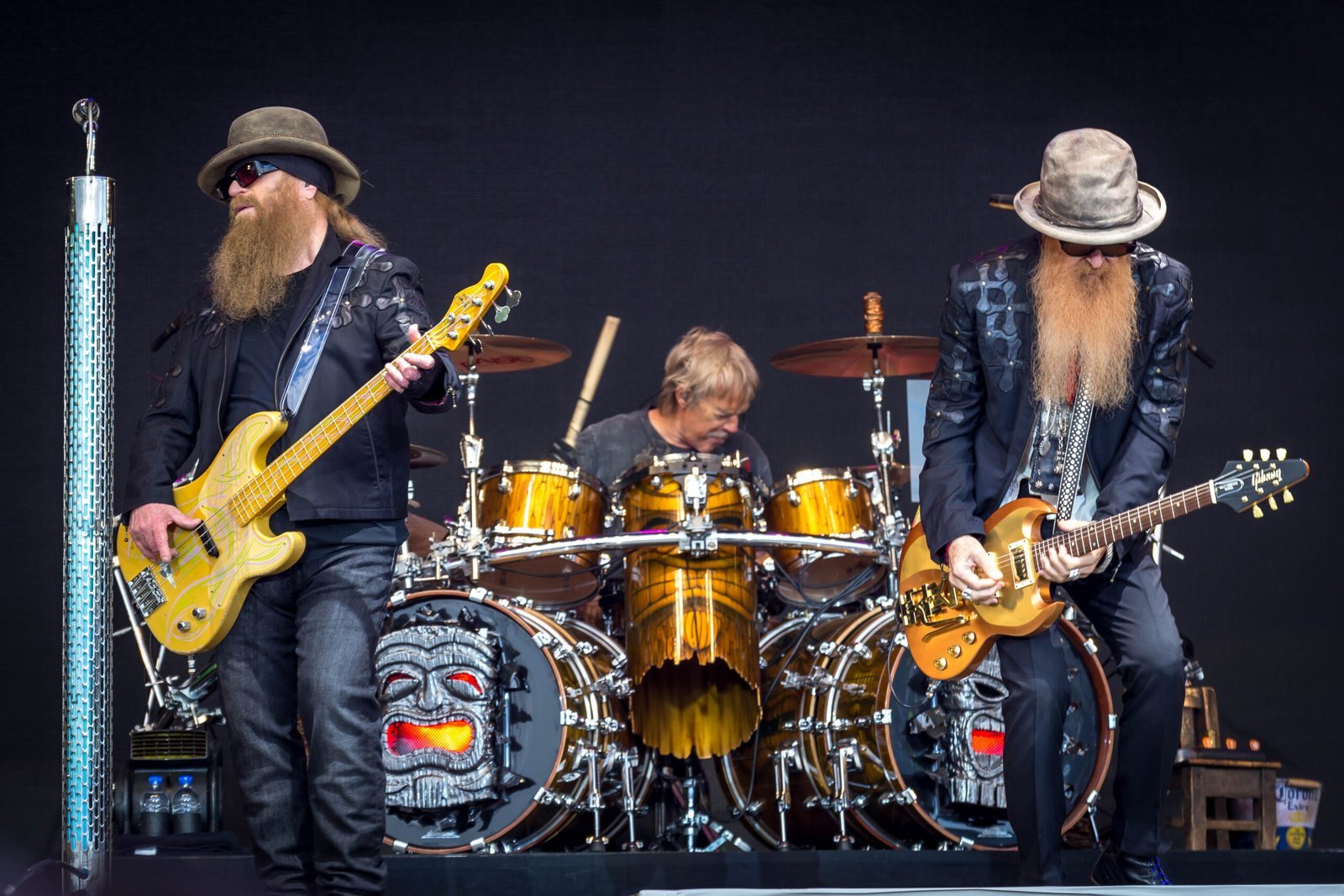
One Afternoon, Two Men, No Band: The Battles Behind ZZ Top’s ‘Got Me Under Pressure’
It is the second song on the biggest album ZZ Top ever made, and it behaves like an engine that refuses to idle. “Got Me Under Pressure” comes off Eliminator at full sprint — a four-minute hard-rock charge built on a riff that seems to lean forward as it runs, a drum track locked to the grid with inhuman patience, and a Billy Gibbons vocal that sounds like a man being chased by his own obligations. It was never released as a single. There was no video, no twelve-inch remix, no push from the label. And yet in May 1983, on the strength of nothing but album play and rock-radio instinct, it climbed to No. 18 on Billboard’s Mainstream Rock Tracks chart, nestled among the four official singles that were turning a Houston bar band into the most unlikely pop phenomenon of the MTV age. Four decades later it remains a fixture of the band’s stage show — so much a fixture that when ZZ Top played their first concert after the death of bassist Dusty Hill in July 2021, it was the song they chose to open with.
The battle behind it is one of the strangest in the band’s history, because by the most detailed insider account we have, “Got Me Under Pressure” was not really written by ZZ Top at all. It was written and demoed in a single afternoon by two men — Gibbons and a Houston engineer named Linden Hudson — in a home studio, on synthesizers and a drum machine, while the band’s bassist and drummer did not even know the session was happening. The finished record, the one millions of people know, was then assembled in Memphis by a process that quietly replaced much of the rhythm section’s work with machines and session craft. When the album became a diamond-selling triumph, the question of who had actually built it turned into a courtroom fight: Hudson sued, management denied he had mattered, and in December 1986 a judge awarded him $600,000. The song’s own credit line tells the story in miniature — modern listings for “Got Me Under Pressure” name Billy Gibbons and Linden Hudson as its songwriters. This is the story of the afternoon that produced it, the machinery that polished it, and the argument over authorship that followed it for years.
A Boogie Band Watching the Ground Move
To understand why “Got Me Under Pressure” sounds the way it does, you have to understand where ZZ Top stood at the start of the 1980s: successful, road-hardened, and facing a slow fade that nobody in the organization intended to accept. The trio — guitarist and singer Billy Gibbons, bassist and singer Dusty Hill, drummer Frank Beard — had formed in Houston at the turn of the 1970s and built their reputation the slow way, album by album, tour by tour. Tres Hombres in 1973 had given them “La Grange” and a gold record. The 1976 Worldwide Texas Tour had turned them into a live attraction of almost absurd ambition. But by 1978 they were exhausted enough to take a hiatus, during which Gibbons traveled in Europe, Hill vacationed in Mexico — both famously letting their beards grow — and Beard checked into a Houston drug program to deal with a serious narcotics problem.
The comeback records were respectable rather than world-beating. Degüello (1979), their first for Warner Bros., went platinum. El Loco (1981) continued their Tex-Mex boogie with increasing eccentricity. But the musical world around them was changing at speed. Punk had burned through, new wave was ascendant, synthesizers were moving from novelty to infrastructure, and in August 1981 a cable channel called MTV began restructuring what a rock band needed to be. Gibbons, always the band’s resident futurist — a man who collected art, electronics and odd ideas with equal appetite — was listening hard to British electronic acts such as Depeche Mode and Orchestral Manoeuvres in the Dark. The question hanging over the next ZZ Top album was whether a blues-boogie trio could absorb the machine age without ceasing to be itself. “Got Me Under Pressure” would be one of the purest answers: a bar-band rocker rebuilt as a precision device.
It is worth remembering what the trio had been, because the Eliminator method was a deliberate break with it. Gibbons had come up in the Moving Sidewalks, a Houston psychedelic band polished enough to open for Jimi Hendrix; Hill and Beard had played together in American Blues before all three converged, by the turn of the decade, into a unit managed by Bill Ham and signed to London Records. Their first records were made the way records were supposed to be made: three musicians in a room, playing together, the chemistry of the take standing as the whole argument. Through the 1970s that method carried them from ZZ Top’s First Album to Tres Hombres and Fandango!, building a road reputation that long outran their singles success. The hiatus of 1978 was the first crack in the machine — exhaustion, addiction, three men scattering to Europe, Mexico and rehab — and when they returned, the room they worked in was no longer quite the room of equals it had been. The center of gravity had shifted to Gibbons, and Gibbons had begun thinking like a producer. “Got Me Under Pressure” is inconceivable in the old method. It required a house, a drum machine, an engineer with a research file on hit tempos, and a bandleader willing to record first and inform the band later.
The House on the Golf Course
The song’s unlikely birthplace was a house in Quail Valley, a suburb southwest of Houston, overlooking a golf course. Beard had bought the house in 1979, part of a deliberate effort to build a life that kept him away from drugs; golf was one of his chosen disciplines. Into that house came Linden Hudson — a former radio DJ and engineer who had worked with Beard on a benefit project for the Palmer Drug Abuse Program, the Houston detox community where Beard had gotten clean. Beard invited Hudson to move in and build a recording studio in the home, and Hudson designed and supervised the construction: an isolation booth sized for Beard’s drum kit, separate booths for guitar and bass amplifiers, microphone lines running to a mixing console and a semi-professional one-inch, sixteen-track Tascam recorder.
It was a sensible arrangement for a working band: a private writing and demo facility, always available, no studio clock running. Hudson was no stranger parachuted into the band’s world; he had earned his place in it through the least glamorous door imaginable. When Beard was working to finance the Palmer program — the community that had helped him get sober — he had organized a benefit concert and an album called Freeway, working at Rampart Studios in Houston with engineers Steve Ames and Linden Hudson. The connection, in other words, began as an act of gratitude: the drummer owed his recovery in part to that world, and Hudson came with it. That Hudson should end up living in Beard’s house, building Beard’s studio, and then co-writing the band’s future in Beard’s absence is one of those arrangements that looks, in hindsight, like a plot twist no novelist would dare. At the time it simply looked like convenience — a gifted engineer on the premises, a bandleader with ideas, and a rhythm section increasingly content to let the two of them get on with it. But the studio changed the band’s internal balance of power in a way nobody announced. ZZ Top’s demos had previously been band affairs. In Quail Valley, the early work on what became El Loco — and then Eliminator — increasingly became a two-man operation between Gibbons and the engineer who lived down the hall. Hudson played on several El Loco demos, contributing a synthesizer line to “Groovy Little Hippie Pad” that engineer Terry Manning mixed into the finished album. Hudson was not credited for it, though he was promised future compensation. He also introduced Gibbons to drum machines during those rehearsals. Gibbons would later describe Hudson generously as “an influential associate” and “a gifted songwriter” who “brought some elements to the forefront that helped reshape what ZZ Top were doing, starting in the studio and eventually to the live stage.” At the time, though, Hudson’s role was kept quiet — manager Bill Ham cultivated an image of the band as a self-sufficient unit, and the mystique was considered part of the product.
The Tempo Research
The single most consequential idea Hudson brought into that house was not an instrument but a statistic. Drawing on his radio background, he had done personal research into the tempos of hit records and found that many of them clustered near 124 beats per minute — noticeably faster than ZZ Top’s natural boogie gait. Gibbons, who was already pushing the band toward a tighter, more electronic sound, seized on the finding. Most of Eliminator was built to that clock: “Legs” and “Sharp Dressed Man” both run at about 125 bpm, “Gimme All Your Lovin’” at 120. Gibbons said in 2012 that Eliminator was the first ZZ Top album on which the band “paid serious attention” to timing and tempo, and that he first used a drum machine on it; the record was, in his words, “timed and tuned very tight.”
This matters for “Got Me Under Pressure” because the song is, at heart, an argument about tempo. Its lyric persona is a man being crushed by demands — a woman who pushes him, a life running too fast to hold. The record itself enacts that pressure mechanically: the beat does not breathe, does not drag, does not swing the way a Houston shuffle swings. It simply bears down, at hit-record speed, for four minutes. The boogie had not been abandoned; it had been put on a conveyor belt. That fusion — blues guitar language delivered with sequencer discipline — was the Eliminator formula, and “Got Me Under Pressure” is where the formula runs hottest, with Gibbons’ guitar left free to snarl and slash over a rhythm bed that never once looks back.
There was a practical corollary that the band kept to itself for years. Once the album was built on sequenced parts, synthesizer beds and machine drums, the trio could no longer reproduce it on stage unaided. From this period onward, ZZ Top concerts quietly employed a small tape player, with a technician pressing play to feed Beard a click track in his headphones and supply the synthesizer parts and drum samples the records required. None of this was public. Ham controlled information about the band’s methods as tightly as he controlled their image, on the theory that the mystique of three men and their instruments was the brand. The irony is rich: the most technologically mediated album of the band’s career was marketed as the purest expression of the band itself. Inside that contradiction sits “Got Me Under Pressure” — a song whose subject is a man being worked over by forces he cannot see, made by a process its audience was not meant to see either.
One Afternoon
The session that created the song has become a set piece of ZZ Top lore, and it survives in print because the band’s longtime stage manager, David Blayney, chose to tell it. Blayney, who spent fifteen years in the band’s employ, published a memoir in 1994 called Sharp Dressed Men, and his account of “Got Me Under Pressure” is disarmingly specific. According to Blayney, Gibbons and Hudson wrote the entire song and cut a recorded demo of it in a single afternoon — without Hill’s or Beard’s knowledge. The first songwriting sessions for Eliminator were mainly the two of them working in Beard’s home studio while Beard was out playing golf; Hill and Beard participated only sometimes, and Ham checked in occasionally. On this song, the division of labor was complete: Hudson built the bass line on a synthesizer and programmed the drums on a drum machine, and he helped Gibbons write the lyrics. Gibbons played the guitars and sang.
Pause on what that means. Two of the three men whose names and beards were on the album cover were not involved in creating one of its defining tracks, and were not told it was happening. The “band” performance that listeners would eventually hear began as a collaboration between the bandleader and an uncredited engineer, assembled from machines in a spare room of the drummer’s house, at a tempo chosen from a chart of hit records. Whatever one thinks of the ethics — and the ethics would soon be litigated in another context — the creative audacity is hard to deny. Gibbons was not merely updating the band’s sound; he was prototyping a new way of making ZZ Top records, in which the trio functioned as the public face of a production process that could proceed with or without them in the room. “Got Me Under Pressure” was the proof of concept, cut in an afternoon.
Remarkably, the secrecy extended upward as well as sideways. Ham — the manager and official producer, the man whose name would appear on the album as its producer — was, by the standard accounts, initially unaware that Gibbons was building a new sound in Quail Valley without Beard or Hill. While the band was away touring, Hudson even wrote an entire song alone: “Thug”, a dark, lurching track that would end up on the album credited to the three band members, and that would later become the legal crux of the whole affair. When the demo tapes were judged ready, the operation packed up and moved to Memphis — carrying Hudson’s blueprints, Hudson’s tempos, Hudson’s bass lines and drum patterns — and left Hudson himself behind in Texas. The album that resulted would be presented to the world as the unmediated work of Billy Gibbons, Dusty Hill and Frank Beard. In the fine print of the finished record, Hudson’s existence was acknowledged in exactly one place: he was listed, on the song’s documentation, as “Preproduction Engineer” — a title that told the truth and concealed it at the same time.
Memphis: The Band, Replaced Quietly
The demos from Quail Valley traveled to Memphis without Hudson. The band lodged at the Peabody Hotel and recorded basic tracks at Ardent Studios, with Terry Manning — ZZ Top’s engineer since the early days — at the custom SpectraSonics console. What happened there has been described by Manning himself in later years, and it extends the story of “Got Me Under Pressure” to the whole album: the finished Eliminator contains far less of Hill and Beard than anyone was told at the time. Manning later revealed that Beard was struggling with substance abuse during the sessions and having difficulty playing, and that he was dismissed from the sessions, with a drum machine used in his place. Manning wound up playing or programming virtually all the drums on the final album — programming his Oberheim DMX, augmenting snare and hi-hat with triggered samples, and overdubbing acoustic tom fills and live cymbals to put human edges on the machine grid.
The rest of the record was built with the same philosophy. For most songs Gibbons played Dean guitars through a Legend hybrid amplifier at punishing volume — so loud that he could not lift his fingers to change chords without feedback, so each chord was recorded separately, doubled, and punched in and out by Manning to form seamless rhythm parts, a side benefit being the total absence of finger squeaks. Hill sang his lead vocal on “I Got the Six” and then went home to Texas. Most of Hill’s bass parts were replaced by Gibbons or Manning playing bass guitar or a Moog Source synthesizer, which could sit an octave below a bass guitar and give the record its peculiar subterranean weight. A Memorymoog supplied supporting synth textures. Vocal harmonies came from Manning and Jimi Jamison, the singer of Cobra, later of Survivor. Even the hit “Legs” was largely rebuilt by Manning alone at his home attic studio, with only Gibbons’ guitar and vocal flown in from the original tape. Manning also created an extended dance mix of “Legs”, and the album’s sonic web had stranger threads still: eight years later, Gibbons publicly thanked Al Jourgensen, because drum samples from Jourgensen’s early work with Ministry had been used to polish Eliminator. A blues record from Texas, burnished with samples from a Chicago industrial band, programmed by a Memphis engineer, from demos written by an uncredited Houston DJ — the “little ol’ band from Texas” had become, in the studio at least, something closer to a production collective operating under a trio’s name. None of this was disclosed. Ham, who controlled the band’s image, presented Eliminator as the work of the trio, full stop — and the trio, to be fair, had to go out and perform the material nightly, which they did, with a technician backstage firing the synth parts and click cues from a tape player so Beard could play along with the record the band had supposedly made.
The Hit That Wasn’t a Single
Eliminator was released worldwide on March 23, 1983, and it detonated. Four singles were drawn from it: “Gimme All Your Lovin’”, “Sharp Dressed Man”, “TV Dinners” and “Legs”, three of them carried into endless MTV rotation by Tim Newman’s videos featuring the band’s customized 1933 Ford coupe — the Eliminator car — and the trio’s sudden second career as deadpan pop icons. The album sold and sold, eventually passing eleven million copies in the United States alone, ten times any previous ZZ Top record, on its way to diamond certification.
“Got Me Under Pressure” had no such machinery behind it, and it hardly mattered. Album-oriented rock radio simply adopted it. It peaked at No. 18 on the Mainstream Rock Tracks chart in May 1983, while the singles were still cresting — a remarkable showing for a non-single in an era when album cuts rarely charted at all. Put it beside the official campaign and the achievement sharpens: “Gimme All Your Lovin’” reached No. 2 on the rock chart in April 1983 and broke into the pop Top 40 a month later; “Sharp Dressed Man” peaked at No. 8 that July; “TV Dinners”, an actual released single, managed only No. 38 in December; “Legs” would top out at No. 3 in June 1984. The album cut with no single, no video and no promotion out-charted one of the album’s four chosen singles and sat comfortably in the company of the others. Programmers were not being sentimental. They were responding to the record’s sheer forward motion — four minutes in which the new ZZ Top sound runs at its purest distillation, with nothing to prove and no chorus engineered for a video moment. Its position on the record helped: as the second track, sequenced immediately after “Gimme All Your Lovin’”, it was the moment the album proved its opening was no fluke, raising the tempo and the stakes before the hits everyone remembers took over. Critics reviewing the album have repeatedly singled it out — one retrospective account calls it the track where Gibbons delivers “one of his most urgent, bluesy vocals,” with guitar breaks, especially the faded outro of “Jeff Beck-like runs,” as highlights. In a catalog built on swagger, it was the song of a man being squeezed — by a demanding lover, by ambition, by the machinery of success itself — and audiences could hear the difference. It sounded like pressure because pressure is what it was made of, and made under.
The Car, the Beards and the Channel
None of it would have landed as it did without the strangest piece of casting in 1980s rock: a hot rod as fourth band member. The album took its name from drag racing — Ham steered an early title suggestion, Top Fuel, toward Eliminator, the term for racing categories run head to head — after the decision to feature Gibbons’ newly customized 1933 Ford coupe. Gibbons had commissioned the car back in 1976 from California builders; it was finished in 1983 in a blaze of red paint and graphics, at a reported cost of $50,000, and it became the visual anchor of everything. Behind the scenes, a Warner Bros. executive named Jeff Ayeroff, who had watched MTV reshape the business through 1982, persuaded the label to fund the band’s first real music video, for “Gimme All Your Lovin’”. Filmmaker Tim Newman directed it and its sequels for “Sharp Dressed Man” and “Legs”, and the trilogy built a miniature America of cars, girls, gas stations and three bearded apparitions who materialize, dispense cool, and vanish. The videos earned the band Best Group honors at the 1984 MTV Video Music Awards, with “Legs” winning Best Group Video, and its famous spinning sheepskin-covered guitars entering the iconography of the decade. The coupe itself outlasted the campaign: Gibbons keeps it in Cleveland, on display at the Rock and Roll Hall of Fame, reserving the right to crank it up and take it out for a spin when he is in the area — a museum piece that still runs, which is more or less the band’s own story.
“Got Me Under Pressure” had no video of its own, which in retrospect only sharpens its achievement: it is the Eliminator track that conquered on sound alone, in the most visual era pop had ever known. Texas Monthly observed that the album’s synthesizer sound was “perfect” for the MTV audience, which had previously filed ZZ Top away as an old-fogey band; the Financial Times called the record the one that made them “bona fide pop stars.” The canonization followed the commerce. Rolling Stone placed Eliminator at No. 398 on its list of the 500 Greatest Albums of All Time and No. 39 in its 100 Greatest Albums of the Eighties; the album appears in 1001 Albums You Must Hear Before You Die; a remastered edition arrived in 2008. And the song itself kept turning up where durable songs turn up: on compilation after compilation — Greatest Hits, the Chrome, Smoke & BBQ box, Rancho Texicano — and, in 2008, in a television commercial for Pennzoil, its pressure-cooker riff repurposed to sell motor oil to drivers who had been flooring it to that record for twenty-five years.
The Lawsuit in the Fine Print
Success of that magnitude turns credits into money, and money turned the Quail Valley arrangement into a legal case. After Eliminator appeared in March 1983, Hudson moved out of Beard’s house and cut his ties with the band. His central claim concerned another album track, “Thug”, which he said he had written entirely by himself while the band was on tour; on the album, “Thug” was credited to Gibbons, Beard and Hill. Hudson sued Lone Wolf, the band’s management company, for $1 million, arguing that his December 1982 copyright for “Thug” predated ZZ Top’s April 1983 copyright. Ham maintained that Hudson had sold the song outright, but no record of such a sale was produced. In December 1986, the court ruled in Hudson’s favor, awarding him $600,000 — of which, as it happened, a third went to his attorneys and a third to his publisher, Huey P. Meaux.
The broader authorship question remains genuinely disputed, and it should be presented that way. Lone Wolf denied that Hudson was significantly involved in the album at all, insisting the concept was solely the work of Gibbons and Ham. Against that stand multiple accounts — Blayney’s memoir, Manning’s later interviews, and Gibbons’ own on-the-record praise of Hudson’s influence — describing a collaboration that touched the album’s tempo, its methods and several of its songs. The catalog of Hudson’s alleged contributions, as set out by Blayney, goes well beyond “Thug” and “Got Me Under Pressure”. He helped write the lyrics of “I Got the Six”. On “Dirty Dog” he originated the shouted line “Hey! Get that dog outta my yard!”, which was duplicated exactly in Memphis, and he added special effects to both “Dirty Dog” and “TV Dinners”. The pulsing synthesizer effect that drives “Legs” — the band’s biggest single — was, by Blayney’s account, Hudson’s invention. Even the demo album prepared in Quail Valley for the Memphis sessions was, in substantial part, the product of Gibbons and Hudson working as a pair. Management’s position was that none of this amounted to authorship; Hudson’s position, vindicated in the one instance that reached a judge, was that he had been a collaborator whose name and compensation were withheld. Blayney’s judgment was blunt: “Linden Hudson in a fair world should have had his name all over Eliminator and gotten the just compensation he deserved. Instead he got ostracized.” For “Got Me Under Pressure” specifically, Blayney’s account documents Hudson’s hand in composing and arranging the song — the synth bass line, the drum machine, the lyric work with Gibbons — and modern songwriting listings for the track credit exactly two names: Billy Gibbons and Linden Hudson. The two-man afternoon, in other words, is now the official version of who wrote the song, whatever was said in 1983.
The Credits Catch Up
What is striking, four decades on, is how completely the official story has inverted. In 1983 the album was sold as the unassisted work of three men, and the men who had actually engineered its reinvention were invisible by design. The correction arrived in stages. Blayney’s memoir came first, in 1994, putting the Quail Valley sessions and the one-afternoon creation of “Got Me Under Pressure” into print while the band was still an active commercial force. Manning, in interviews given long after the fact, described the Memphis sessions with an engineer’s plainness — who was sent home, what was programmed, which parts he rebuilt alone in his attic — without apparent rancor, as a man simply setting down how a famous record was actually made. And Gibbons himself, whatever the management line of 1983, has never been stingy in print about Hudson’s role, calling him a gifted songwriter whose elements helped reshape the band in the studio and on stage. Read together, the sources do not agree on everything — authorship disputes never resolve that cleanly, and Lone Wolf’s denial remains part of the record — but they agree on the essential architecture of the event: the Eliminator method was born in collaboration, and Hudson was its co-architect.
What remains uncertain, and probably always will, is the precise personnel of the released “Got Me Under Pressure” itself. The album-wide accounts are consistent that the Memphis process replaced most of Hill’s bass work with synth and session playing and virtually all of Beard’s drumming with Manning’s programming, while Gibbons’ guitar and vocal — the elements cut with Hudson on the demo — were the record’s continuous thread. Whether any given bar of the finished track contains Hill’s fingers or Beard’s sticks is a question the surviving documentation does not answer track by track, and honest history should leave it open. What is not open is the songwriting: the modern credit line for “Got Me Under Pressure” reads Gibbons and Hudson, two names for a two-man afternoon. The paper trail, in the end, caught up with the tape.
On Stage, It Became Their Song
There is an irony at the end of the story that no lawsuit could touch: whatever its origins, “Got Me Under Pressure” became a genuinely communal ZZ Top song the moment the band had to play it for people. In concert, Gibbons and Hill developed a signature staging for it, trading the vocal between them phrase by phrase — the guitarist delivering a line, the bassist answering — turning a studio construction into a piece of live theater between the two bearded frontmen. The song became a reliable ignition point in the set, the kind of number bands place where they need guaranteed lift. It opens the band’s Double Down Live concert film package and appears on the Live from Texas document of the trio in full cry; the official ZZTopVEVO channel’s performance video of the song shows why it survived: played by three men in a room, it loses none of its drive.
Its most poignant appearance came on July 30, 2021. Dusty Hill had died two days earlier, on July 28, and the band — honoring Hill’s own directive that the show should go on, with longtime guitar tech Elwood Francis stepping in on bass — played their first concert without him. They opened with “Got Me Under Pressure.” Gibbons introduced Francis, and the machine-tooled rocker from 1983 carried a weight its makers could never have planned: it was the sound of the band continuing. The song kept generating small legends, too — in November 2022, fans in Huntsville watched Francis play it on a preposterous seventeen-string bass, a moment that traveled around the world as a viral clip. A track cut by two men in an afternoon, with half the band unaware, had become the song the band reached for at the most exposed moment in its history. The pressure, by then, was real.
Why It Endures
“Got Me Under Pressure” endures because it contains, in four minutes, the whole argument of ZZ Top’s second life. It is a blues band’s song — the riff, the snarl, the comic desperation of the lyric — executed with a pop machine’s discipline, at a tempo chosen by market research, on instruments its credited performers partly did not play. Every tension in the band’s story runs through it: tradition against technology, camaraderie against control, the mystique of the self-contained trio against the reality of engineers, drum machines and lawyers. That it also happens to be a ferociously exciting record is almost beside the point — except that the excitement is precisely why all the arguments matter. Nobody litigates over a flop.
It also endures as a quiet correction to the myth. The Eliminator story is usually told as a triumph of image: the car, the beards, the videos, the spinning guitars. “Got Me Under Pressure” — the non-single that radio refused to ignore, the two-man demo that became a three-man ritual — tells the other half: that the triumph was engineered, in a house on a golf course and a studio in Memphis, by people whose names were not on the poster, and that it took a lawsuit, a memoir and the slow honesty of old engineers to say so. The pressure in the title turned out to be prophetic in every direction — on the singer, on the band, on the men who built the song and then had to fight to be named as its builders. Four minutes, one afternoon, and an argument that outlasted the decade: that is a battle worth remembering.
Perhaps the simplest verdict came from the bandleader’s own camp. A list of the ten best ZZ Top songs published on Gibbons’ official website places “Got Me Under Pressure” at No. 2 — above “La Grange”, above “Sharp Dressed Man”, above every official single the band ever released, behind only the songs that built their name in the first place. For a track with no video, no single, no credited rhythm section and a co-writer the organization once insisted did not matter, that is a remarkable resting place. It got there the way it was made: on pressure, applied steadily, for a very long time. That is not a bad epitaph for the song — or for the band that learned, in one secret afternoon, how to run on it.