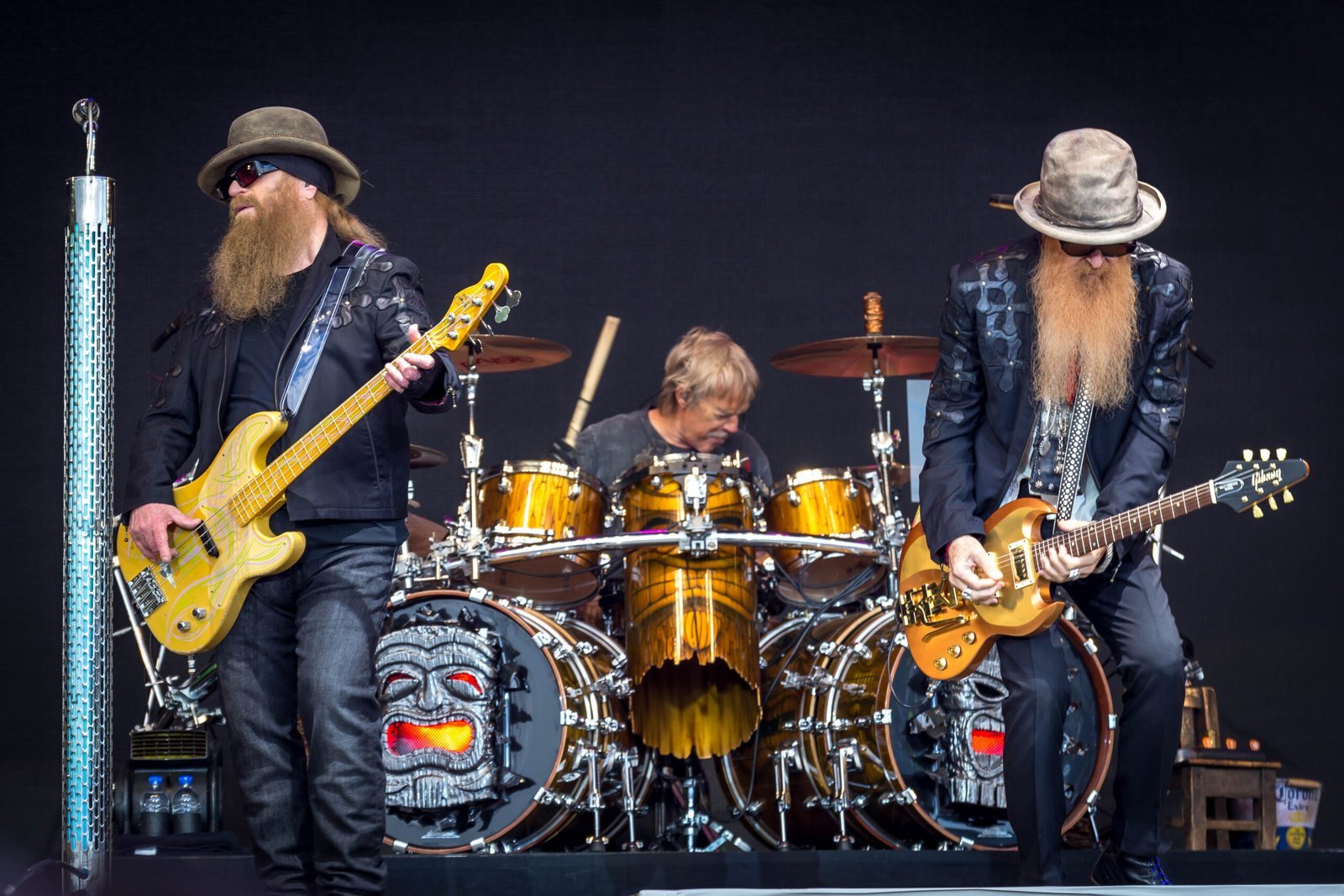
The Ballad He Played at His Wedding: The Battles Behind ZZ Top’s ‘Rough Boy’
In March 1986, the hardest-boogieing band in Texas released a slow dance. “Rough Boy”, the third single from ZZ Top’s ninth album Afterburner, is a power ballad wrapped in synthesizer haze: nearly five minutes on the album, unhurried where the band was famous for velocity, tender where they were famous for innuendo, with Billy Gibbons singing a plea for tenderness over sequenced keyboard beds while his guitar wept in the spaces. It should not have worked. This was the trio of “La Grange” and “Tush”, the bearded merchants of the twelve-bar leer, now asking America to sway. America swayed. The single reached No. 22 on the Billboard Hot 100, No. 5 on the Album Rock Tracks chart and No. 23 in Britain, and its music video — in which the band’s famous hot rod, reborn as a spacecraft, submits to an intergalactic car wash — became one of the defining MTV images of the era.
The battles behind “Rough Boy” were fought on three fronts at once. There was the battle of the follow-up: Afterburner had to succeed Eliminator, a diamond-selling phenomenon that had remade the band’s career, and every choice on it was shadowed by the temptation to simply rerun the formula at higher gloss. There was the battle of identity: a ballad this soft, built partly on the bones of an earlier ZZ Top ballad, “Leila”, split critics and fans between those who heard range and those who heard surrender — Robert Christgau named it one of the album’s highlights while later reassessments dismissed the record around it as a product of its time. And there was the quiet, decisive verdict inside the band itself. Dusty Hill, the bassist, the man whose job was to be half of the toughest rhythm-and-leer act in rock, said of “Rough Boy” in 2007: “I like that song so much, I had it played at my wedding.” This is the story of how the rough boys made their tenderest record — and what it cost, and proved.
After the Diamond
Every follow-up album is an argument with its predecessor, but few bands have had to argue with a predecessor like Eliminator. Released in March 1983, ZZ Top’s eighth album had converted a decade of road-earned respect into full pop stardom: four hit singles, a customized 1933 Ford coupe that became as famous as its owners, a shelf of MTV awards, and sales that eventually passed eleven million copies in the United States alone — ten times any previous ZZ Top record, and enough for diamond certification. The band that had once toured with live livestock on stage as a Texas joke now stood, in the Financial Times’ phrase, as “bona fide pop stars.” The sound that did it was a calculated hybrid: boogie and blues-rock rebuilt on drum machines, synthesizers and studio sleight of hand, at tempos researched for maximum radio effect.
Success on that scale creates a very specific trap, and Afterburner was made inside it. Do the same thing again and you are a formula act, embalming your own breakthrough. Do something different and you risk the new audience that the breakthrough bought you. ZZ Top’s answer, characteristically, was to lean in and exaggerate: if Eliminator had tightened the boogie with sequencers, Afterburner would tighten the sequencers. Stephen Thomas Erlewine of AllMusic, in his retrospective review, diagnosed the temptation exactly: a band praised as visionary for playing blues grooves to a sequenced beat would naturally “tighten the sequencer and graft on synthesizers.” Rolling Stone, reviewing the album at the time, framed it as “a tricky period in ZZ Top’s continuing evolution from bell-bottom-blues band to sharp-dressed pop machine.” Robert Christgau, awarding a B, was blunter about the strategy, calling it a hard-boogieing market play defined by “conscious commercial ambition” — an announced intention, as he put it, of making ZZ Top the next Bruce, Madonna, Prince or Michael, “with two beards and a Beard at every checkout counter.”
The fame itself had become a kind of costume the band could not take off. Before Eliminator, ZZ Top were a connoisseur’s band — respected, road-tested, and largely invisible to the pop mainstream. After it, they were characters in their own videos: the beards, the sunglasses, the car, the keys tossed to the kid at the gas station. A worldwide tour followed the album, and the trio’s deadpan mythology followed them everywhere. That is the context in which Afterburner’s every track was heard, and it cuts two ways for a ballad. On one hand, the characters were so established that a slow song arrived as a plot twist the whole audience could read instantly — the rough boys, tender at last. On the other, anything the band released risked being consumed as another episode of the cartoon, its sincerity discounted as a bit. “Rough Boy” had to fight its way out of the band’s own image to be believed, and the fight is audible in the record: the production insists on the joke’s world — chrome, orbit, neon — while Gibbons’ singing and playing insist, just as firmly, that the feeling is not one.
Building Afterburner Without the Fourth Man
Afterburner was recorded between March and July 1985 and released on October 28, 1985, produced as ever by manager Bill Ham. Behind the scenes, one significant figure was missing. The album was the first ZZ Top record since Rio Grande Mud — all the way back in 1972 — made without longtime engineer Terry Manning, the Memphis sonic architect who had shaped the band’s records for over a decade and had been central to constructing Eliminator. Manning was willing to work on the album but was unavailable because of other commitments; engineering duties fell to Joe Hardy, with Bob Ludwig also credited. The band even reached back into the vault: some material, including part of “Can’t Stop Rockin’”, was leftover from the Eliminator sessions, carried forward into the new record like furniture from a previous house.
Commercially, the strategy held. Afterburner reached No. 4 on the Billboard 200, No. 2 in Britain, and became the band’s first album to top a national chart, hitting No. 1 in New Zealand; it was certified five times platinum in the United States. The international numbers, often forgotten in the American telling, were the numbers of a band operating at genuine world scale: No. 1 in Canada and Finland as well as New Zealand, No. 2 in Switzerland, No. 3 in Germany and Sweden, No. 6 in Australia, No. 8 in Norway. In Britain it was certified gold in the year of release and platinum by 1990. The album also completed a visual trilogy of its own: where the Eliminator videos had put the red coupe on American highways, the Afterburner artwork — by Barry E. Jackson, under Jeri McManus’ art direction — launched it into orbit, the hot rod redrawn as a spaceplane on the sleeve. The message was unmistakable and frankly commercial: the band’s totem could go anywhere, even off the planet, and the band intended to follow it.
Its singles performed like a franchise firing on schedule: “Sleeping Bag” hit No. 1 on the Mainstream Rock chart and No. 8 on the Hot 100, equalling the pop peak of “Legs”; “Stages” reached No. 21; “Velcro Fly” No. 35. The critics were cooler than the customers — Kerrang! and The Encyclopedia of Popular Music were warm, AllMusic and the Rolling Stone Album Guide lukewarm, Christgau wryly appreciative — but the machine was plainly still running. Inside that machine, “Rough Boy” sat as the deliberate anomaly: track four, the long slow exhalation on an album of pumped-up synth-rock, and the song that would test whether the new ZZ Top could do the one thing the old one had never been asked to do on a single — be gentle in public.
There is a tendency, in the band’s legend, to treat the Afterburner period as a victory lap, but the record’s construction tells a tenser story. The Eliminator sessions had been a genuine reinvention, driven by research, experiment and a producer-engineer team willing to rebuild the band’s sound from the rhythm up. The follow-up had to be manufactured under the opposite conditions: a fixed deadline of expectation, a public that now associated ZZ Top with a specific chrome-plated sound, and the absence of Terry Manning, the engineer who had translated the reinvention into tape. Joe Hardy was a more than capable pair of hands, and the sequenced keyboard beds that run through the album gave it a cohesion of its own — but Afterburner is audibly a record made to a specification, where Eliminator had been made to a discovery. That difference is the background hum beneath every argument about “Rough Boy”. The ballad was not merely a slow song; it was the place where a band executing a formula paused, in the middle of side one, and did something the formula had not predicted — which is precisely why the formula’s defenders and the band’s purists both ended up claiming it.
A Slow Song from a Fast Machine
“Rough Boy” is credited, in the Afterburner manner, to all three band members — Gibbons, Hill and Frank Beard — and its construction reflects the era’s division of labor: Gibbons on guitar and lead vocal, Hill on bass, keyboards and backing vocals, Beard on drums, the whole wrapped in the sequenced keyboard beds that run through the album. But the song’s deepest peculiarity is genealogical. Listeners with long memories noticed that “Rough Boy” shares a similar tune with “Leila”, the weepy ballad from the band’s seventh album, El Loco, in 1981. The Something Else! review site put it cheerfully: the band essentially remade “Leila” on Afterburner, “albeit with a lot more in the way of drum machines and keyboards” — and judged it one of those rare occasions when a band ripping itself off produced the better record.
That act of self-recycling is the key to the song’s character. “Leila” had been the anomaly on El Loco, a slow, sincere ballad smuggled onto a record of Tex-Mex eccentrics, and it had actually been a modest single in its own right. “Rough Boy” takes that impulse and rebuilds it with the full Afterburner apparatus: where “Leila” pleaded, “Rough Boy” floats. Wikipedia’s dry summary of the song makes the anomaly official — unlike the other songs on the album, it has a much slower tempo and is more of a power ballad — but dry summaries cannot capture how strange the record must have sounded in sequence, to a listener who had bought Afterburner for the band of “Sleeping Bag” and found, four tracks in, a slow dance in a spaceship.
There is also the matter of the narrator, who represents a genuine first in the catalog. ZZ Top’s classic songs are populated by braggarts and hunters — men cruising for trouble, dressed sharp, talking big, their desire a form of conquest. The rough boy is built from the same timber but turned inside out: the toughness is presented not as the prize but as the problem, the thing standing between the narrator and the tenderness he is asking for. In a catalog famous for never apologizing, “Rough Boy” is an apology set to synthesizers — or nearer to one than the band would ever otherwise come. That is why the song could not have been a hit for them in 1975 and could not have failed to matter in 1986: it required the band to have become so completely identified with roughness that softening it registered as news. The beards, in effect, sang the ballad. Without the image, it is a pretty song. With the image, it is a confession from behind it. The narrator is the title character — a rough boy, all leather and reputation — asking to be taken as he is and held anyway, the tough exterior presented as precisely the reason the tenderness is needed. It is the oldest arrangement in the ZZ Top songbook, the leer replaced by the confession. And crucially, the record keeps one foot in the barroom: Gibbons’ two guitar solos are pure Texas blues, burning through the synthesizer sheen. One hostile critic, writing in Popdose’s “Death by Power Ballad” series, conceded the point against his own thesis — Gibbons’ voice and guitar were “the only real Top totems in the song,” but the solos fought the track’s “calming sheen” with Texas heat and resuscitated it “like a couple live defibrillator paddles to the chest.” Even the song’s detractors kept admitting that its center was real.
The single release sharpened the test. Issued in March 1986 with “Delirious” on the B-side, “Rough Boy” was edited down from the album’s near-five-minute drift to a 3:45 single version — the ballad trimmed to radio dimensions, its slow burn asked to smolder faster. Even the pairing told the story of the band’s two natures: flip the record over and there was “Delirious”, an uptempo album track sung by Hill, all appetite and momentum — the old ZZ Top riding on the back of the new one, each side of the vinyl vouching for the other. Cash Box, reviewing the single in March 1986, reached for the exact image the band would have wanted: a “rapturous teen ballad” in which “the band turns its leather-tough into pure silk.”
In the Age of the Power Ballad
Timing helped, and the band’s instincts deserve credit for reading it. The middle of the 1980s was the great age of the power ballad, when hard-rock and metal acts discovered that a slow song with a loud chorus could cross them over to audiences their fast material never reached — the era’s rock radio was held together by lighter-waving anthems from bands who had built their names on volume. ZZ Top’s version of the maneuver was distinctive in two ways. First, they came to it late and from an unusual direction: not a metal band softening for pop, but a blues band that had already crossed over with machines, now testing whether the machines could do sincerity. Second, their ballad was not a concession written for the occasion but a homecoming — the “Leila” impulse, present in the catalog since 1981, finally given the full production treatment. Where rival ballads often sounded like assignments, “Rough Boy” sounds like a band revisiting a room in its own house it had been meaning to furnish for years.
The sequencing of the album makes the intention plain. Afterburner opens at full synthetic throttle — “Sleeping Bag”, “Stages”, “Woke Up with Wood”, three tracks of pumped, sequenced momentum — and then, at track four, downshifts into “Rough Boy” and stays down for nearly five minutes, the longest track on the record. It is the album’s center of gravity, placed where a listener could not miss the statement: this band intends to be heard at more than one speed. Side one then closes with “Can’t Stop Rockin’”, the throttle reopened, as if to reassure the faithful. Album sequencing is a quiet art, and the placement of “Rough Boy” is the boldest piece of sequencing on any ZZ Top record — the slow heart installed in the middle of the machine, daring the machine to beat around it.
Five Minutes, Slowed to a Heartbeat
Listen to how the record is built, and the argument about it starts to settle itself. “Rough Boy” opens in the machine world of Afterburner — a synthesized atmosphere, a measured electronic pulse, the temperature low and blue. Nothing in the first moments promises a blues band. Then Gibbons begins to sing, and the record’s double identity declares itself: the voice is unhurried, low, almost conversational, a man talking his way into a confession he has rehearsed too long. The arrangement holds its fire with unusual discipline for a band of showmen. The rhythm stays level, the keyboards carry the harmony like weather, and the space that a boogie record would fill with riffing is left open — deliberately, even bravely open — so that the song’s emotion has somewhere to live.
Then the solos arrive, and they are the song’s true verses. Gibbons plays the way the narrator is asking to be understood: rough at the edges, tender in intent, each phrase bending toward resolution. It is some of the most purely melodic playing of his career, closer to a second vocal than to a guitar break, and it reframes everything around it. The synthesizers stop sounding like a costume and start sounding like a setting — the modern, neon world in which this rough boy happens to live — while the guitar supplies the man. That division of labor is the Afterburner method turned humane: machines for the scenery, human beings for the feeling. The single edit, at 3:45, tightens the arrangement for radio, but the album version’s patience is the point; at nearly five minutes it is the longest track on the record, and it earns its length the way ballads must, by never once raising its voice to keep your attention.
Hill’s role deserves a word, too, because it is easy to miss. On an album where the bassist also carried keyboards, “Rough Boy” is the track where that doubling matters most: the low end is as much atmosphere as anchor, and the backing vocals soften Gibbons’ lead at exactly the moments the lyric asks for mercy. Beard, the drummer who had been displaced by machines on parts of the previous album, is present in the personnel and in the feel — the track’s steadiness has a human governor on it, a pulse rather than a grid. Taken together, the three performances amount to a quiet rebuttal of the era’s laziest criticism. This was not a record on which anybody could have been playing. It was a record only this band could have made: three Texans in their second decade, playing slowly on purpose, inside the most fashionable machinery of 1985, and trusting that the feeling would read through the chrome. It did. Radio took the shorter edit and made it a hit, but the album cut remains the full document — nearly five minutes in which the fastest boogie band in Texas proved it could hold a single feeling, at a walking pace, without flinching or reaching for a joke to break the spell.
The Charts Answer
Radio and the public delivered their verdict through the spring of 1986. “Rough Boy” climbed to No. 22 on the Billboard Hot 100 — a remarkable address for a slow synthesizer ballad by a blues band — and, perhaps more tellingly for a group whose empire was built on rock radio, No. 5 on the Album Rock Tracks chart. It travelled, too: No. 23 on the UK Singles Chart, No. 22 in France, No. 23 in Ireland, No. 58 in Canada, and an appearance in the Australian charts. In the sequence of Afterburner singles it completed a pattern that said something important about the band’s range in that era: the album produced a rock-chart No. 1 in “Sleeping Bag”, two further pop Top 40 hits, and a ballad that stations could play between all of them. The sharp-dressed pop machine, it turned out, had a slow gear, and the slow gear worked.
The song refused to stay in its era. In 1992, as the band’s Greatest Hits collection carried the catalog to a new generation, “Rough Boy” charted again — No. 49 in Britain, No. 38 in Switzerland, No. 81 in the Netherlands, with a further showing in Australia. Re-chartings of that kind are the quietest form of canonization: nobody campaigns for them, no video premieres, no press cycle. A song simply turns out, years later, to still be on the radio in enough countries to register. It lived on stage, too, documented in the Live from Texas concert release, and footage circulates of ZZ Top performing it in London in 2015 alongside Jeff Beck, two generations of guitar mythology sharing the band’s softest song. In 2019 it was remastered for Goin’ 50, the band’s fiftieth-anniversary retrospective — the rough boy, by then, officially part of the family silver.
The Car Wash in Orbit
If the song was the era’s softest ZZ Top product, its video was among the most gloriously absurd. The “Rough Boy” clip was directed by Steve Barron, one of the defining directors of the MTV age, and it built outward from the Afterburner album cover, on which the Eliminator coupe had been reimagined as a spacecraft. In the video, the car-spaceplane hybrid arrives at an intergalactic car wash — the band’s automotive totem, having conquered the American highway in the Eliminator trilogy, now getting detailed in orbit. Around it, in keeping with Barron’s surreal grammar, the band members appear in pieces: hands and faces protruding from metal plates, a woman’s legs emerging likewise, some of the plates doubling as lighted message signs or crosswalk signals. The Something Else! retrospective remembered it as one of those “great, meaningless videos packed with visuals that simply burn into viewer’s minds” — the coupe arcing up from the atmosphere to an orbital car wash, logic be damned.
It mattered that the video was witty, because the ballad needed the band’s deadpan to protect it. A slow, sincere love song from ZZ Top risked reading as a genre exercise — one more hard-rock band renting a ballad for the quarter’s earnings. The clip announced that the band was in on its own joke even while meaning the song: yes, the rough boys had built a spaceship, and yes, they were washing it while singing about wanting to be held. The contrast with the Eliminator trilogy is instructive. Tim Newman’s earlier videos had kept the band on American asphalt — highways, gas stations, diners — with the coupe as a kind of secular guardian angel. Barron’s “Rough Boy” video leaves the planet entirely, and the escalation is the era in miniature: by 1986, the ZZ Top visual universe had nowhere left to go but up. Yet the emotional grammar stayed the same. The band barely performs in the clip at all; they haunt it in fragments, faces and hands sealed in metal, present the way the feeling in the song is present — everywhere, and just out of reach.
When Rhino eventually brought the band’s classic Warner Bros. videos to YouTube officially — a dozen of them, presented as available on the platform for the first time — “Rough Boy” took its place in that canon alongside the Eliminator trilogy and the other Afterburner clips. The official music video, hosted on Rhino’s channel, is how most listeners now encounter the song first: the car wash in orbit introducing the tenderest thing the band ever released, to an audience that mostly never saw MTV show it the first time around.
The Critics Go to War
The argument about “Rough Boy” has never really ended; it simply changes weapons by decade. At release, the notices were a split decision wrapped around a hit: Cash Box swooned over the silk, Christgau singled the song out — naming “Rough Boy” and “Velcro Fly” as the highlights of Afterburner — and the chart numbers did their own talking. The backlash came with retrospection. Erlewine’s AllMusic reassessment of Afterburner is the famous broadside: the album as “merely a product of its time,” a record that “hardly exists out of that time,” on the grounds that “blues-rock just doesn’t kick when it’s synthesized.” Read against that frame, “Rough Boy” is the prime exhibit — the moment the synthesizers stopped serving the boogie and started replacing it, a ballad on which, as Popdose argued, virtually anybody could have been playing behind Gibbons.
It is worth pausing over Christgau’s position, because it captures the contemporary case for the defense better than anyone else managed. Writing in the Village Voice in December 1985, he read Afterburner not as a sellout but as a strategy openly declared — the “conscious commercial ambition” was the point, announced rather than concealed — and he heard the album with a pop critic’s ear, picking its two most melodic constructions as its peaks. His co-highlight pairing matters: “Velcro Fly” is the album at its most gleefully artificial, a sequencer novelty, while “Rough Boy” is the album at its most exposed. That the same critic could prize both tells you how the record was heard by sympathetic ears in 1985 — not as a blues album corrupted, but as a pop album by a band whose blues roots were a flavor rather than a fence. The later AllMusic verdict inverted every term of that reading: the ambition became careerism, the pop construction became sterility, the era became a cage. Neither side invented its evidence. They simply disagreed about whether a band is obliged to remain what it was.
The fans, characteristically, split along the seam the song was designed to straddle. Something Else!, revisiting the track decades later, delivered the affectionate verdict — a slow-burner that improved on its own template, “one of those rare times when it worked out for the better that the band ripped themselves off” — while the Popdose essay, from its title onward (“Death by Power Ballad”), treated the song as a favorite example of a record a band should never have made, and then, in the act of prosecuting it, kept conceding the guitar solos’ brilliance. That pattern — the prosecution praising the evidence — recurs so often in writing about “Rough Boy” that it amounts to a finding in itself. The case against the song is a case against its frame: the synthesizers, the era, the marketing. The case for it is the record itself, which even its enemies describe in the language of rescue and silk.
The defense writes itself from the same evidence. The song’s champions hear the identical facts as virtues: the sequenced sheen is the point, the friction between the machine surface and Gibbons’ unmistakably human guitar and voice is the drama, and the self-borrowing from “Leila” is not laziness but a band revisiting its own buried impulse with better tools. There is also the stubborn matter of the audience. A product of its time does not usually re-enter foreign charts six years later, soundtrack its bassist’s wedding, or get pulled back into the live set two decades on because the band missed playing it. “Rough Boy” did all three. The critics’ war, in the end, is really about what ZZ Top were for in 1985 — custodians of a blues tradition, or pop modernists in beards — and the ballad is simply where the argument is easiest to have, because it is where the band stepped furthest from the barroom and found that the room followed them anyway.
Dusty Hill’s Wedding Song
Every long-running critical argument has a footnote that quietly settles it, and for “Rough Boy” the footnote belongs to Dusty Hill. In March 2007, talking to The Oklahoman while on the road, Hill discussed the song with the plain affection of a man describing an old friend: “‘Rough Boy’ is a pretty li’l song. We’re doin’ it this tour. We pulled it back out. I like that song so much, I had it played at my wedding.” Consider the source. Hill was the band’s bassist and second singer, the co-frontman of the leer, a man whose stage persona was built on exactly the roughness the song’s narrator is asking to be forgiven for. Of every track in the catalog — the boogies, the hits, the car songs — the one he chose for his own wedding was the synthesizer ballad the purists had sneered at.
The detail does real historical work. It establishes that inside the band, “Rough Boy” was never regarded as a commercial expedient to be apologized for; it was a favorite, kept in the repertoire by affection rather than obligation, revived on tour in 2007 because the men who made it wanted to play it. And it reframes the song’s meaning one last time. The rough boy of the lyric is not a marketing pose; he is a self-portrait — three men whose public identity was toughness, asking in their softest voice to be loved as they were. Hill simply took the song at its word and used it for the purpose it describes. No chart position argues as well as a wedding does.
There is a further resonance that time has added, and it should be noted with care. Hill died in July 2021, closing the fifty-year run of the band’s only lineup, and the catalog he left behind has been re-heard ever since in the light of his absence. In that re-hearing, his own testimony about his favorite song carries a weight no critic can match. The hits will always define ZZ Top in public — the car, the beards, the boogie — but the bassist’s wedding choice stands in the record as the band’s private definition of itself: not the fastest song, not the biggest, but the tender one. When the trio’s story is told whole, “Rough Boy” keeps turning up at the moments of sincerity — a wedding, a comeback slot in the set, a guest appearance by a guitar legend — as if the song had become the band’s way of saying the quiet part. Hill started that tradition. He quite literally married it.
Why It Endures
“Rough Boy” endures because it is the point where the two ZZ Tops — the bar band and the pop machine — stopped fighting and briefly became the same band. The Eliminator revolution is usually remembered for speed, chrome and jokes, for tempos researched like ad campaigns and videos cut like commercials. The ballad from the follow-up album is the revolution’s other proof: that the machinery could serve a feeling instead of a hook, that a sequencer could hold a slow dance, and that Billy Gibbons’ guitar — the one element no engineer ever replaced — could say more in two solos over a synthesizer bed than most bands say in a career of ballads. It survived its critics by outlasting the argument: re-charting in the nineties, holding its place in the live show, remastered for the fiftieth anniversary, canonized in the official video archive.
Most of all, it endures because it was true. A rough boy asking to be taken gently is not a concept a marketing department assigns; it is the confession the toughest band in Texas smuggled into its glossiest era, first sketched as “Leila”, perfected under pressure on Afterburner, and vouched for in the end by Dusty Hill in the most binding review a song can receive. The battles behind it — formula against feeling, blues against machines, critics against the wedding guest who knew better — were all, in their way, the same battle: whether a band built on toughness was allowed to be tender. “Rough Boy” settled it the only way that counts. It asked, and people said yes.
There is a symmetry, finally, between this song and the era that produced it. The Eliminator/Afterburner years are remembered as the time ZZ Top learned to run on machinery — drum machines, sequencers, researched tempos, a car rebuilt as a spaceship. “Rough Boy” is the record of what the machinery could not do for them and what they had to supply themselves: the patience to slow down, the nerve to mean it, and a guitarist’s two solos standing where a lesser band would have put a string section. Every band that lasts half a century has a song that tests the limits of its own myth. ZZ Top’s test came dressed in synthesizers and was played at the bass player’s wedding. The myth passed.