Everybody knows the voice. It is the first thing people mention about Barry White: a bass so deep it seemed to come from somewhere below the floor, a voice that could make a spoken introduction sound like a promise. What almost nobody tells first is how long that voice waited. Before the orchestra, before the gold records, before the man himself finally stepped up to a microphone as a solo singer in 1973, Barry White spent roughly a decade learning the record business from the inside — as a group singer, a session musician, a songwriter, an arranger, and an A-and-R man for small Los Angeles labels that mostly did not survive. The famous voice arrived late, and it arrived reluctantly. The story of why it arrived at all begins not in a studio but in a cell, with a song by another singer entirely.
That is the angle of this article, and it is worth stating its limits plainly at the start. The cell story comes from White himself, retold in his 1999 memoir and in interviews, and the details around it have shifted in later retellings. Sources disagree about how long he was locked up, and even about whether he was sixteen or seventeen. This article does not pretend those disagreements do not exist. It keeps the core that every serious account agrees on — a teenage boy from South Central Los Angeles, jailed for stealing tyres, who heard Elvis Presley singing on a radio and later said the moment changed his direction — and it treats the disputed numbers as disputed, not as facts to be smoothed over. The rest of the story, the ten flat years that followed, is better documented, and it is the part that explains the voice better than any single anecdote can.

Galveston, South Central, and a piano in the house
Barry White was born Barry Eugene Carter on 12 September 1944 in Galveston, Texas. His mother was Sadie Marie Carter, and his father was Melvin A. White; the boy took his mother’s surname, Carter, at birth, and the name Barry White came later. The family moved to California when he was still an infant, and he grew up in South Central Los Angeles, in the Watts area, in a household where music was present before it was a career. His mother had been an actress and became a piano teacher, and the house held a piano and a collection of classical records. White later recalled being glued to the phonograph while his mother played, and learning to harmonise as a small child. He took piano lessons as a boy, and he sang in the local Baptist church choir, eventually playing the organ there and helping the choir director.
Two things about that childhood matter for everything that followed, and neither of them is the glamorous part of the legend. The first is that White was, from the start, a musician before he was a singer in the public sense: he learned by ear, he understood harmony and arrangement from inside the music, and he could play and write as well as sing. The second is that his voice changed, suddenly and dramatically, in his early teens. As a child he had, by his own account, an ordinary high voice. Then, around the age of thirteen or fourteen — accounts differ on the exact year, and White himself gave different ages in different interviews — his voice dropped overnight into the deep bass-baritone that would become his signature. His mother, he recalled, cried when she heard it, because her boy had suddenly become a man in sound. It is a small domestic detail, but it is the hinge of his whole career: the instrument that made him famous arrived unannounced, years before he knew what to do with it, and in a neighbourhood where a deep voice and a tough reputation could each, in different ways, be a kind of protection.
The neighbourhood also gave him the other half of his youth, the half he spent the rest of his life trying to leave behind and, later, to warn other young people away from. He and his younger brother Darryl, who was about thirteen months younger, grew up close and got into trouble together. White later described them, in an interview with Rolling Stone, as a two-man gang, respected and feared in their streets. The streets of South Central in the late 1950s were hard streets, and the brothers ran with them. It would be wrong, and sentimental, to present White as a choirboy who accidentally wandered into trouble. He was, by his own frank admission, a gang member, a teenager who stole and fought and lived by the codes of his block. The music in his house and the trouble on his street were not two separate lives. They were the same boy, pulled in two directions at once, and for a time the street was winning.
The cell, and the song
The turning point, as White told it for the rest of his life, came when he was still in his teens — most accounts say sixteen, one says seventeen — and was caught stealing Cadillac tyres, valued in the retellings at about thirty thousand dollars, from a car lot. He was sent to a juvenile detention facility. How long he stayed there is one of the details this article refuses to settle, because the sources will not settle it. The most commonly repeated figure is four months. Other accounts say three months, five months, or seven months. A reader who meets a single confident number in a short biography should know that the record behind it is messier than that. What the accounts agree on is the shape of the stay: it was short, it was at a formative age, and it was long enough for a night to change him.
That night, as White described it in his memoir, he was in his cell when a song drifted in from a radio somewhere down the hall, played by another inmate. The song was Elvis Presley’s “It’s Now or Never,” the 1960 hit built on the melody of the old Neapolitan song “‘O Sole Mio.” White had heard the record many times before, on the street and on the radio, without it stopping him in his tracks. That night it did. In his later telling, the title itself became a personal message: stop wasting time, change your ways, now or never. He sat up in his cell bed, he said, and made himself a promise that he would leave the gang life behind and give his life to music. He held on to that feeling, he wrote, through the rest of his detention and through his court hearing, after which he was released on probation.
It is important to say what kind of evidence this is. It is White’s own memory, shaped and polished over decades of retelling, and memoirs are not court records. The song was real, the detention was real, and the change of direction that followed is visible in the record of his life: after his release, he did not go back to the gang in the same way, and he did begin, seriously and steadily, to work in music. Whether the transformation happened in a single night, as the memoir presents it, or gradually over the months that followed, cannot be proved from the outside. What can be said is that White chose, for the rest of his life, to tell the story as a single night, and that the choice itself tells us something about how he understood his own life: as a life saved by music, twice over — once by the music in his mother’s house, and once by a song on a radio that was not even addressed to him.
There is a second, quieter turning point that White also described, and it belongs in this story because it shows that the cell was a beginning, not a complete conversion. On his eighteenth birthday, by his later account, instead of going to school he walked to the Capitol Records building in Hollywood and stood across the street for hours, watching the life of the place — the musicians, the cars, the sheer busyness of a record company at work — and imagining himself inside it. He could not read or write music in the formal sense, and he had no connections. What he had was a determination to be part of that world, and a voice, and a piano player’s understanding of how songs are put together. The cell had given him the decision. Hollywood would have to give him the trade.
The Upfronts, and the small-label years
White’s first steps in music were as a group singer, not as a solo star. After his release he joined a rhythm-and-blues vocal group called the Upfronts, singing bass, and he recorded with them at the start of the 1960s. Their record “Too Far to Turn Around,” released in 1960, is the earliest Upfronts release most discographies cite, and White was still a teenager when he made it. He also sang, in those early years, with other small Los Angeles vocal groups, and he began to learn the unglamorous geography of the local record business: small independent labels with short lives, studios that hired whoever could sing, play, and arrange, and singles that sold locally or not at all.
Through the early 1960s he recorded several singles under his own name, backed by vocal groups called the Atlantics, for the Rampart and Faro labels, and the Majestics, for the Linda and Jordan labels. None of them made him famous, and that is the point. A young singer with a remarkable voice and no hit was, in Los Angeles in the early 1960s, not a rarity but a type: talented, employable, and invisible. White learned to survive in that world by becoming useful in more ways than one. He could sing bass, he could play piano, he could write a song, and he could hear an arrangement in his head and explain it to other musicians. Usefulness, in a small-label economy, was a career in itself.
The break into the professional side of the business came in the mid-1960s, when Bob Keane of Del-Fi Records — the man who had discovered Ritchie Valens — hired White as an A-and-R man, at first for about forty dollars a week, for his Bronco and Mustang labels. A-and-R, artists and repertoire, meant finding talent, choosing songs, and overseeing sessions, and White took to it. He worked with the label’s artists, including Viola Wills and the Bobby Fuller Four, as a songwriter, session musician, and arranger. He discovered the singer Felice Taylor and, with his friend and writing partner Paul Politi, wrote and arranged songs for her, including “I Feel Love Comin’ On” and “It May Be Winter Outside (But in My Heart It’s Spring),” which became hits in Britain. He worked, too, with arranger Gene Page, a partnership that would last into his solo years and shape the orchestral sound of his later records. Page’s string arrangements, warm and sweeping without becoming syrupy, became one of the signatures of the Barry White sound, and the two men learned to work together in those small-label rooms long before anyone outside Los Angeles knew either name.
It is worth pausing on what this period teaches about White, because it corrects the most common misunderstanding of his career. The popular image is of a man who simply opened his mouth and became a star. The reality is of a man who spent his twenties learning how records are made, from the other side of the glass. He learned what a session costs, what a singer needs from an arrangement, what a small label can and cannot do for an artist, and what it feels like to watch a good record fail because the label behind it is too small to push it. He also learned, by making records under other names — as Lee Barry for Downey, where his 1966 single paired two of his own songs, and as Gene West for Original Sound — that a name on a label is not the same as a career. He was building a trade, not a persona, and the trade would outlast every one of those small labels.

The lean years, and the habits of a producer
The small-label world White had learned to navigate did not last. Bronco went out of business in 1969, and White, who had worked his way up to head of A-and-R there, was suddenly without the structure that had employed him. He signed as a producer with Forward Records of Los Angeles in 1969, but the years that followed were lean. Accounts of this period describe him doing independent production work, taking what jobs he could, and being helped out by Gene Page, who gave him work and, on occasion, loans that were not expected to be repaid. This is not the part of the story that makes a good poster, but it is the part that makes the later success believable. White did not go from the cell to the charts. He went from the cell to a decade of near-misses, and the near-misses taught him patience.
He also, during those years, wrote songs that show how wide his work had become. In the late 1960s he wrote “Doin’ the Banana Split” for the Banana Splits, the television bubblegum act — a piece of cheerful, commercial songwriting as far from his later romantic ballads as it is possible to get, and a useful reminder that a working songwriter in Los Angeles in those years wrote what the job required. Sources differ on whether the Banana Splits song dates to 1968 or 1969, so this article does not pin it to a single year; the point is the range, not the date. A man who could write a children’s television song in one session and arrange a soul ballad in the next was a man who understood the record business as a craft, not as a single style. That breadth would matter when he finally found the act that let him use everything he knew at once.
There is another habit White formed in those years that matters even more. He preferred, consistently, to be behind the scenes. He wanted, as he said himself many times, to be a writer, composer, arranger, and producer — the man who made the record, not the man whose face was on it. That preference was not modesty in the simple sense. It was a professional judgement, formed by a decade of watching singers come and go, and by his own early singles failing to find an audience. He believed his gift was for shaping other people’s voices, for building a track around a singer until the singer sounded like the best version of themselves. It took a particular set of circumstances, and a particular group of singers, to change his mind. Those circumstances arrived at the end of the 1960s, in a studio where he was working on someone else’s record.
Love Unlimited: the group he built before he sang
The group was Love Unlimited, and White did not so much discover them as assemble them, in the way a producer assembles a group when he already hears the sound in his head. He met the singers while producing a record on a friend of theirs, for which they sang backing vocals. They asked him if he would produce them as a group. He saw that they were serious, and they began to work together. The trio was made up of sisters Glodean James and Linda James, and their cousin Diane Taylor, from San Pedro, California. Glodean would later marry White, but at the start she was simply the lead voice of a group that had not yet done any professional singing.
White rehearsed with them for almost a year. That length of preparation is itself a statement about his method. He was not looking for a quick single. He was building a group sound, teaching three inexperienced singers to blend, to phrase, and to hold a ballad the way he heard it. He gave them their name, Love Unlimited, and he wrote their material. His friend Larry Nunes helped finance the album, and Nunes took the finished recording to Russ Regan, the head of Uni Records, part of MCA. Uni signed the group, and in 1972 released their debut album, with a title in White’s later, famously long-winded style: From a Girl’s Point of View We Give to You… Love Unlimited.
The single that made the album matter was “Walkin’ in the Rain with the One I Love.” White wrote it, with lyrics he said were inspired by conversations with Glodean, and he produced and arranged it with Gene Page. The record is, in retrospect, a perfect prototype for everything White would do next: a slow, intimate soul ballad, with strings that rise and fall like weather, a rhythm section that stays out of the way of the voices, and a spoken voice on the telephone at the end — White himself, calling the singer, in a few low words that let the listener hear, for the first time on a hit record, the voice that would soon be famous. Accounts describe that telephone appearance as a handful of spoken words, and one account counts thirteen of them; this article does not insist on the count, because the point is not the number but the effect. Millions of people heard Barry White’s voice on a gold record before they ever heard him sing a solo song.
The single worked. It reached No. 14 on the Billboard Hot 100 and No. 6 on the Billboard rhythm-and-blues chart in 1972, and it was certified gold in July of that year for a million copies shipped in the United States. It was White’s first million-selling single as a writer and producer, and it changed his standing in the business overnight. A man who had spent a decade as a useful pair of hands for small labels was now a producer with a gold record, a group of his own, and a sound — lush, romantic, unhurried — that radio had proved it wanted. The album sold a million copies as well. White, who had always wanted to be behind the scenes, had built a scene of his own, and it was working.

The reluctant singer
What happened next is the most telling part of the story, because it shows how little White still wanted the spotlight, even after Love Unlimited had succeeded. At the end of 1972, while working on the group’s debut album, he recorded a few of his own songs as demos, intending them for a male singer he had not yet found. His method, as he described it himself, was always the same: write the songs, finish them, lay down a good demo with just voice and piano, and then find an artist to teach them to. This time, when he came out of the studio and listened back to the demos, something was different. Larry Nunes, his business partner, heard them and insisted that White did not need to find a male singer, because White himself was the voice for those songs. They argued about it for days. White was still hesitating, by several accounts, even when the label copy was being made.
He gave in, and the result was his first solo album, I’ve Got So Much to Give, released in 1973 on 20th Century Records, after Russ Regan moved from Uni to head that label and took Love Unlimited and White with him. White had considered calling himself White Heat, but he used his own name instead. The album’s first single, “I’m Gonna Love You Just a Little More Baby,” reached No. 1 on the rhythm-and-blues chart and No. 3 on the pop chart in 1973, and sold a million copies. The reluctant singer, who had spent ten years trying not to be a singer, was suddenly a solo star, and the Love Unlimited Orchestra — the large ensemble he had built to back the group and himself, eventually numbering around forty musicians — gave him the orchestral sound his arrangements had always wanted.
This article stops, deliberately, at that threshold. The solo hits that followed — the run of 1970s records that made White a household name, the Love Unlimited Orchestra’s own instrumental success with “Love’s Theme” in 1974, the long career that followed — are not retold here, because they are not this story. This story is about the road to that threshold, and about a man who reached it by the longest possible route: a cell, a song by Elvis Presley, a decade of small labels, and a girl group he built by hand. The solo career is the payoff. It is not the story.

Why the ten years matter
It is tempting to treat the 1960s as a prelude, a waiting room before the real Barry White arrived. That reading misses what the decade actually gave him, and why his 1970s records sound the way they do. First, it gave him the arranger’s ear. A singer who has spent years writing for other voices, and arranging strings for other people’s ballads, does not waste a note when he finally arranges for himself. The spaciousness of White’s best records — the long introductions, the strings that enter slowly, the rhythm section that holds back — is the work of a producer who knows how much a track can carry and how much it should leave out. He learned that by making records that failed, and by hearing, session after session, what a good arrangement does to an ordinary song.
Second, it gave him the producer’s patience. White rehearsed Love Unlimited for almost a year before they recorded an album. A younger man, or a man in a hurry, would not have done that. A man who had watched small labels rush singles into the world and watched them die there would. The patience is audible in the records: nothing in “Walkin’ in the Rain with the One I Love” sounds rushed, and nothing in his solo debut sounds like a man trying to prove himself in three minutes. He had already proved himself, to himself, over ten years. The records could afford to take their time.
There is a third thing the decade gave him, quieter than the others but just as important: a craftsman’s confidence in his own ear. White had no formal training in reading or writing music, and he never pretended otherwise. He worked by ear, at the piano, building arrangements from what he heard and from what the musicians in the room could play. In a business that often treated formal training as a credential, that could have been a weakness. In White’s hands it became a strength, because it forced him to listen harder than other people did — to a singer’s phrasing, to the space between the strings and the rhythm section, to the moment when a track had enough and the moment when it had too much. The small-label years were, in that sense, his conservatory. No diploma came out of them, but a working method did, and it was the method he used, unchanged in its essentials, on every record that followed.
Finally, and most importantly, it gave him a reason to sing about love the way he did. White’s later reputation as a romantic singer sometimes makes his early life sound like a contradiction, as if the gang member and the love man were two different people. They were not. The man who sang about devotion and tenderness in the 1970s was a man who had seen, at close range, what the absence of those things looked like — in his streets, in his family, and in his own youth. He did not sing about love as an abstraction. He sang about it as a choice, made by someone who had once chosen badly and knew the cost. That is why the cell story, for all its uncertainties of date and duration, belongs at the centre of his story rather than at its edge. It is the moment he chose, and the ten years that followed are the evidence that the choice held.
There is a final point, and it is a modest one. White spent much of his later life telling young people, in interviews and in school visits, to choose music over the street, and he spoke about his brother and his own youth with a frankness that did not flatter him. He knew, better than most stars, how thin the line is between a talent and a wasted life, because he had stood on it himself. The boy who listened to a radio in a cell and decided to change did not become a star the next day, or the next year, or even in the next decade. He became a working musician, then a producer, then, almost by accident, a singer. That slow arc is less dramatic than a single night of conversion, and it is more honest. It is also, for anyone listening to his records today, the reason they still work: they were made by a man who had earned the right to sing them, one small label at a time.
Sources
- Amoeba Music — Barry White biography (small Southern California labels, Bronco/Mustang A-and-R work, Gene Page partnership, Felice Taylor, pseudonyms Lee Barry and Gene West).
- American Songwriter — “Elvis Presley’s Biggest Hit Was Written in 20 Minutes and Inspired Barry White to Change His Life in Juvie” (memoir account of the cell, the radio, and the promise to change, summarised and paraphrased here, not quoted at length).
- uDiscover Music — “‘Walkin’ in the Rain…’: Barry White Begins His Unlimited Success” (Love Unlimited, Uni Records, chart positions, gold certification, Gene Page arrangement).
- Lost45 — “Chapter 11: Barry White” (Bronco folding in 1969, grooming Love Unlimited from 1969 to 1971, telephone voice on the hit, White’s own account of not wanting to sing).
- Bear Family Records — Barry White, “I’ve Got So Much to Give” (early labels, Downey single as Lee Barry, Del-Fi/Bronco A-and-R work, Love Unlimited gold record in 1972, reluctant solo debut).
- Barry White biography, Wikipedia (birth name and date, Upfronts and early singles, Felice Taylor and Banana Splits work, Forward Records signing in 1969, Love Unlimited chart positions; used as a secondary synthesis and cross-checked against the sources above where dates or figures matter).
- YouTube — “Walkin’ in the Rain with the One I Love” by Love Unlimited (provided to YouTube by Universal Music Group, 1972 UMG Recordings, composer/lyricist/producer Barry White).
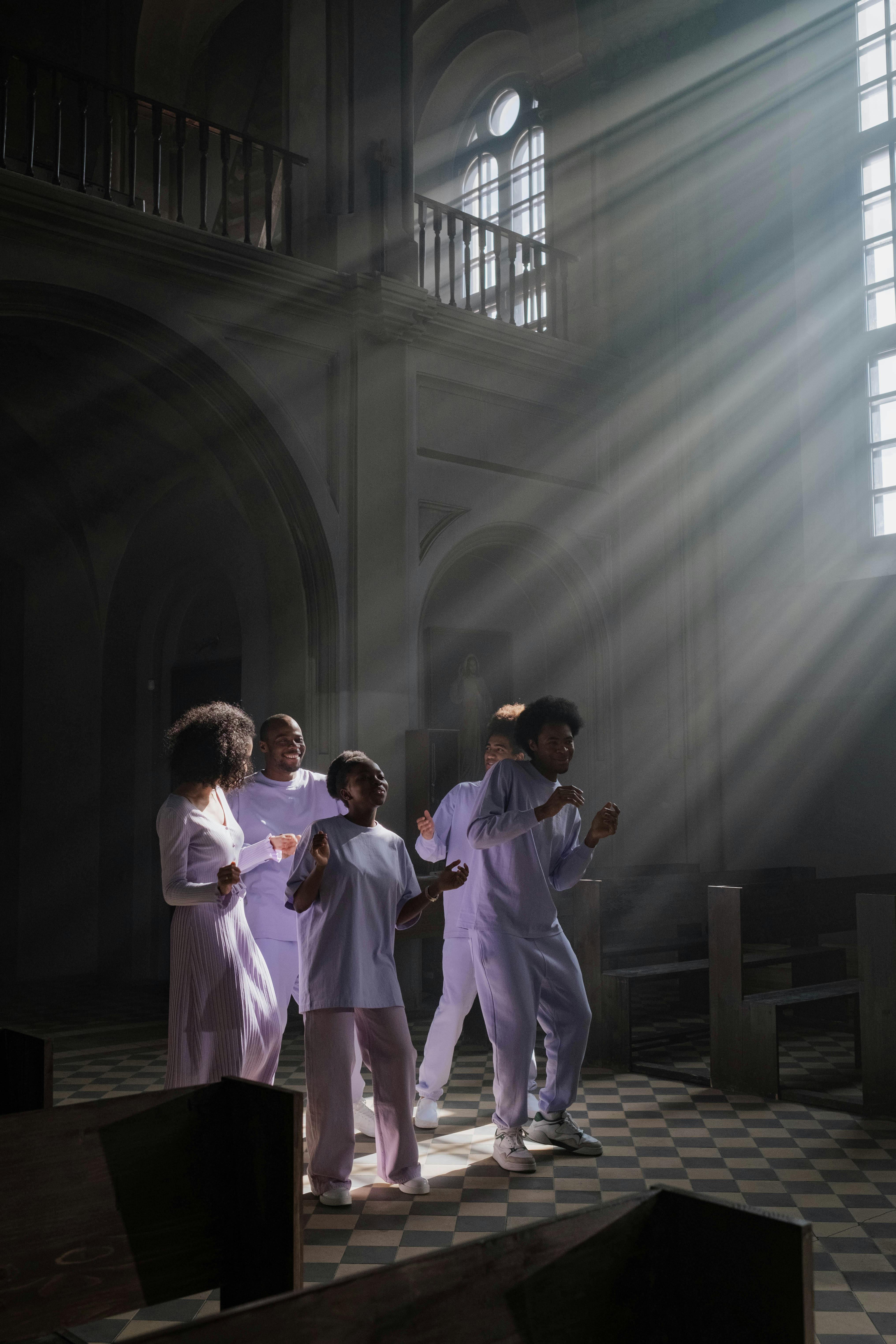
Image credits: Urban street scene — photo by Lesli Whitecotton, Pexels free licence (thematic image only, not a photograph of Barry White). Choir singing in a church — photo by cottonbro studio, Pexels free licence (thematic image only, not a photograph of Barry White). Illuminated control panel — photo by Daniel Ponomarev, Pexels free licence (thematic image only, not a radio from Barry White’s cell). Close-up of microphones in a studio — photo by Clement Lepetit, Pexels free licence (thematic image only). Microphone on a dark stage — photo by Michael DO, Pexels free licence (thematic image only). All images are thematic illustrations; none is a photograph of Barry White.